A current operator catalogue can show whether Yggdrasil titles are listed, but it cannot guarantee wider or lasting access.
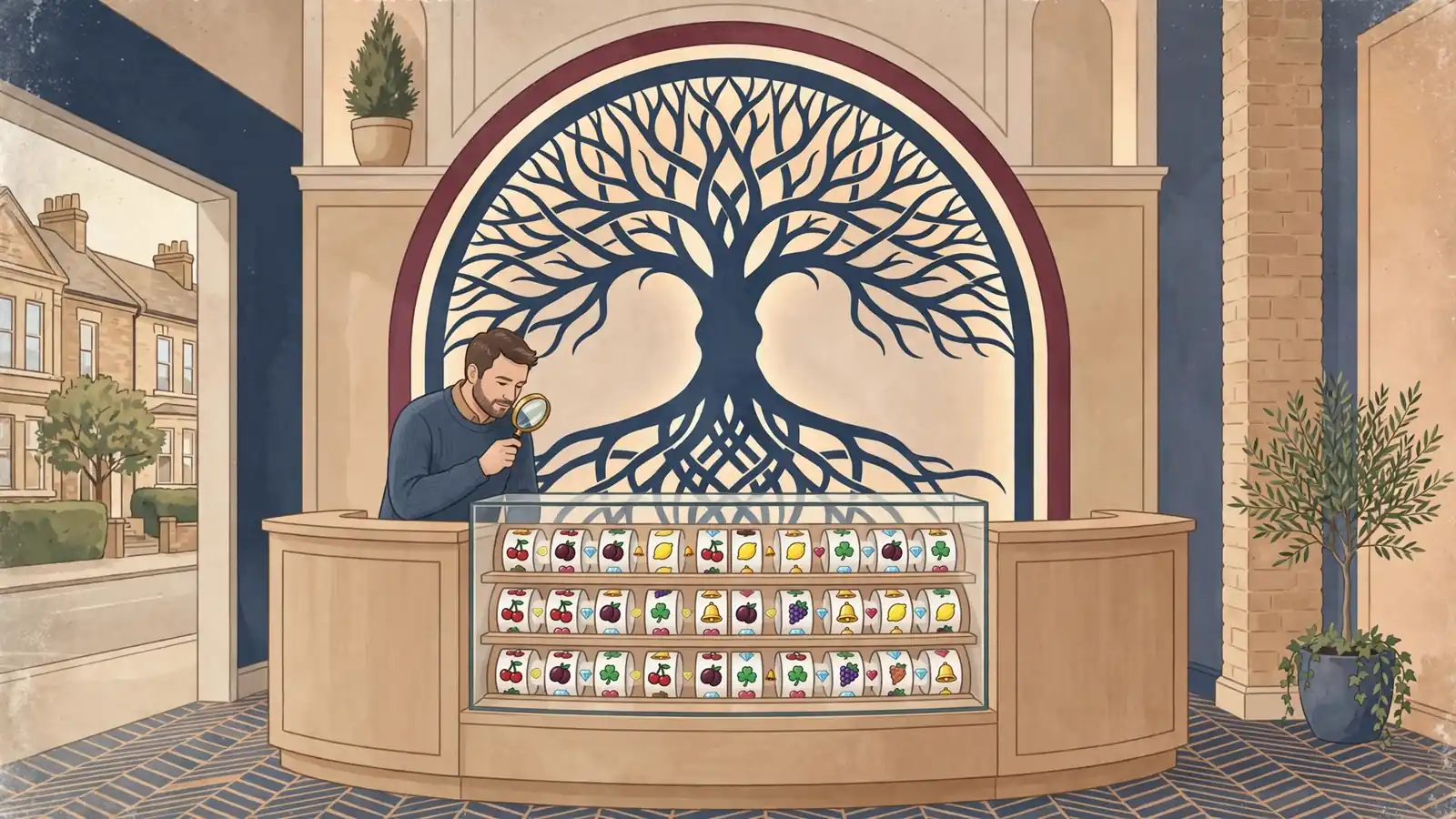
A casino’s general description of its games does not establish that Yggdrasil titles are available to its UK customers. Availability is a narrower claim: it concerns the games that the operator currently makes accessible through its own service. A provider name on a broad promotional page, an old review or an external game directory is not equivalent to a title appearing in the casino’s current catalogue.
The useful evidence is the operator’s own games lobby or another current catalogue maintained by the operator. A search for “Yggdrasil” can indicate whether the lobby associates any listed games with that provider. If a result appears, the game’s listing should be checked in context: the provider label, title and access status should all be visible, rather than inferred from a search snippet or a logo elsewhere on the site.
That check establishes only what the catalogue displays at the time it is viewed. It does not prove that every title attributed to the provider is offered, that access will remain unchanged, or that the same selection is available to every customer. A catalogue entry can be restricted, removed or presented differently as an operator changes its offering. The relevant claim should therefore stay close to the evidence: a particular casino’s current lobby lists a particular title, if that is what the lobby shows.
When looking for UK casinos with Yggdrasil slots, check the details that matter to your play and verify that the games you want are available. The listed payout speed is one practical detail to consider.
Britsino
The listed payout speed is 1–3 business days. No information is provided here about its Yggdrasil slots.
Zombillion
The listed payout speed is 1–3 business days. No information is provided here about its Yggdrasil slots.
SlotoSport
The listed payout speed is 1–3 business days. No information is provided here about its Yggdrasil slots.
Chanze
The listed payout speed is 1–3 business days. No information is provided here about its Yggdrasil slots.
Dieselwin
The listed payout speed is 1–3 business days. No information is provided here about its Yggdrasil slots.
NightLuck
The listed payout speed is 1–3 business days. No information is provided here about its Yggdrasil slots.
WinBeast
The listed payout speed is 1–3 business days. No information is provided here about its Yggdrasil slots.
x3bet
The listed payout speed is 1–3 business days. No information is provided here about its Yggdrasil slots.
Amunbet
The listed payout speed is 1–3 business days. No information is provided here about its Yggdrasil slots.
EvoSpin
The listed payout speed is 1–3 business days. No information is provided here about its Yggdrasil slots.
A search that returns no result also needs careful interpretation. It may mean that the operator does not list the provider’s games, but it can also reflect how the lobby is organised or indexed. Searching by provider, browsing the catalogue categories and checking individual game details are different ways of testing the same limited question. None should be treated as proof of a larger network-wide catalogue.
The distinction matters for phrases such as “Yggdrasil casino games in the UK” or “Yggdrasil online slots”. Those descriptions can sound as though they refer to a fixed selection available across UK casinos. In practice, a casino listing is operator-specific. A result at one licensed site cannot establish availability at another, and a provider name in a casino’s general software information does not by itself confirm that a particular game is playable there.
The operator’s regulatory status is a separate check. Remote gambling offered to consumers in Great Britain must be provided by an operator holding the relevant UKGC licence. A provider label in a lobby is not a licence record, and a licence record is not a game catalogue: each answers a different question. The licence concerns whether the operator is authorised to serve the market; the lobby concerns which games it currently lists.
 Pariplay Casinos UK: What the Evidence ShowsThe text distinguishes Pariplay from Amatic and explains how casino integration, wagering terms and game versions affect games and offers.
 Amatic Slots at UK Casinos: Games and AccessFind UK operators named in specialist reviews, learn why their Amatic catalogues need checking, and explore slot formats, mobile play and bonus…
For a defensible catalogue statement, the two records should not be collapsed into one. The operator’s UKGC status can be checked against the Gambling Commission’s register, while the game claim must be supported by the operator’s own current listing. A casino can be properly licensed without that fact establishing that it carries Yggdrasil games. Equally, a title shown on a page that is not part of a UKGC-licensed operator’s service does not establish that it is available through a legal UK casino.
The wording of any finding should reflect its scope. “The current lobby lists a Yggdrasil title” is more precise than “Yggdrasil is available in the UK”. The former describes a specific operator’s displayed catalogue; the latter implies broad market availability. A single catalogue check cannot support that broader conclusion.
A dated record of the page or lobby can help distinguish a current observation from an old listing. This is particularly relevant when a title is mentioned in third-party material: that material may describe a past catalogue, a different market or a different version of an operator’s service. The operator’s own current listing is the more direct evidence of what its UK-facing catalogue displays.
A careful check can therefore establish a limited but useful point: whether an identified UK casino currently presents a Yggdrasil title in its own games catalogue. It cannot, on its own, establish a complete provider catalogue, a permanent offering, or availability across UK casinos. That boundary keeps a catalogue check factual rather than turning one listing into a market-wide promise.
Calling a slot “3D” is a claim about its presentation, not a finding established by the provider name. A Yggdrasil title would need to be assessed individually before that label could be treated as more than promotional wording. The distinction matters because polished artwork, animated symbols and a changing background can all appear in a game without demonstrating that its visual environment is three-dimensional.
A useful assessment separates observable features from interpretation. Relevant evidence would include the game itself in operation, rather than a still image or a short promotional extract. The assessment would consider whether the scene presents depth through perspective, whether objects appear to occupy different spatial planes, and whether movement changes the apparent relationship between foreground and background. Those features can support a 3D description, but no single visual flourish settles the question. Animation is not synonymous with three-dimensional rendering.
The term can also refer to different things in different descriptions. It may suggest depth in the play area, three-dimensional character models, or simply a cinematic style. A precise description should identify the feature being claimed. If the only visible evidence is an animated symbol or a decorative scene, calling the whole slot a 3D game would stretch the label beyond what that evidence shows.
A reliable review would record the title’s exact name and examine the game in a playable form. It would distinguish the base game from promotional artwork, bonus sequences and any separate feature presentation. A trailer may show effects that do not represent ordinary play; a static image can suggest depth without showing how the scene behaves. The claim should therefore match what is observable during the actual game, not what its graphics might imply in a marketing image.
 Megaways slots in UK casinos: what can be verifiedThis guide explains why a Megaways label does not confirm a game's rules, casino availability, demo access or RTP, and why bonus…
 UK Online Casinos with NetEnt Slots: What to CheckLearn why a NetEnt supplier label does not prove a game is available for real-money play, and how to verify claims in…
The same discipline applies to wording on casino pages. A listing that groups titles under a “3D slots” heading is evidence of how that operator categorises them, not independent proof of the visual technology or design. A provider’s description is relevant, but the term still needs a clear meaning if it is to inform a comparison. Without a stated basis, two sites can use the same label for different visual qualities.
This is particularly important when a page names Yggdrasil alongside a broad category of 3D casino games. The provider name does not establish that every title in its catalogue, or any specific title, meets a particular definition of 3D. Nor does a casino’s use of the label establish that the game is available in every version or presentation offered by that operator. Each assertion needs to be tied to the specific title and the material being described.
For a UK-facing page, the distinction between game description and regulatory status should remain clear. The UK Gambling Commission regulates remote gambling supplied to consumers in Great Britain, including where the operator’s equipment is located elsewhere. A UKGC licence concerns the operator’s permission to provide gambling services; it does not certify a slot’s graphics as three-dimensional. Those are separate checks, and one cannot stand in for the other.
A concise, defensible description would therefore name the observed visual feature rather than relying on the category alone. “Animated symbols” or “a perspective-based scene” is narrower than “3D slot” when those are the only features established. Where the game can be examined and the depth effect is clear throughout play, a broader description may be supportable, provided it does not imply a technical specification that has not been confirmed.
For searches about Yggdrasil casino sites or a list of its 3D slots, the label should not be treated as a substitute for title-level evidence. Casino branding, provider branding and visual presentation answer different questions. Keeping those distinctions intact produces a more useful description than applying “3D” to a whole provider catalogue on the strength of a category heading.
Playing a Yggdrasil slot on a phone depends first on the title being available through the casino being used. The mobile question comes after that: a game listed in a casino’s general catalogue is not, by itself, confirmation that it can be opened on a particular device. Availability should be assessed at the point of play, rather than inferred from the provider name or a casino’s wider software catalogue.
The same distinction applies to an app. A casino may have a mobile service, but that does not establish that every title in its desktop lobby is included there. Nor does a game’s appearance in a mobile lobby prove that a separate Yggdrasil app exists. A sensible check is therefore limited to the actual route offered by the operator: whether the specific slot is shown and can be opened in the casino’s mobile service. This avoids treating “mobile casino” as a promise about every game.
 Thunderkick Slots at UK Online CasinosLearn how to check casino catalogues, game rules and paytables, and assess Thunderkick availability, bonus terms and UK slot safeguards.
 Jackpot King Slots in UK Casinos: What to VerifyLearn how to check whether a Jackpot King game is linked to Amatic, and what UK software licence status does—and does not—confirm…
UK online slots cannot offer autoplay. Each spin must also be separated from the next by at least 2.5 seconds. Those requirements apply to mobile play as well as play on other devices; moving a slot to a smaller screen does not change the rules governing its spin controls.
In practical terms, spins must be initiated individually rather than set to run automatically. The minimum interval also places a floor on the pace of consecutive spins. A game may have its own presentation, animations or pauses, but none of that removes the requirement for the prescribed interval between spins. The relevant measure is not how quickly a screen appears to respond: it is whether the next spin can begin before the required time has elapsed.
That matters when judging a mobile slot by convenience. A control that reduces the number of taps cannot lawfully turn spins into an uninterrupted sequence. Claims about rapid play should be read against the actual UK rules, not treated as a feature that overrides them. The interval is a design constraint, not an optional setting.
A practical mobile check is straightforward:
These checks concern access and operation, not a guarantee of a particular interface or performance. Screen size, layout and control placement can affect how comfortable a game is to use, but those are matters to assess in the actual service rather than assume from a provider label. No claim about a title’s mobile format follows simply from the words “Yggdrasil slots”.
“Popular” and “best-paying” are also not measures of mobile suitability. A game’s prominence says nothing about whether it is available in a given casino’s mobile lobby, while a payout description does not establish how it works on a phone. The useful mobile assessment is narrower: confirm the title in the operator’s service, then judge its controls and play sequence against the UK requirements. Free-play access is a separate question from mobile operation, so it should not be inferred from a game appearing on a phone.
“Casino software” can refer to the games supplied to an operator, the platform through which its casino is delivered, or the operator’s own service. These are separate roles. A game-provider name appearing in a description does not, by itself, establish who runs the casino, which titles its lobby currently carries, or whether those titles can be opened without staking money.
A game-provider supplies the titles, but the operator runs the casino service. A supplier's role is not the same as operating a consumer-facing casino, and a provider label does not establish who runs the casino or which titles are available.
For British customers, the operator remains central to real-money remote gambling. A business offering it to consumers in Great Britain must hold the relevant UKGC licence. The Gambling Commission regulates the activity, while a software supplier’s role is not the same as operating a consumer-facing casino. A claim about Yggdrasil software therefore needs to identify what the name refers to: a supplier relationship, a casino’s game catalogue, or a consumer product. Those descriptions are not interchangeable.
Free play is a separate question from software supply. A title may be discussed as part of a provider’s catalogue without that establishing a free-play version at any particular UK casino. Nor does the presence of a casino’s name alongside a provider establish that a game can be launched without a deposit or a real-money stake. Availability depends on what the operator actually makes accessible, and it should not be inferred from the software label alone.
The distinction matters because “free slots” can describe different arrangements. A game might be available to play without a cash stake, or an offer might provide spins subject to conditions. Those are not equivalent to a supplier’s software being available as a free-standing product. A statement about free play needs to specify the operator, the game or offer, and the applicable terms; without those details, the label says little about the final cost or access.
 Eyecon slots at UK casinos: what can be verifiedSeparate verified facts from assumptions on Eyecon casino availability, UK licensing, slot limits, mobile access and bonus wagering.
 NoLimit City Slots at UK Online Casinos: What to CheckLearn how NoLimit City games differ from the casinos offering them, and why UK Gambling Commission regulation applies to the gambling business.
For real-money play, the relevant account and customer service sit with the licensed operator, not with a software name on a game screen. The operator is responsible for deposits, payouts, and the terms attached to its service. A supplier description cannot substitute for confirmation that the casino itself is authorised to serve the British market.
The same care applies to searches for Yggdrasil gaming software, casino software, or free Yggdrasil slots in the UK. Such wording can describe an intended category, but it is not proof of a particular distribution arrangement, software platform, or playable free version. No technical format or demo mode should be assumed from the provider’s name.
A useful distinction is therefore simple: software identifies a possible supply relationship; free-play access describes a specific way a game can be used; and real-money gambling takes place through an operator subject to UK rules. Each claim requires its own confirmation. Until an operator’s current offering and the relevant access conditions are clear, a Yggdrasil label alone cannot establish either free-play availability or a consumer-facing casino service.
A ranking of casinos carrying Yggdrasil slots needs comparable evidence about the operators being assessed. A name on a promotional page is not enough: a meaningful comparison would establish that each casino is authorised to serve the relevant market and that its current offering supports the claim being made. Without those checks, a numbered shortlist gives an impression of measurement without showing what was measured.
In Great Britain, the Gambling Commission regulates commercial gambling, including remote gambling offered to consumers. Its remit applies regardless of where an operator’s key equipment is located. The Commission issues operating licences to businesses; personal licences apply to individuals working in relevant roles. A casino’s regulatory status is therefore an operator-level question, not something established by the game supplier’s name or by a slot appearing in a review.
A comparison should keep these checks separate. First comes the operator: its UKGC licence should be confirmed against the Commission’s public register, and the licence details should correspond to the business providing the casino service. Then comes the product claim: the operator’s current lobby must support any statement that Yggdrasil games are available there. A past listing, a general provider page or an editorial mention does not establish present availability.
Only after those points are settled can other comparison criteria be applied consistently. A review might assess the clarity of game information, the usability of account controls, or the presentation of terms. Each criterion needs the same method across the operators being compared. A rating without a stated basis cannot show whether it reflects regulatory standing, catalogue breadth, customer service or simply editorial preference.
 Play’n GO Slots at UK Online Casinos: What to KnowLearn how searches for Play’n GO slots differ from searches for casinos, and what to check when exploring demos, RTP, bonuses and…
 Online Casino Game Shows in the UK: What the Label MeansLearn what “live game shows” means in online casinos, and why the category label alone cannot establish a title’s format, operation or…
The same discipline applies to claims about “top-rated” casinos. A rating has meaning only when its scale, evidence and date are clear. An operator’s own promotional language is not an independent comparison, and a score gathered under one method cannot fairly be placed beside a score produced under another. Even a carefully defined editorial assessment is not a regulator’s endorsement.
RTP comparisons require particular care. A figure is relevant only when it is tied to a named game and the version available at the casino being assessed. A general provider-level RTP claim cannot establish the return setting of a particular title at a particular operator. No Yggdrasil-specific RTP figure or casino-level setting should be inferred from a broad label.
Mobile access also does not by itself make a casino superior. A comparative claim would need evidence about the actual service and the same evaluation criteria across the sites. The word “mobile” in a description is not a substitute for testing or documentation.
For a ranking to be defensible, the evidence would need to identify the operators assessed, confirm their UKGC status, establish current Yggdrasil availability, and explain the scoring method. Without that foundation, the more accurate description is a set of unverified recommendations, not a comparison of the best Yggdrasil casinos in the UK.
“Real-money play” describes a slot session in which a player stakes funds held in a casino account and any resulting winnings are credited under that operator’s terms. Free play is different: it does not involve staking the player’s cash. The distinction affects the financial exposure, but it does not establish that a particular Yggdrasil title is available for either type of play in the UK.
Maximum stake of £5 per game cycle, effective from 9 April 2025.
Maximum stake of £2 per game cycle, effective from 21 May 2025.
No cash stake is at risk, but availability does not guarantee real-money access.
For real-money remote gambling in Great Britain, the operator must hold a UKGC licence. A software supplier’s role is separate: it does not become the casino operator simply because its games appear in a casino’s lobby. Accordingly, a search for a Yggdrasil real-money casino in the UK cannot be answered by the provider name alone. The relevant questions are whether the licensed operator offers the title and what stake controls apply to that game.
The online-slot stake cap applies across the market, not as a setting specific to Yggdrasil. For players aged 25 and over, the maximum stake is £5 per game cycle. That limit took effect on 9 April 2025. For players aged 18 to 24, the maximum is £2 per game cycle, effective from 21 May 2025.
The age bands are material. A slot’s permitted stake is not determined only by its software provider or by the casino’s own presentation of the game. In real-money play, the applicable ceiling depends on the player’s age and the UK rules for online slots. A casino cannot use a game-specific configuration to turn a higher stake into a permitted one.
These caps describe the maximum, not a required stake. The amount actually wagered may be lower. Nor do the limits indicate what a particular Yggdrasil slot costs to play: no title-specific stake setting follows from the market-wide figures.
A free-play session and a cash-funded session should not be treated as interchangeable. A displayed game being available without a cash stake would not prove that the same title can be played for real money at a UK casino. Conversely, real-money availability would not establish that a free version is offered. The two forms of access require separate confirmation.
Where a Yggdrasil slot is offered for real-money play by a UK-licensed operator, the relevant age-based stake cap still applies. The provider’s identity does not create an exception. A title name, a promotional description or a free-play option also does not establish the operator’s licence status or the game’s current real-money availability.
The financial comparison is therefore straightforward: free play does not put the player’s cash stake at risk, while real-money play does, subject to the applicable cap. The cap limits the stake per game cycle; it does not guarantee a return or set a player’s total spending. These are separate questions, and only the first is answered by the statutory stake limits.
A casino’s name on a third-party list is not proof that it currently offers Yggdrasil slots to UK players. Game catalogues change, and a listing may be out of date, refer to another market or describe a provider relationship without confirming that any titles are available in the casino’s UK lobby.
The relevant check has two parts: whether the operator is authorised for the market, and whether Yggdrasil games appear in its current offering. Neither establishes the other. A UKGC licence confirms the operator’s regulatory status; it does not confirm a particular game supplier or title.
Remote gambling operators serving consumers in Great Britain must hold the relevant UKGC licence, regardless of where the operator is based. The Gambling Commission’s Public Register is the place to check the operator’s licence details. The name on the casino site should match the licensed business responsible for the service; a familiar brand name alone is not enough to establish that.
Verifying a Casino
Check UKGC Status
Verify the operator's licence details on the Gambling Commission’s Public Register and ensure the name matches the business providing the service.
Confirm Game Offering
Search the casino's current games lobby or use a provider filter to see if Yggdrasil titles are actually listed.
Validate Access
Ensure the game is available within the operator's UK-facing service rather than relying on third-party lists or cached pages.
This distinction matters when assessing claims about online casinos with Yggdrasil games in the UK. A provider’s presence in a general corporate statement, or a licence entry for a software supplier, does not show that a casino currently carries its games. The operator is the business offering gambling to customers, and its authorisation must be checked separately.
The casino’s own current games lobby is the practical place to look for Yggdrasil titles. A provider filter, if available, can narrow the results; otherwise, the lobby’s search function or provider information may help identify the relevant games. The result should be checked on the casino’s own service, rather than inferred from an old article, cached page or promotional graphic.
A search result that names Yggdrasil is useful only if it leads to a current listing within the operator’s UK offering. If the game is absent, unavailable or shown only in material that does not establish access for UK customers, the casino should not be described as carrying it on that basis. A Yggdrasil casino list is only as reliable as the date and market covered by each entry.
Crypto payment options do not resolve either part of the check. They do not establish a UKGC licence or prove that Yggdrasil titles are available to UK customers. Offshore casinos operate outside the UKGC system and do not provide the same UK regulatory framework; their game claims should not be treated as evidence of a UK-licensed offering.
A defensible statement that a UK casino carries Yggdrasil therefore needs current confirmation in the operator’s own lobby, alongside a matching UKGC licence check. Without both, the accurate description is that availability has not been established—not that the casino belongs on a list of UK Yggdrasil casinos.
A no-deposit promotion and a first-deposit bonus have different starting costs. The first may require no payment to receive the advertised benefit; the second depends on making a deposit under the operator’s terms. Neither description establishes that a promotion is linked to Yggdrasil games. A casino’s marketing label is not evidence that a particular provider’s titles qualify.
The financial value is the amount that can actually be withdrawn, not the headline bonus figure. Before treating an offer as valuable, its terms need to show how bonus funds convert into withdrawable money, which games count towards any wagering requirement, and whether other conditions can reduce or prevent a payout. If those details are unclear, the value cannot be calculated reliably.
For UK players, wagering requirements on bonus funds are capped at 10 times the bonus amount. The UK Gambling Commission’s cap took effect on 19 December 2025. That limit puts a ceiling on the wagering multiple; it does not make a bonus equivalent to cash or remove other conditions. A promotion can still have a low practical value if its eligible games, withdrawal rules or other restrictions make the advertised benefit difficult to realise.
A sensible comparison therefore uses the offer’s stated cash value and conditions, not the words “free” or “no deposit”. For a first-deposit promotion, the deposit is part of the cost calculation: any funds committed remain subject to the operator’s terms, and a bonus does not guarantee a return. A claimed low minimum deposit is likewise only one term, not a measure of the offer’s overall value.
The same distinction matters when an offer is presented as a Yggdrasil bonus. The provider name in promotional copy does not establish that Yggdrasil games are included, or that a bonus is available for those games. The relevant terms would need to identify qualifying play clearly. Without that, assigning a cash value to a Yggdrasil-specific promotion would be guesswork.
“Non-GamStop” wording is also incompatible with a UK-licensed offer: GamStop has been mandatory for online operators licensed in Great Britain since 31 March 2020. Promotion language cannot alter that regulatory condition.
A bonus described as being for Yggdrasil slots is not, by its label alone, evidence of a Yggdrasil-specific offer or code. The relevant terms are those published by the operator for the promotion in question. They determine who qualifies, which games count and what happens to bonus funds and any resulting winnings.
For UK players, the Gambling Commission’s cap on wagering requirements for bonus funds is ten times the bonus amount. The cap took effect on 19 December 2025. It applies to the wagering requirement attached to bonus funds; it does not establish that a particular Yggdrasil promotion exists, nor does it make every other offer condition identical.
Eligibility needs to be read separately from the wagering calculation. Promotion terms may define which customers can take part, what action is required to qualify and whether particular games contribute to wagering. A general casino welcome offer should not be treated as applying to a specific provider’s slots unless the operator’s terms say so. The same applies to a deposit offer: its headline value does not establish the qualifying deposit, eligible games or treatment of winnings.
A useful comparison is made from the written conditions, not the promotional heading. The amount of bonus funds, the stated wagering requirement and any qualifying contribution rules determine the playthrough obligation. Restrictions on eligible customers or games can also affect whether the advertised value is attainable. If the offer does not clearly identify how its conditions apply, its value cannot be calculated reliably.
Eligibility sits within the UK licensing framework. Remote gambling offered to consumers in Great Britain must be provided by an operator holding the relevant UKGC licence. A provider’s name in a promotion does not replace the operator’s responsibility for the offer’s terms.
No Yggdrasil-specific bonus code or eligibility condition can be inferred from the phrase “Yggdrasil bonus”. The dependable basis for assessing one is the operator’s current promotion wording, including its stated wagering requirement and scope.
The phrase “Yggdrasil slots” identifies a provider name, not a casino licence or a confirmed selection of games. Those are separate claims: a title must be identifiable, its availability must be tied to a particular operator, and that operator must be authorised to serve the relevant UK market. Without those links, calling a site a Yggdrasil casino or naming its games as available in Britain would go beyond what can be stated responsibly.
For consumers in Great Britain, remote gambling operators must hold the relevant UKGC licence, regardless of where the operator is based. A provider name on a page, advert or search result does not replace that requirement. Nor does it show, by itself, that a specific game can be opened through a licensed casino.
“Best” also requires more than a recognisable label. A defensible comparison would need confirmed game availability and a consistent basis for assessing the operators. Without those elements, a ranked list would imply distinctions that have not been demonstrated. No title can be singled out as the best Yggdrasil slot on this basis, and no UK casino can be described as the best place to play one.
The practical distinction is simple: game availability belongs to an operator’s current offering, while legal permission to accept British customers belongs to the operator’s UKGC licence. A provider name alone establishes neither. Any description of Yggdrasil games in a UK casino therefore needs to be specific about the title and the licensed operator, rather than treating the words “Yggdrasil casino” as proof of either.