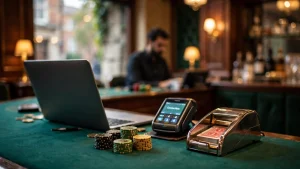
Visa can fund an account, but game access and bonus eligibility depend on separate casino rules.

A Visa deposit is a way to fund a casino account, not a slot feature and not a promotion. UK casinos commonly accept debit cards, including Visa and Mastercard, but that says nothing about which games an account can open or whether a bonus will attach to a payment. Those are separate conditions. Treating them as one offer can make a deposit look more valuable than it is.
The practical sequence is simple: a payment is submitted through the cashier, the casino account is credited if the transaction is accepted, and any eligible funds can then be used according to the casino’s rules. Slot access and play remain subject to the operator’s game catalogue and account terms. A Visa logo on a payment page therefore confirms neither a particular slot selection nor a special way to play.
The same separation applies to promotions. A casino may advertise a welcome offer or another bonus, but the payment method alone does not establish eligibility. The promotion’s own terms determine whether a Visa-funded deposit qualifies, which customers can claim it, and what steps are required. A deposit can succeed while a bonus does not apply. That is not a payment failure; it is a difference between the cashier’s conditions and the promotion’s conditions.
When choosing a UK casino that accepts Visa, check the available payment methods and terms before signing up. The listed payout speed is one useful detail, but it does not by itself confirm Visa acceptance.
Britsino
The listed payout speed is 1–3 business days.
Zombillion
The listed payout speed is 1–3 business days.
SlotoSport
The listed payout speed is 1–3 business days.
Chanze
The listed payout speed is 1–3 business days.
Dieselwin
The listed payout speed is 1–3 business days.
NightLuck
The listed payout speed is 1–3 business days.
WinBeast
The listed payout speed is 1–3 business days.
x3bet
The listed payout speed is 1–3 business days.
Amunbet
The listed payout speed is 1–3 business days.
EvoSpin
The listed payout speed is 1–3 business days.
Before a promotional deposit, the relevant documents are the cashier’s payment information and the offer’s full terms. The first concerns the transaction. The second concerns the bonus. A headline may describe an offer broadly, but the detailed conditions control how it is claimed and used. If those conditions identify eligible payment methods, the listed methods matter; a Visa deposit should not be assumed to qualify simply because Visa appears in the cashier.
This distinction also matters when an account has a choice between a promotional and a non-promotional deposit. The payment method does not, by itself, determine which option is better. The meaningful comparison is between the amount paid, the bonus conditions attached to it, and the rules governing any resulting balance. A larger headline offer can carry conditions that make its practical value lower. Without the full terms, a cash figure alone is incomplete.
Promotions can also exclude particular payment routes. A specialist review has reported that PayPal may be excluded from bonus eligibility, but that is not a universal rule for every casino or offer. The operator’s current terms are decisive. The broader point applies to Visa as well: eligibility needs to be stated for the specific promotion, not inferred from general acceptance of the card.
 Casinos That Accept WebMoney in the UKWebMoney and Boku are different payment methods. Learn what a Boku cashier listing confirms, and why it does not establish WebMoney availability.
 Casinos that accept UKash in the UK: what to checkLearn why a casino’s general payment page may not reflect your account’s options, and how to check the cashier and account details…
A Visa deposit does not reserve a slot, change its rules or confer an advantage within a game. Once funds are in the account, game play is governed by the casino’s terms and the rules shown for the selected game. A payment method cannot be used as evidence that a particular slot is present or available. Nor does a list of casinos accepting Visa establish which titles they carry.
Where a bonus is involved, the distinction between deposited funds and promotional funds may matter under the operator’s terms. The terms should explain how the promotion is credited and what restrictions apply to its use. If the offer does not clearly explain how a Visa-funded deposit qualifies or how the bonus balance works, the value cannot be calculated from the headline alone. Unclear terms are not an extra benefit; they are an unresolved cost of the offer.
For real-money gambling in Great Britain, the operator must hold a UK Gambling Commission licence. Remote gambling licensees also have to prompt new customers to set a financial limit before their first deposit and provide accessible account-level controls. These account safeguards do not alter Visa’s payment function or the promotion’s eligibility rules. They sit alongside them.
The clean reading of a Visa slot offer is therefore a three-part check: whether the payment is accepted, whether the promotion permits that payment method, and what the game and bonus terms allow after funds are credited. Each answer comes from a different set of conditions. Acceptance is not bonus eligibility, and bonus eligibility is not a promise about available games. A deposit is only the first line of the calculation.
A casino’s general payment information is a starting point, not confirmation that a Visa deposit will be available for a particular UK account. A specialist review may list Visa and Mastercard among a casino’s payment methods, but that listing does not establish current UK availability or confirm that a specific card product is eligible. The practical check is the cashier for the account in question.
The distinction matters because payment information can describe a method at operator level without resolving whether it is enabled for every customer or card product. A Visa logo on a general page therefore answers only part of the question. The cashier is the place to confirm whether Visa appears as an available deposit method under the current account conditions.
The clearest check is to sign in to the casino account and open its deposit cashier before relying on Visa as a payment route. Look for Visa in the methods offered for that account and read any accompanying conditions. If the cashier presents Visa as an available deposit option, that is more relevant than an older review or a general payment-method page.
If Visa is absent, a logo elsewhere does not override that result. The method may not be available for the account, or the listed information may not reflect current UK availability. A review can help identify what to check, but it cannot confirm the live cashier configuration. Treat it as an indication to verify rather than as proof that a deposit will be accepted.
 Casinos That Accept Solana in the UK: What to CheckLearn why a casino account, Solana payment option and welcome offer are separate conditions, and how bonus terms can exclude payment methods.
 Casinos That Accept AstroPay in the UK: Fees & TermsLearn why an accepted AstroPay deposit may not qualify for a bonus, and how promotion terms, cashier availability, limits and withdrawal rules…
The same principle applies when a casino advertises several card brands together. Visa and Mastercard are separate payment options; seeing one named does not establish that the other is available. The cashier should identify the option itself, rather than requiring an assumption based on a shared card-payment category.
A Visa mark alone does not establish that every product carrying the Visa name will work. Card-product eligibility is part of the check, and it must be confirmed against the casino’s current cashier information. Where the cashier’s wording is unclear, the operator’s support team can clarify whether the particular product is accepted for a UK deposit.
This is a compatibility check, not a reason to infer approval from previous use elsewhere. A card accepted by one casino is not evidence that another casino will accept it. Nor does a successful transaction at an earlier time settle whether the method remains available now. The current account and current cashier are the relevant reference points.
The check should stay specific: whether Visa is offered for deposits on this account, and whether the card product is eligible. Broad statements such as “Visa accepted” can conceal those two separate conditions. A clear answer to both is more useful than a payment logo or a general list of methods.
When Visa is listed but the cashier does not make the account’s eligibility clear, the uncertainty should be resolved before treating the method as usable. An operator’s response should address the exact point at issue: current availability for a UK account and eligibility of the card product. A generic confirmation that the casino accepts Visa may not answer either question precisely.
If the cashier does not show Visa, or the operator cannot confirm eligibility, the deposit should not be planned on the assumption that the method will work. This avoids confusing a published payment option with an available transaction route. It also keeps the decision tied to information that applies to the account, rather than to a general description that may not cover it.
For someone comparing casinos that accept Visa deposits in the UK, the comparison therefore needs a live check, not merely a list of names or card brands. A payment-method listing narrows down where to look; the cashier establishes whether the option is presented for the account, and the operator can clarify product eligibility where needed. Those checks are specific, and neither should be replaced by the presence of a logo.
The same standard applies to a casino’s app if it is used to access the account: the relevant question remains whether the account’s cashier presents Visa as a deposit option and whether the card product is eligible. The label “Visa casino” is not a transaction confirmation. Availability is established at the point where the deposit method and account conditions can be checked together.
Yes. Visa is a commonly accepted debit-card option at UK casinos, alongside Mastercard. That makes Visa a familiar way to fund an online casino account, but it does not mean every casino accepts every Visa card or makes the method available to every account.
Acceptance is determined by the casino’s payment arrangements, not by the Visa logo alone. A casino may support Visa as a general payment option while the cashier for a particular account shows a different set of methods. The cashier is therefore the practical confirmation of whether Visa can be selected for that account at that time. A general statement that a casino accepts Visa is not the same as confirmation that a specific transaction will be offered.
 Casinos That Accept POLi in the UK: Payment ChecksLearn how to verify POLi at the cashier and separate payment access from slot availability. A specialist review puts starting minimums at…
 Casinos That Accept Wirecard in the UKLearn why general Visa or Mastercard listings do not confirm Wirecard acceptance, and how a usable deposit can still be excluded from…
The distinction matters because “accepts Visa” is often used as shorthand. It can describe the casino’s general support for Visa debit deposits; it does not establish that Visa is available in every account or circumstance. Nor does the presence of Visa branding on a page, by itself, confirm that the payment option is currently selectable. The account cashier provides the relevant view of the available choices.
This gives a straightforward answer to whether Visa can be used at online casinos in the UK: it is a commonly accepted debit-card method, but availability is not universal. A casino’s payment page may describe its general arrangements, while the cashier reflects the options presented for an individual account. The latter is the more useful point of reference when deciding whether Visa is accepted in practice.
“Best” does not have a single payment-based meaning. Visa acceptance can establish that a casino supports a familiar card route, but it does not, on its own, determine the quality of the casino or make one option preferable to another. Payment support is one condition among the account’s terms and the operator’s wider arrangements. A label such as “Visa casino” should not be read as a complete assessment.
It is also useful to keep the payment brand separate from the casino itself. Visa provides the card network; the casino decides which payment methods it makes available through its cashier. As a result, two casinos may both be described as accepting Visa while showing different payment options to their customers. The broad market pattern is common debit-card acceptance, not an identical cashier at every casino.
For a UK account, the general answer is therefore positive but qualified: Visa is widely used as a debit-card option at casinos, while the cashier confirms whether it is actually available for the account. That distinction keeps a broad claim of acceptance from being mistaken for a guarantee about a particular account or payment.
Visa is a card network, not a single card product. A Visa debit card takes money from a linked bank account; a Visa credit card draws on a borrowing facility. That difference determines whether the card can be used for gambling at a UK-licensed casino. The logo alone does not establish that a card is eligible.
UK casinos commonly accept debit cards, including Visa. Credit-card payments for gambling are prohibited, however, and the restriction has not been relaxed. The regulator introduced the ban on 14 April 2020. It applies to remote gambling, so a credit card cannot be used to fund a casino account through a payment intermediary instead of entering card details directly.
This is a regulatory boundary, not a preference set by an individual casino. A UK-licensed operator cannot decide to accept a credit card because a customer requests it or because a particular card transaction appears to have cleared. A transaction routed through a money service business remains covered when the underlying funds come from a credit card. Changing the route does not change the source of credit.
 Casinos That Accept USDC in the UK: Payment ChecksLearn how to check USDC in a casino cashier, distinguish payment eligibility from bonus and slot rules, and review withdrawals, fees and…
 Casinos That Accept Klarna in the UK: Deposit RulesLearn why Klarna may not appear in a UK casino cashier, how credit-card funding rules affect deposits, and why a deposit does…
The same principle applies to digital wallets. UK remote gambling operators cannot accept wallet payments where the wallet permits credit-card funds to be used for gambling. A wallet balance is not a way around the restriction if it was funded with a credit card for that purpose. The relevant question is the source and permitted use of the funds, not whether the casino sees a card number.
A debit card is different because the payment is drawn from available funds in a bank account rather than borrowed through a credit facility. That distinction makes Visa debit an eligible card type in principle; it does not mean every Visa-branded product or every transaction will qualify. The card’s actual product classification matters. A card connected to a credit facility should not be treated as debit merely because it carries a Visa logo or is stored in a mobile wallet.
For a payment decision, the practical dividing line is therefore clear: debit-card gambling is permitted within the applicable operator rules, while credit-card gambling is not. A casino may present several payment choices, but the presence of Visa branding does not turn a credit product into a permissible deposit source. Nor does using a phone or wallet alter the character of a credit-funded payment.
This distinction matters when searching for online casinos accepting Visa payments in the UK. The phrase can refer to different Visa products, but only the debit-card side is compatible with the credit-card gambling ban. The rule concerns the funding instrument, not whether the payment is made on a desktop or mobile device. On a UK-licensed site, a credit card is not an alternative Visa deposit method; it is a prohibited source of gambling funds.
Visa identifies a way to fund an account; it does not identify the slots in that account. A casino accepting Visa may offer a slot catalogue, but the payment method does not establish which titles are included, whether a particular game is available to a particular account, or whether the same selection appears on mobile. Those details belong to the casino’s games section, not its cashier.
This distinction matters when comparing casinos by payment method. A Visa logo is not evidence of a larger slot selection, better game terms or a bonus attached to a particular title. Nor does a casino’s description of itself as suitable for mobile play show that every game works on every device. Payment acceptance and game access are separate conditions, and neither should be inferred from the other.
The same applies to searches for a “best” Visa casino for slots. There is no meaningful ranking based on Visa alone: the card does not change a game’s rules or determine which games the operator makes available. Game availability is set by the casino. Any game-specific restrictions or promotion conditions need to be read separately from the payment information.
UK slot rules also affect the play itself, regardless of whether the account was funded by Visa. Online slot autoplay is prohibited in Britain, and each spin must last at least 2.5 seconds. These constraints are part of the regulated slot experience, not a Visa condition. A payment method cannot bypass them, and a site’s mobile layout does not alter them.
Stake limits are another separate control. For customers aged 25 and over, the maximum stake is £5 per online slot game cycle. For customers aged 18 to 24, it is £2. The £5 limit for all adults took effect on 9 April 2025, but the lower limit remains relevant to younger adults. These are maximums, not recommended amounts or a statement about what a game will pay.
 Casinos That Accept Citadel in the UKLearn how to check Citadel deposit support, understand return-to-source withdrawals and distinguish payment access from slot availability or bonus eligibility.
 Casinos That Accept Click2Pay in the UKLearn why Click2Pay availability needs checking in the cashier and why bonus eligibility depends on the payment-method terms for each promotion.
A practical comparison therefore has distinct parts: whether the casino offers Visa, whether the desired games appear in its catalogue, and what UK slot rules apply to those games. A cashier can answer the first point; it cannot serve as a catalogue or a guide to the game’s mechanics. Equally, a slot page can describe a game without proving that Visa is available for funding the account.
For a UK player, the useful boundary is simple: Visa concerns the transaction, while the casino’s catalogue and applicable rules govern slot access and play. The card does not guarantee a particular game, bonus, mobile experience or stake setting. Treating those as separate checks avoids mistaking a payment label for a description of the product.
A payment alternative is only useful if it fits the intended transaction. The main distinction is whether a method supports deposits, withdrawals or both, and whether using it changes access to a promotion. These conditions belong to the casino’s payment and bonus terms, not to the name of the payment brand.
Bank transfers and open banking are worth comparing where a method is needed for both directions. A specialist review describes these routes as capable of providing instant deposits and fast withdrawals at many sites. That is not a timing commitment for every casino: availability, processing and the route offered must be confirmed in the relevant cashier. A bank transfer may suit an account that needs a direct link with a bank, while open banking authorises a payment through a participating banking service. The labels are not interchangeable, so the exact option shown matters.
Capable of providing instant deposits and fast withdrawals; availability must be confirmed in the cashier.
A prepaid voucher used for deposits only; a separate payout route is required for withdrawals.
Popular for speed and convenience, though they are often excluded from promotional bonus eligibility.
Paysafecard has a narrower function. It is a prepaid voucher for deposits, so it is not a complete substitute where the same method is expected to receive withdrawals. Its deposit-only status makes the comparison straightforward: the initial payment may be possible, but a separate payout route would still be needed.
E-wallets offer another route where supported. Skrill and Neteller are available at some casinos; specialist reviews report that these methods are often excluded from promotions. PayPal is described by specialist reviews as popular for speed and convenience, but those reviews also note that it may not qualify for bonuses. The relevant promotion terms determine the outcome. A deposit method can work correctly while leaving a bonus unavailable; payment acceptance alone does not establish eligibility.
A practical comparison can therefore be made on three points: whether the method appears in the cashier, whether it supports the required transaction direction, and whether its use is permitted under the chosen promotion. For a deposit-only voucher, the second point rules out using that route for a payout. For an e-wallet, the promotion terms may be decisive. For bank transfer or open banking, the claimed speed should not be treated as a guarantee for an individual account.
The broadest substitute is not necessarily the most suitable one. A route that supports deposits and withdrawals may reduce the need to switch methods, while a voucher can be useful only for funding. An e-wallet may be available but conflict with a bonus condition. The useful comparison is therefore not a league table of brands; it is the match between the payment route, the transaction required and the terms attached to the deposit.
A Visa logo on a casino’s payment page is not enough to establish that every Visa card can fund an account. Specialist review pages may list Visa and Mastercard, but availability for UK customers and eligibility for a particular card product need to be confirmed in the cashier. The relevant test is the payment option shown for the account at the time of the intended deposit.
The cashier can also clarify whether the available Visa route matches the card being used. A general Visa listing does not, by itself, confirm acceptance of every product issued on the network. If the card type is not identified clearly, the payment-method terms or the casino’s support service can resolve that point before a transaction is attempted. This avoids treating a broad network label as a product-level approval.
Currency is a separate check. Specialist review pages state that GBP is supported, but the account currency should still be confirmed before the first transaction. A casino may offer sterling while an account has been set up in another currency; the displayed payment route alone does not confirm which currency the account will use. The account’s cashier or settings should show the denomination before the deposit is submitted.
That distinction affects the amount charged to the card. If the casino account and the card transaction use different currencies, conversion may apply. The resulting card charge can therefore differ from the sterling amount displayed at the casino, depending on the conversion applied. Confirming GBP as the account currency before paying removes that particular uncertainty; it does not establish that the card product itself is eligible.
A practical pre-payment check has three parts:
These checks answer different questions. A method can be listed while the account’s current cashier does not offer it; an available network can still leave the card product unconfirmed; and an eligible card can still be used against an account currency that triggers conversion. Treating those as separate conditions makes a declined or unexpectedly converted payment less likely.
The final screen before confirmation should match the intended method and account currency. If either differs from the earlier selection, the transaction should not be treated as a routine repeat: the cashier terms and displayed details are the operative information for that payment. A casino’s general payment list is useful for narrowing the check, but the account-specific cashier is where the final compatibility decision is visible.
A Visa deposit does not establish that a later payout will be sent back to the card as cash. UK anti-money laundering rules generally require casino funds to be returned to the original payment source. This closed-loop approach helps connect the withdrawal to the transaction that funded the account and limits the use of unrelated destinations.
The cashier’s payout instructions determine how that rule applies to a particular Visa account. A casino may return eligible funds to the card, or require another approved route if the original source cannot receive the payment. A listed Visa deposit option is therefore not, by itself, confirmation of Visa withdrawal support. The destination and any conditions should be checked in the withdrawal area before a payout is requested.
Timing has separate stages. The casino first reviews the withdrawal; only after approval does the payment move through the relevant processing route. A specialist review reports that a card deposit may be instant while a payout can take several business days. That is an observed timing pattern, not a fixed service deadline for every account or transaction.
The first withdrawal can take longer if KYC checks are still outstanding. Verification may involve confirming identity and the ownership of the payment source. A mismatch between the casino account details and the cardholder information can create avoidable questions, while complete verification does not remove the casino’s internal approval step. The time shown for a payment method should therefore not be treated as the time from clicking “withdraw” to funds appearing in the bank account.
For a Visa debit withdrawal, the practical calculation is: pending review time, any time needed to complete verification, then payment delivery. These stages may not be reported separately, so a displayed estimate may not explain where a delay occurs. If a withdrawal remains pending, the relevant distinction is whether the casino is still reviewing it or has approved and sent it onward.
A casino’s Visa payment options also do not establish its regulatory status. In the UK, real-money gambling is legal only at sites holding the relevant UK Gambling Commission licence; a payment logo is not evidence of that licence. Visa acceptance and payout routing describe payment handling, not permission to serve UK customers.
Visa Withdrawal Process
Casino Review
The operator reviews the withdrawal request, which may include outstanding KYC identity and payment source verification.
Approval
Once the casino approves the request, the payment is sent through the relevant processing route.
Delivery
Funds are delivered to the original payment source, with timing varying from instant to several business days.
The amount needed to open a Visa deposit is set by the casino’s cashier, not by the Visa logo. A specialist review reports minimum deposits in the £10–£20 range, with the exact threshold depending on the payment method. That is a reported range, not a fixed Visa-wide tariff: the amount displayed before confirmation is the relevant minimum for that transaction.
A low minimum does not indicate how much can be deposited overall. Casinos may set separate caps for a single transaction, a day or a month, and the applicable ceiling can depend on both the payment route and account status. A deposit within the stated minimum can still be rejected if it exceeds a separate limit. The cashier and account terms need to be read together; one figure does not describe every permitted deposit.
The debit to the account may also differ from the amount entered. A specialist review identifies possible charges at several points in the payment chain: a casino fee, a payment-provider charge, an issuer or bank fee, a currency-conversion spread, or a network fee. Not every transaction attracts every charge, and the party applying a cost may not be the casino. A fee-free label at the cashier therefore does not establish that the bank or card issuer will make no adjustment.
For a useful comparison, calculate the total cost of the intended deposit rather than comparing headline minimums alone. Start with the amount entered, add any disclosed casino or provider charge, then account for any conversion or issuer cost shown by the relevant provider. A conversion spread is a price difference embedded in the exchange rate, so it may affect the final debit without appearing as a separate fee.
Promotional wording does not change the deposit minimum or the payment limit. A bonus attached to a Visa deposit is a separate offer with its own conditions; it should not be treated as cash available to meet the deposit amount. The decision point is the final transaction screen: amount, any stated charge and the amount actually authorised.
A Visa logo in a cashier answers a payment question: whether the casino offers that card route for deposits. It does not establish whether the operator participates in GamStop, whether an account is covered by a self-exclusion, or whether the casino is suitable for someone who has chosen to stop gambling. Those are separate checks, not different descriptions of the same feature.
Searches for casinos that accept Visa but are not connected to GamStop can blur two unrelated details. A card brand cannot confirm an operator’s self-exclusion arrangements, and a casino’s GamStop status cannot confirm that Visa will be available for a particular account. The cashier and the operator’s published information serve different purposes.
For a UK-facing casino, regulatory status also needs its own check. Remote gambling operators serving Great Britain must hold the relevant UK Gambling Commission licence; payment acceptance does not demonstrate that a licence is current. UKGC-licensed casinos must provide self-exclusion tools, but that requirement should not be treated as proof of a particular GamStop connection. Confirm the operator’s position directly rather than inferring it from Visa availability or an advertisement.
Self-exclusion is not a payment preference. If a person has registered with GamStop, looking for Visa casinos said to be outside the scheme is not a sound way to manage that decision. The relevant next step is to use the support and account controls associated with the exclusion, rather than treating another payment route or casino as a workaround.
There is a separate financial control at the point of opening an account: remote operators must ask new customers to set a financial limit before their first deposit, and must make account-level limit controls accessible. That requirement concerns spending controls; it does not confirm GamStop participation.
Claims about “no-fee” Visa casinos are another distinct matter. A fee claim needs to be checked against the payment and account terms; it says nothing about self-exclusion coverage. Keep the checks separate: Visa availability, charges, UKGC licensing and GamStop status each require their own confirmation.
No. UK casinos commonly accept Visa and Mastercard debit cards, but a logo alone does not confirm that a particular card product is eligible; check the cashier.
Returning funds to the original payment source is a common anti-fraud and anti-money-laundering control. An alternative route may require additional verification.
The casino must approve the withdrawal, and first withdrawals can take longer while verification is completed. An unverified account can also slow payment.
Yes, GBP is supported. Confirm your account currency before your first transaction to avoid conversion.
The minimum usually starts at £10–£20, depending on the payment method.
Commonly listed options include Visa and Mastercard, bank transfers, e-wallets and some cryptocurrencies. Availability can vary, so check the account cashier; Paysafecard is for deposits only.
There is no universally cheapest method. Compare casino and provider charges, bank or issuer fees, currency-conversion spread and any network costs for the amount you plan to transfer.