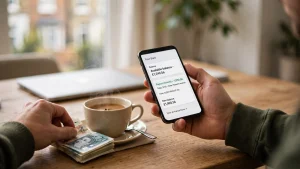
See how a casino deposit is charged to a mobile account and why the deposit and withdrawal routes are different.

A Pay by Phone deposit is charged through the mobile account rather than taken directly from a bank card. The casino receives a deposit request, and the resulting charge is recorded against the phone service. For a customer on a monthly contract, it appears on the next mobile phone bill. For a pay-as-you-go customer, it is deducted from the available prepaid credit.
That billing route determines where the money is accounted for, not what the casino balance represents. The deposited amount is added to the casino account for play; the corresponding phone charge is settled through the mobile account. The phone bill or prepaid balance is therefore the place to check for the payment’s effect on the mobile account. A casino balance and a mobile account balance are separate records, even though the transaction connects them.
The distinction matters because “pay with phone credit” can sound as though the casino is drawing from a general pool of phone allowance. The relevant balance is the account or credit against which the carrier records the charge. A monthly bill carries it forward for billing; prepaid service reduces the stored credit. If the prepaid balance cannot cover the charge, the available amount may not be sufficient to complete it. The exact handling of an unsuccessful transaction depends on the service and payment flow, so it should not be assumed that a rejected payment will be treated like a completed deposit.
When looking for a UK mobile casino that accepts phone credit, check the available deposit methods and withdrawal terms before signing up. This list provides a limited point of reference: the payout timing stated for each operator.
Britsino
Britsino has a stated payout speed of 1–3 business days. Check whether phone-credit deposits are available before choosing it for that payment method.
Zombillion
Zombillion has a stated payout speed of 1–3 business days. The available information does not confirm whether it accepts phone-credit deposits.
SlotoSport
SlotoSport has a stated payout speed of 1–3 business days. Confirm its deposit options if paying by phone credit is important to you.
Chanze
Chanze has a stated payout speed of 1–3 business days. No phone-credit deposit details are available here, so check the payment options directly.
Dieselwin
Dieselwin has a stated payout speed of 1–3 business days. The available information does not establish whether phone credit can be used for deposits.
NightLuck
NightLuck has a stated payout speed of 1–3 business days. Check its payment methods directly to confirm whether phone-credit deposits are supported.
WinBeast
WinBeast has a stated payout speed of 1–3 business days. No information is provided here about accepting phone credit for deposits.
x3bet
x3bet has a stated payout speed of 1–3 business days. Verify its deposit options directly if you are specifically looking to pay with phone credit.
Amunbet
Amunbet has a stated payout speed of 1–3 business days. The available details do not confirm whether it accepts phone-credit deposits.
EvoSpin
EvoSpin has a stated payout speed of 1–3 business days. Check its payment options directly to see whether phone-credit deposits are available.
A specialist review of UK casino payment options reports that most operators cap Pay by Phone deposits at £30 per transaction. That is a ceiling for an individual transaction, not a statement that every casino accepts this method or that every account can deposit that amount. The operator’s payment screen sets out the amount available for the particular transaction. The practical limit can also be lower where the mobile account does not have enough available credit or the carrier does not accept the charge.
The cap is specific to this payment route. It does not describe the maximum amount that can be placed in a casino account through every method, nor does it mean that a casino balance itself is limited to that figure. A phone-credit transaction is constrained by the payment channel: its charge is assigned to a mobile account, and the per-transaction ceiling applies to that channel. Other ways of funding a casino account are accounted for through their own payment routes and terms. They should not be treated as interchangeable with Pay by Phone simply because all of them can add funds to the same casino balance.
This also separates the casino’s deposit record from the carrier’s billing record. The casino records the amount credited to the account; the mobile provider records the associated charge against the phone account or prepaid credit. A customer reviewing both records may see the same transaction reflected in different places, but each record serves a different purpose. The casino account shows the deposit; the mobile account shows how it is billed.
For a contract customer, the charge does not necessarily appear as a separate bank-card transaction at the moment of deposit. It is carried onto the next mobile bill. For a pay-as-you-go customer, the reduction is made from prepaid credit instead. That difference affects when the mobile account shows the charge, but it does not change the basic nature of the payment: the casino deposit is being funded through the mobile service.
The £30 figure should consequently be read narrowly. It is a reported typical per-transaction cap for Pay by Phone, not a promise of a £30 deposit option on every account, and not a guide to the full cost of a transaction. The amount displayed before confirmation is the relevant figure for the deposit being made. The distinction between the amount credited and any separate charge associated with the payment route is a matter of transaction cost, rather than of how the mobile bill or prepaid deduction works.
In short, Pay by Phone turns a casino deposit into a charge on a monthly mobile bill or a deduction from prepaid phone credit. The reported cap applies to each transaction made through that route. It should not be confused with a general casino-account limit or with the rules for other funding channels.
A Pay by Phone deposit has two figures that need to be kept separate: the amount credited to the casino account and the total value taken from the mobile account. They can match, but a network surcharge can make the second figure higher. The deposit screen may show the amount being added to the casino balance without making the full cost equally prominent.
A specialist review describes deposit amounts in the £5 to £30 range and reports that some mobile networks add a premium-rate fee of £0.50 to £1.50. These are reported figures, not a guarantee that every network or casino applies the same terms. The important distinction is that the network fee is an additional charge: it is not part of the balance credited to the casino account.
The basic calculation is:
Total charged to the mobile account = casino deposit + any network fee
If £10 is deposited and a £0.50 fee applies, £10 goes into the casino balance while the mobile account is charged £10.50. With a £1.50 fee on that same deposit, the balance still receives £10, while the total charge becomes £11.50. The extra amount does not create additional playable funds; it is the cost of processing the Pay by Phone transaction.
The fee is conditional, not automatic. The specialist review reports that some networks apply one, so the final cost depends on the terms attached to the particular transaction. A deposit of £10 could therefore cost £10, or it could cost more if a surcharge is added. The difference matters even when the fee looks small: a charge that does not increase the casino balance still reduces the value of the transaction.
For a £5 deposit, the reported fee range would produce a total charge of £5.50 to £6.50 if the applicable network fee were added separately. For a £30 deposit, the corresponding total would be £30.50 to £31.50. Those figures are arithmetic illustrations of the reported amounts, not a statement that every transaction is charged at either end of the range.
This distinction also prevents a common accounting error. If the payment confirmation shows a £10 casino deposit, that does not by itself establish that only £10 has been deducted from mobile credit or added to the phone bill. The casino balance and the mobile account record different parts of the transaction. The balance records the amount credited; the phone account records the deposit charge and any applicable fee.
The amount entered on the casino’s payment screen is the deposit amount, not necessarily the final cost. The confirmation details should be read for any separate network charge before the transaction is completed. If the fee is shown as a separate line, the two amounts can be added directly. If the transaction wording gives only a total, that total should not be mistaken for the amount that will appear in the casino balance.
The same check applies when a charge is settled through a phone account rather than paid immediately from prepaid credit. A later bill can contain the cost of the transaction even though the casino account was credited earlier. Timing does not alter the arithmetic: the amount deposited and the total billed remain separate figures where a surcharge applies.
Transaction Costs
Select deposit amount
A player chooses to deposit £10 into their casino account.
Apply network fee
A network surcharge of £0.50 to £1.50 is added to the transaction.
Final total charge
The mobile account is charged a total of £10.50 to £11.50, while only £10 is credited as playable funds.
A practical record of each payment can use three entries: the amount selected for the deposit, the amount credited to the casino account, and the total charged by the network. When no surcharge applies, the first two figures should correspond, while the final charge is the same as the deposit. When a surcharge does apply, the difference is visible as a separate cost rather than as extra casino funds.
The surcharge has a larger proportional effect on a smaller deposit. A £0.50 fee added to £5 increases the cost by a greater share of the deposit than the same fee added to £30. The fee does not change the amount credited, so the effective cost per pound of casino balance rises as the deposit amount falls. That is a straightforward consequence of adding a fixed charge to different deposit amounts.
The upper reported fee has the same effect in absolute terms whether the deposit is small or large, but its relative weight differs. For example, a £1.50 surcharge on a £5 deposit means a total cost of £6.50 for £5 of casino credit. On a £30 deposit, the same surcharge means a total cost of £31.50 for £30 of credit. The credited balance is not reduced in either calculation; the additional amount is a separate transaction cost.
For any phone-credit deposit, the meaningful comparison is therefore not only the amount selected on screen. It is the amount that reaches the casino balance alongside the full charge made to the mobile account. Treating those as two separate figures gives an accurate cost of the transaction without counting a network fee as gambling funds.
Pay by Phone describes a way to fund a casino account; it does not determine how a slot is accessed or played. The mobile experience depends on the casino’s site and the device being used. For most UKGC-licensed casinos, slots can be opened for instant play through a mobile browser, so a dedicated app is not required for access.
The browser route keeps the process straightforward: open the casino’s mobile site, sign in to the account and navigate to its slots. A selected game then opens within the site or its game display. The exact layout varies, but the key point is that mobile-browser access is a normal route at most UKGC-licensed casinos, rather than an unusual workaround.
A phone-credit payment does not make a casino game run through the mobile network’s billing service. Once funds are in the casino account, the slot is accessed through the casino’s mobile site. The payment choice and the game interface are separate parts of the experience. That distinction matters: a casino accepting Pay by Phone is not necessarily an app, and an app is not a requirement for playing on a phone.
Browser play also means that access is tied to the casino’s mobile website. There is no need to treat the presence of a downloadable app as proof that a casino supports mobile slots. The relevant question is whether the site provides the game in a browser on the device. Most UKGC-licensed casinos offer instant play through mobile browsers, making that a practical starting point when checking how a phone-based session works.
A mobile screen changes the way the casino is presented, not the basic account relationship. The game remains part of the casino account, while navigation and play take place on the phone. If the site’s menus, sign-in page or game display are difficult to use on a particular device, that is an access issue rather than a feature of phone-credit payment. The payment method cannot correct a poorly presented mobile site.
It is also useful to separate mobile access from the idea of a casino-specific app. Browser play can provide access without installing one, but the experience still depends on the casino’s own site and the game being available there. A browser-based route may therefore be sufficient for a player who wants to use a phone without making app installation part of the process.
Before playing, the account must be accessible on the phone and the selected game must load in the mobile browser. If either step fails, the difficulty is with access to the site or game, not with the fact that the account was funded using phone credit. This keeps the decision in the right category: Pay by Phone concerns funding; mobile-browser support concerns where and how the slot can be opened.
For a mobile casino using phone credit, the useful distinction is simple. The payment method handles the deposit, while the casino’s mobile site provides the route to the slots. Most UKGC-licensed casinos support instant browser play, so the phone can be used without treating payment and gameplay as the same feature.
A Pay by Phone deposit and a withdrawal are separate transactions, even when they belong to the same casino account. Paying with phone credit puts funds into the account; it does not establish that the same route can return a cash balance to a mobile bill or prepaid balance. The payment method used to deposit is almost always the method required for withdrawal, so the route chosen at the start can shape what happens when funds are later requested.
That matters when considering a deposit with phone credit at a mobile casino. The payment option may be presented alongside other ways to fund an account, but that does not mean every option is interchangeable at cash-out. A deposit confirms only that the casino accepted funds through that route. It is not evidence that a withdrawal can be sent by a different method, or that the phone-credit route can handle a withdrawal.
The practical check is the operator’s withdrawal policy, not simply the list of deposit methods in the cashier. Before using phone credit, the terms should be read for the permitted withdrawal route and any conditions attached to it. If the policy requires the deposit method for withdrawal, the phone-credit payment may affect how a later cash-out is processed. The exact procedure depends on the operator’s stated rules; assumptions based on other payment options are not a substitute.
This distinction applies whether the account is used for slots on a phone or through another device. The game format does not change the payment relationship: a mobile slots session funded by phone credit is still subject to the account’s withdrawal rules. A successful deposit is therefore not the final step in assessing whether the method suits the account. The relevant question is whether the return route is clear before funds are committed.
Where more than one payment method has been used, the operator’s instructions remain important. The general pattern is that the deposit route is almost always the route required for withdrawal, but “almost always” is not an absolute rule for every account or transaction. The cashier terms should specify how the operator handles the particular method. If those terms do not make the withdrawal route clear, the uncertainty is itself material: the deposit should not be treated as though it guarantees a particular way to receive funds.
A sensible comparison therefore separates two decisions. The first is whether phone credit is an acceptable way to add money to the account. The second is whether the resulting withdrawal process is acceptable. A quick deposit can still lead to an inconvenient cash-out route if those decisions are treated as one. The payment method is not merely an entry point; it can determine how the account must be settled.
A Pay by Phone option does not confirm that a mobile casino holds a UK licence. Payment availability and regulatory status are separate matters: the presence of a phone-credit deposit route is not evidence that the operator is authorised to serve customers in the UK.
The first check is on the casino’s own website. Its UK Gambling Commission (UKGC) licence number should appear at the bottom of the homepage, often in the footer. If it is not immediately visible, the footer is the place to inspect before opening an account or making a deposit. A claim such as “UK licensed” is less useful than a number that can be checked.
The number should then be checked against the UKGC register. The purpose is to establish that the licence belongs to the operator running the site, rather than relying on a badge, a statement in promotional material or a payment logo. The operator’s identity matters: a licence number displayed on one site should not be assumed to cover a different company or brand without checking the register details.
This is relevant to any phone-credit casino, whether accessed through a mobile browser or another format. UK rules require operators selling remote gambling to the British market to hold the relevant Gambling Commission licence. A current UK licence is the strongest consumer protection available in this market; it places the operator within the UK regulatory framework. It is not a guarantee that every transaction or account issue will be resolved in a particular way, but it is a meaningful threshold for checking who is providing the service.
The check should be completed before treating the site as a UK-licensed mobile casino. A missing number, a number that does not correspond to the operator, or a registration detail that does not support the site’s claim leaves the licensing position unverified. In that situation, the sensible conclusion is not that the payment option makes the site legitimate; it is that the operator’s status has not been established.
Phone-credit casino searches can make the payment feature seem like the defining point. For a UK account, the licence is a separate and more fundamental check. The amount charged to a phone bill or deducted from prepaid credit says nothing about whether the casino is regulated. A payment route can be present on a site without proving who holds responsibility for the gambling service.
The check is brief: locate the licence number in the homepage footer, then verify the operator’s details through the UKGC register. That keeps the decision anchored to the company’s regulatory status rather than the wording of an offer or the convenience of a deposit method.
A minimum deposit and a payment ceiling answer different questions. The minimum is the smallest amount a casino accepts for a deposit; the ceiling is the most that a particular payment route will allow in one transaction. With Pay by Phone, the second figure can matter more when the intended deposit is larger.
A specialist casino-payment review reported that many casino apps set a minimum deposit of £5, while some accept £2. The same review put the Pay by Phone transaction cap at £30 for most operators. These are reported figures, not terms guaranteed across every mobile casino: the applicable minimum and cap depend on the operator and payment option available to the account.
The comparison leaves room for small deposits but limits the size of a single phone-credit top-up. A casino may accept a deposit amount above the Pay by Phone ceiling through another payment route, while the phone-credit option itself cannot fund that amount in one transaction. A low minimum therefore does not mean the method can cover any amount the casino accepts.
For someone checking whether an online casino accepts payment by phone credit, the useful figures are the minimum shown for that method and its per-transaction maximum. The casino’s general minimum may differ from the minimum attached to Pay by Phone, and a payment page may show only options available to that account. The amount entered should be within both the casino’s rules and the payment method’s limit.
The word “most” in a review should not be treated as a promise about a particular operator. Payment limits can differ between casinos, and the stated ceiling should be checked against the amount displayed at deposit. If an intended top-up exceeds the Pay by Phone maximum, the issue is not necessarily the casino’s general deposit minimum; it is the boundary on that payment route.
This distinction also applies when searching for online slots that accept phone-credit deposits. The slots are played through a casino account; the payment method determines how much can be added at once, not whether the account’s general minimum is low. A small minimum can make a modest deposit possible, while the transaction ceiling still prevents a larger single top-up. Pay by Phone is therefore a bounded way to fund an account, rather than a measure of the largest deposit the casino accepts overall.
Paying through a mobile phone account does not create a separate legal category of casino. In the UK, online casino gambling is legal only when offered by a licensed and regulated operator. The payment route—whether the deposit is charged to a phone bill or deducted from prepaid credit—does not alter that requirement.
For customers in England, Scotland and Wales, operators offering real-money gambling must hold the relevant UK Gambling Commission licence. That applies to operators based outside the country as well as those based within it when they serve the British market. A casino does not become lawful for UK customers simply because its website loads on a phone or it accepts Pay by Phone.
This distinction matters when looking for mobile casinos that accept phone credit. Payment availability is a feature of the cashier; it is not evidence of the operator’s regulatory status. The same applies to a casino promoted as a phone-credit option: the method itself neither grants a licence nor substitutes for one. UK legality rests on the operator’s permission to serve the market, not on how a deposit is routed.
A UK-licensed mobile casino can offer a payment method subject to its own terms and payment-provider conditions. Conversely, an operator outside the UK regulatory system does not become part of it by accepting a UK mobile number. These are separate questions: whether the operator is authorised for the market, and whether a particular deposit option is available for an account.
The term “mobile casino” describes access from a phone, not a different legal standard. A browser-based casino and a mobile app are both ways of reaching the service; neither changes the requirement that real-money gambling for UK customers be provided under the appropriate UK licence. Phone-credit searches therefore need to be read as searches for a payment facility, not as a signal that every matching site is legally available to UK players.
The practical limit is straightforward: phone credit can be a way to fund an account, but it cannot make an unauthorised operator lawful. The UK market permits online casino play through licensed and regulated sites. Payment convenience and legal status remain separate parts of the decision, and one cannot stand in for the other.
A bonus advertised alongside phone-credit slots is not the same thing as withdrawable cash. Its value depends on the offer’s wagering requirements, the time allowed to meet them and any limit on winnings. The headline figure describes what may be credited under the terms, not what can necessarily be taken out.
A specialist review reports wagering requirements of 35x to 40x the bonus amount. The calculation is the bonus multiplied by the stated requirement: a bonus of B would therefore require qualifying stakes totalling 35B to 40B. That is turnover, not a required deposit and not a promise of an equivalent return. Losses can reduce the balance before the turnover is complete.
The terms also determine which games count and how much each stake contributes. Game weighting can make a displayed stake count for less than its face value towards the requirement. Maximum bet rules may restrict play while a bonus is active; exceeding them can affect eligibility for bonus winnings. The arithmetic therefore needs to use qualifying turnover, rather than simply adding every stake placed.
Time is another condition. A specialist review describes completion periods of 7 to 14 days for some offers, while others allow only 72 hours. The deadline in the specific offer controls. If the requirement is not completed in time, the bonus and any winnings tied to it may be removed under the offer’s terms.
A specialist review also reports maximum bonus-winnings caps of £100 to £200. Where a cap applies, winnings above it do not increase the amount available from that bonus. The final contribution is consequently constrained by both successful completion of wagering and the cap: a larger balance on screen does not override either condition.
Before accepting a promotion at a phone-credit slot site, the relevant figures are the bonus amount, the wagering multiple, the deadline, eligible games, maximum bet and maximum cashout. Each condition changes the calculation. A large headline bonus with a short completion window or a low cashout cap can have less practical value than its displayed amount suggests; the offer terms, not the banner, determine the result.
Pay by Phone is one way to fund a mobile casino account, but it is not the only method available on a phone. Apple Pay, debit cards and PayPal work through different payment routes, so the relevant comparison is how each handles a deposit and whether the transaction can carry an additional cost.
A specialist review reported that Apple Pay deposits in the apps it tested were instant and took two taps. That is a direct, phone-based checkout: the payment is authorised through the wallet rather than charged to a mobile account. The reported result applies to those tested apps, not every casino or device.
Debit card deposits are also described as generally instant, although some banks may flag casino transactions. A flagged payment can interrupt the process, so an expected quick card deposit is not the same as a guaranteed one. The comparison is practical: a card uses the bank’s payment route, while Pay by Phone places the charge on the mobile bill or deducts it from prepaid credit.
PayPal can introduce a different cost issue. A specialist review noted that currency-conversion fees may apply when the casino account is not in pounds sterling. For an account operating in GBP, that particular non-GBP conversion condition does not arise; where another currency is involved, the payment total may differ from the amount shown at the point of deposit.
The distinction is not simply speed versus convenience. Pay by Phone connects the deposit to the mobile service account; Apple Pay and debit cards use payment credentials held in a wallet or with a bank; PayPal processes the payment through its account. Each route can therefore produce a different record of the transaction and, in PayPal’s case, currency may affect the cost.
For someone comparing online casinos that accept Pay by Phone with other mobile payment options, the useful check is the amount ultimately debited and the currency in which the casino account is held. A fast authorisation does not settle the cost question. Nor does a phone-based checkout mean every method is billed in the same way: Pay by Phone is tied to mobile credit or billing, while the other methods follow their own payment accounts.
A Pay by Phone top-up is one deposit among all the others made to the account. An account-level limit can therefore constrain repeated deposits across the chosen period, rather than treating each payment as an isolated decision. That distinction matters when several small top-ups seem manageable individually but add up to a larger total.
UKGC-licensed operators must provide deposit limits. These can be set for a daily, weekly or monthly period and are managed in the account settings. New customers must also be prompted to set a financial limit before making their first deposit. The control is separate from any limit attached to a particular payment method: it applies to deposits into the casino account.
The period determines how the control works in practice. A daily setting limits deposits counted against that day; a weekly or monthly setting gives a wider view of cumulative funding. Before making a phone-credit deposit, the remaining allowance under the selected limit is therefore relevant. A payment may be declined or unavailable if it would exceed the account’s limit, even when the payment method itself could accept it.
Limits are a spending control, not a way to make a deposit affordable. A figure set too high offers little constraint; a lower limit can prevent further funding once the chosen threshold is reached. The account settings are also where the active limit can be reviewed or adjusted, subject to the operator’s process.
When topping up a casino account with phone credit, the useful check is the account’s remaining deposit allowance—not just whether the payment option is available.
For UK-licensed operators, e-wallet withdrawals are realistically expected to take under 24 hours; the fastest observed PayPal payout took 2 hours. Bank transfers took 3–5 business days, while debit card withdrawals took 1–3 business days.
Some mobile networks add a premium-rate fee of £0.50 to £1.50. If charged, it is added to the deposit cost rather than the casino balance.
It means you must place bets totalling a multiple of the bonus amount before bonus winnings can be withdrawn. Typical requirements are 35x to 40x the bonus, and maximum bet limits, game weighting and cashout caps may also apply.
Yes, most UKGC-licensed casinos offer instant play through a mobile browser, so you can play without downloading an app.
E-wallet withdrawals are generally expected within 24 hours at UK-licensed operators, with the fastest observed PayPal payout taking 2 hours. Bank transfers took 3–5 business days and debit card withdrawals 1–3 business days.