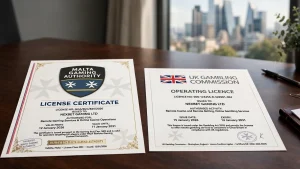
European branding does not determine whether a casino can serve Great Britain; UK licensing and GAMSTOP are separate considerations.

A casino’s European branding describes how it presents itself; it does not establish which gambling rules apply to its service. For customers in Great Britain, the relevant question is whether an online operator holds the required UK Gambling Commission licence. Remote operators selling gambling to people in Great Britain must hold that licence regardless of where the business is based. A European address or identity, by itself, does not demonstrate compliance with British requirements.
That distinction matters when considering an online casino described as European. The label may refer to a company’s location, its intended audience or its marketing, but it does not determine whether the site is authorised to serve customers in Great Britain. The legal position attaches to the service offered to the market, not to a broad regional description. A foreign licence is not a substitute for the UK licence required to offer real-money gambling to customers in Great Britain.
GAMSTOP is the national online self-exclusion scheme for Great Britain. It allows people to exclude themselves from gambling with UK-licensed online casinos through one scheme rather than treating each licensed operator as an unrelated decision. The Gambling Commission made participation compulsory for online operators from 31 March 2020. In practical terms, the scheme is intended to prevent access to current gambling accounts and the creation of new accounts across participating UK online gambling businesses.
When considering non-GamStop European casinos in 2026, payout timing is one practical detail to check alongside your own requirements. This list offers a brief reference point based on the information available for each operator.
Britsino
Britsino lists a payout speed of 1–3 business days.
Zombillion
Zombillion lists a payout speed of 1–3 business days.
SlotoSport
SlotoSport lists a payout speed of 1–3 business days.
Chanze
Chanze lists a payout speed of 1–3 business days.
Dieselwin
Dieselwin lists a payout speed of 1–3 business days.
NightLuck
NightLuck lists a payout speed of 1–3 business days.
WinBeast
WinBeast lists a payout speed of 1–3 business days.
x3bet
x3bet lists a payout speed of 1–3 business days.
Amunbet
Amunbet lists a payout speed of 1–3 business days.
EvoSpin
EvoSpin lists a payout speed of 1–3 business days.
Self-exclusion is not a label attached to a particular kind of game or a preference that can be ignored when a different site looks appealing. It is a formal arrangement to stop gambling with the businesses covered by the exclusion. For online gambling, the available routes include registering with GAMSTOP or contacting an individual casino to exclude from that business. Gambling businesses are required to offer self-exclusion; it is part of the regulatory framework, not an optional customer-service feature.
Registration involves identifying the sites or venues to be covered, supplying personal information for identity checks, selecting a duration and receiving confirmation. Once the exclusion is in place, the covered businesses are expected to refuse service. The scope is therefore central: a person seeking to stop gambling needs to consider all the places where gambling may be tempting, rather than treating one account as the whole picture. A single-site request and a multi-operator scheme serve different scopes.
The phrase “non-GamStop European casino” should not be read as proof that a site is outside the reach of every relevant rule, nor as proof that it is a lawful option for someone in Great Britain. If an operator accepts customers in this market, its location does not remove the UK licensing requirement. At the same time, an offshore site may be accessible online while remaining outside the UK Gambling Commission’s regulatory system. Accessibility is not the same as authorisation.
For someone who has registered with GAMSTOP, opening another account elsewhere to get around the exclusion is not a sound workaround. Playing at a non-GamStop casino could breach the terms of an existing self-exclusion agreement. The exclusion is a commitment not to gamble during the agreed period, and changing the website does not change that commitment. The financial consequence is straightforward: an account outside the scheme does not cancel the agreement already made.
The distinction between site branding and regulatory status also limits what can responsibly be inferred from a European presentation. A casino’s name, language options or claimed location cannot establish that it holds a UK operating licence, participates in GAMSTOP, or is suitable for a person who has self-excluded. Those are separate questions. A self-exclusion decision should be based on its intended scope, not on an assumption that a regional label changes the rules.
For people who want to stop online gambling across licensed operators in Great Britain, GAMSTOP is the multi-operator route. A request to one casino applies to that individual business, while the national scheme covers participating licensed websites and apps. The useful distinction is not between European and non-European branding, but between the scope of the exclusion selected and the operators it covers. A wider exclusion is the relevant choice where temptation extends beyond a single account.
A search for roulette at a European-branded casino can make the game seem like the main decision. For self-exclusion, the relevant boundary is different: the request is made to a gambling business or website, not to one table game. A person excluded from a casino site is not simply asking to avoid roulette while leaving other gambling available through the same business.
UK rules also make the operator’s status more important than its branding. A remote gambling business serving customers in Great Britain must hold the relevant UK Gambling Commission licence. A European name or presentation does not establish whether that requirement is met. A casino’s regulatory position cannot be inferred from the word “European”, nor does that word establish what games it offers.
This distinction matters when a roulette search leads to a particular casino website. If a person wants to exclude themselves from that business, the request is made to the business, rather than being limited to the roulette section or a particular table. Gambling businesses must offer self-exclusion by law. The request is therefore an account-level safeguard, not a game preference that can be switched on and off between different products.
For a single gambling website or app, the Responsible Gambling or Safer Gambling page is the place to find its self-exclusion instructions. If those instructions are not available there, customer services can be contacted. A player can also request exclusion from one gambling business directly.
That route is relevant whether the original interest was roulette, another casino game, or a wider set of gambling products. The reason for making the request does not narrow its scope to the game that prompted it. Once the business is the target of the exclusion, treating the restriction as roulette-only would misread what the request is for.
The same principle is useful when evaluating a casino described as premium or VIP. Those labels do not change the practical unit of self-exclusion. A special table, a high-status account description, or a dedicated roulette area is not a separate gambling business merely because it is presented as a distinct experience. The exclusion request concerns the operator or website selected, not the marketing category attached to a game.
An account may contain several kinds of gambling, but self-exclusion is not a menu for blocking one game while preserving access to the rest of that same business. The operator-level boundary is the point to check before opening or using an account. If a person is considering exclusion, the casino’s own safer-gambling instructions describe how to submit the request; customer services are the alternative where the instructions cannot be located.
The phrase “European roulette” can refer to a game preference, while “European casino” can describe branding or a business’s claimed location. Neither phrase answers whether a remote operator is legally entitled to serve customers in Great Britain. The applicable test is the operator’s UK regulatory status, not the geographic impression created by its name.
That distinction avoids two separate assumptions: that a European-branded site necessarily offers the roulette sought, and that any such site is within the UK regulatory system. Neither follows from the label alone. A search for a premium or VIP experience does not supply those missing facts either.
Where a UK-licensed operator serves the market, responsible-gambling measures are part of its regulatory obligations, including self-exclusion. The relevant action is still to identify the business and use its account or customer-service process. A game description does not replace that step, and a casino’s presentation does not define the reach of the restriction.
For a person who has already decided to self-exclude, choosing a particular table or game as the focus does not make the request narrower. The business is the meaningful boundary. That is a less glamorous distinction than a VIP label, but it is the one that determines what the request addresses.
A European label is not enough to establish which company operates a casino, where it is licensed, or whether its site is available to customers in Great Britain. Those details matter more than branding. Remote gambling operators offering services to the British market must hold a UK Gambling Commission licence, regardless of where the business is based. A site’s European identity, language or presentation does not answer that regulatory question.
For that reason, a list of European casino sites cannot be treated as a verified shortlist merely because the sites appear to fit a regional description. A meaningful comparison would need confirmed operator identities and regulatory details for each entry. Without those checks, presenting names as suitable options would turn an untested label into a recommendation. Calling the same list “top” or “best” would add a ranking without a substantiated basis.
The same caution applies to sites described as outside GamStop. A casino’s absence from a self-exclusion scheme does not establish that it is a European operator, verify its licence, or show that it is appropriate for someone who has excluded themselves. In Britain, online gambling is legal only through sites holding the relevant UK licence. The distinction is consequential: a geographic description is not a regulatory credential.
Site-level self-exclusion is a separate, practical option. For online gambling, a person can contact an individual casino to ask to exclude themselves from that business. The site’s own instructions may be on its Responsible Gambling or Safer Gambling page; customer services can be contacted if those instructions are not available. This applies to an individual account relationship, rather than establishing anything about other companies using similar branding or descriptions.
Before making such a request, the relevant business needs to be identified. The site name displayed to customers may not, by itself, make clear which company operates the account. Terms, account pages and customer-service information can help identify the business to contact. If the operator cannot be established, a request addressed only to a familiar brand name may leave uncertainty about which account has been included.
An individual-site exclusion has a defined scope: it concerns the gambling business contacted. It should not be treated as a substitute for a wider self-exclusion measure where gambling at other sites is also a concern. Nor is it a reason to open another account elsewhere to get around an existing exclusion. A person seeking to stop gambling should include every place where they may be tempted, rather than interpreting one site’s action as coverage across unrelated operators.
European casino bonuses and slot selections do not resolve these questions. An advertised offer or games catalogue cannot verify the operator’s identity, licensing position or the reach of an exclusion request. Those are separate matters, and promotional wording does not fill the gap.
The usable decision is therefore narrower than a site ranking: identify the business behind a particular online account, then contact that casino directly if exclusion from it is required. A regional label cannot stand in for those checks, and a site-specific request should not be mistaken for a universal block.
A no-deposit bonus describes an offer that does not require an initial deposit; the label alone does not establish its cash value, withdrawal conditions or any other terms. Those details must be read in the specific offer conditions before play. Without them, there is no sound basis for comparing a European casino free bonus with a deposit offer or calling one the best.
For UK customers, the more concrete calculation starts before money reaches an account. A remote gambling operator must verify a customer’s age before allowing a deposit. UK-licensed operators must also prompt new customers to set a financial limit before the first deposit and make account-level limit controls accessible. These safeguards concern the account, not the wording of a promotion: a bonus does not replace a limit, and a limit does not make unclear bonus terms clearer.
Payment rules also constrain the deposit stage. UK-licensed casinos cannot accept credit cards for gambling. Remote operators must not accept credit-card payments for gambling, including credit-card funding routed through a money service business. They also cannot accept wallet payments where the wallet permits credit-card funds to be used for gambling. A payment method appearing in a cashier is therefore not sufficient evidence that every source of funds is permitted.
After a deposit, account controls remain relevant. UK-licensed casinos must provide responsible-gambling tools, including self-exclusion. Gambling businesses are required by law to offer self-exclusion, which can be used where continued access is not wanted. It is a formal commitment, not a bonus-management feature. If someone has self-excluded, opening another account elsewhere to get around that restriction is not an appropriate workaround; gambling at a non-GamStop casino could breach the terms of the exclusion. Exclusion should cover all places where gambling may be tempting.
Online slots have additional limits in Britain: autoplay is prohibited, and each spin must last at least 2.5 seconds. These rules are not promotional conditions, but they shape how slot play is conducted on licensed services. For a deposit decision, the distinction matters: offer wording governs the offer, while payment restrictions and account safeguards govern the gambling account.
A no-deposit offer should therefore be assessed only from its published conditions, including what can be withdrawn and what requirements apply. If those terms do not give a clear final amount, the headline bonus cannot supply one. The Gambling Commission does not refund money spent gambling, so account limits and payment checks matter before funds are committed, not after a promotional balance has been used.
GamStop is a multi-operator self-exclusion scheme for licensed online gambling websites and apps. A registration is designed to apply across participating operators, rather than to a single casino account. For UK players, that distinction matters: GamStop is not a label for a particular game, country of origin or style of casino, but a scheme linking participating gambling businesses.
The Gambling Commission made participation compulsory for online operators from 31 March 2020. Since then, every UK-regulated online casino has been required to block customers who are self-excluded through GamStop. A casino serving the British market cannot become an exception to that requirement merely by describing itself as European or locating its business elsewhere.
The phrase “non-GamStop European casino” therefore needs careful interpretation. It describes a site presented as outside GamStop, but the wording does not establish where the operator is based, which regulator oversees it, or whether it is authorised to serve customers in Great Britain. “European” is a geographical or marketing description, not proof of a UK licence. Nor does the phrase itself establish that a site is a lawful alternative for a UK customer.
The relevant UK rule is based on the market being served. Remote gambling operators offering services to consumers in Great Britain must hold the relevant UK Gambling Commission licence, regardless of their physical location. Online gambling is legal in the UK only through licensed and regulated sites. An overseas address does not remove that obligation when an operator sells into the British market.
That leaves two separate questions which should not be collapsed into one. The first is whether an operator participates in GamStop. The second is whether it holds the UK licence required to provide remote gambling to British customers. A site described as not on GamStop should not be treated as a UK-licensed casino outside the scheme: UK-licensed online operators are required to participate. The description may instead signal that the operator is outside the UK scheme, but it does not settle the operator’s legal status or establish its suitability.
For someone searching for European casinos not on GamStop, the practical point is that the phrase cannot identify a verified class of UK-licensed casinos. GamStop’s role is to connect self-exclusion across participating licensed operators, while the UK licensing requirement determines which operators may legally serve the British market. Those are related protections, but they are not interchangeable.
A European-sounding name, a foreign address or the wording of an advert cannot override the participation rule. In the UK, a regulated online casino is expected to be part of GamStop; a claim to be both UK-regulated and outside the scheme does not fit that framework. The distinction is factual, not cosmetic: the scheme’s reach follows participating licensed operators, while the word “European” alone says nothing reliable about either participation or authorisation.
A “best” ranking is meaningful only when the same criteria are applied to each operator and the underlying terms can be compared. European branding, a country reference in a site name or a broad claim of international reach does not establish where a casino is licensed, which customers it may serve or what rules apply to its gambling products. Those labels are not a comparative measure.
For customers in Great Britain, the relevant regulatory point is whether an operator selling remote gambling into the market holds a licence from the UK Gambling Commission. The operator’s location does not remove that requirement. Online gambling is legal in the UK only through licensed and regulated sites, and the Gambling Act 2005 governs Great Britain, though not Northern Ireland. A casino presented as European is not, on that basis alone, a UK-licensed casino.
A useful comparison therefore needs more than a polished site or a catalogue described as extensive. It needs operator-specific information that can be checked against consistent criteria, including the applicable licence and the terms governing play. If those details are not established, a ranked European casino list would imply a level of comparison that the label “best” cannot supply. A list of names without a basis for distinguishing them is not a verdict; it is decoration.
The same distinction applies when the request is narrowed to casinos outside GamStop or to sites offering particular casino games. A game category does not determine an operator’s legal status, and a European connection does not establish that a site is outside a UK regulatory requirement. Remote operators serving Great Britain must hold the relevant UKGC licence. UK-licensed online operators have been required to participate in GamStop since 31 March 2020, so a claim that a site is “not on GamStop” should not be treated as evidence that it is a lawful UK option.
A comparison can also be misleading if it treats exclusion as a minor feature. GamStop is a multi-operator scheme that blocks access across participating licensed online gambling websites and apps. Separately, a person can ask an individual gambling business to exclude them. Self-exclusion is a formal agreement, not a preference setting that should be bypassed by opening an account elsewhere. Any ranking that ignores that distinction would leave out a material condition of use.
The practical conclusion is narrow: “European” describes neither a licence nor a quality grade. A defensible best-casino verdict requires comparable, operator-specific terms and a clear regulatory basis. Without those, no ranking can establish which European casino is best for a UK customer, and game labels cannot fill the gap.
A European casino’s branding or location does not determine the rules for serving customers in Great Britain. An operator offering real-money gambling to people there must hold a UK Gambling Commission licence. For a UK-licensed business, self-exclusion is not an optional customer-service feature: gambling businesses must make it available.
Once a self-exclusion agreement is in place, the business has specific duties. It must close the customer’s account, return any funds remaining in it and remove the customer’s details from its marketing databases. It must also take reasonable steps to prevent that person from gambling with the business. These requirements apply to the operator’s handling of the excluded account; they are not a promise that every gambling-related loss can be recovered.
The distinction matters when assessing European casinos for UK players. A site describing itself as European is not, on that basis, outside UK requirements if it offers gambling to customers in Great Britain. Conversely, an operator outside the UK licensing system does not acquire UK-licensed status through its branding. The relevant question is the regulatory position of the business, not the geography suggested by its name.
Self-Exclusion Process
Identify the Business
Determine the company operating the site using terms, account pages, or customer service information.
Submit Request
Use the instructions on the Responsible Gambling or Safer Gambling page, or contact customer services directly.
Confirm Action
The business must close the account, return remaining funds, and remove the user from marketing databases.
Account closure also has a defined financial meaning. Funds still held in the account must be returned after exclusion. That is different from a refund of money already spent gambling: the Gambling Commission cannot provide refunds for gambling losses. The amount returned is therefore the account balance due, not a reversal of previous bets.
Marketing removal is another separate obligation. After exclusion, the business must remove the customer’s details from its marketing databases, rather than continue sending promotional material while the account is closed. Reasonable prevention steps address the possibility of further gambling with that business; they do not make it safe to open another account elsewhere to get around an exclusion.
Self-exclusion is most effective when it covers every gambling setting where participation may be tempting, not just one European online casino or one account. Trying to play at a non-GamStop casino while an existing exclusion applies could breach its terms. An operator’s ability or willingness to accept an account is not evidence that doing so is consistent with the exclusion agreement.
The practical test is therefore not whether a site accepts UK players, or whether it presents itself as one of the best online casinos for European players. It is whether the operator is subject to the applicable UK requirements and, after exclusion, closes the account, returns its remaining funds, stops marketing and takes reasonable steps to prevent further gambling.
Interest in cryptocurrency does not change what self-exclusion means. A casino’s European branding, payment language or use of digital assets does not, by itself, establish its regulatory status or whether it accepts cryptocurrency. The relevant distinction is the gambling company covered by an exclusion agreement, not the currency associated with a game.
Self-exclusion is a formal request for a gambling company to stop accepting a person’s bets for a set period. The agreed term is generally between six months and five years. During that period, the agreement is not a filter that can be applied only to conventional deposits or selected games. It concerns betting with the company named in the exclusion.
That makes the phrase “European crypto casino” an unreliable guide to the effect of an existing exclusion. If a person has excluded themselves from a gambling business, attempting to gamble with that business through a different payment method would not make the agreement irrelevant. Nor should a new account elsewhere be opened to get around an exclusion. Playing at a non-GamStop casino could breach the terms of an existing self-exclusion.
For gambling offered to customers in Great Britain, operators must hold a UK Gambling Commission licence. UK-licensed online gambling businesses are required to provide self-exclusion. A European identity or a crypto-related label does not replace that requirement for an operator serving the British market, and it should not be treated as proof that an operator is within the UK regulatory system.
The practical boundary remains the agreement itself: the company from which betting has been excluded and the period set out in that agreement. Self-exclusion is a commitment not to gamble, not a payment restriction that can be bypassed by changing currency or account details. If gambling is a temptation in more than one place, excluding from only one company may leave other routes open; all places where gambling may be tempting need to be considered.
A real-money casino offer is not separate from a self-exclusion agreement. Self-exclusion is a formal commitment not to gamble for the agreed period, and responsibility for keeping that commitment rests with the person who entered it. A European label, a cash-play offer or a promotion does not change the terms.
That matters when a casino advertises real-money games or free spins. The form of an offer does not establish that gambling is consistent with an existing exclusion. Nor does the word “European” establish a casino’s regulatory status or make it an exception to an agreement. For customers in Great Britain, operators offering remote gambling must hold a UK Gambling Commission licence; an overseas identity alone does not supply one.
Where an exclusion is in place, opening an account elsewhere to continue gambling is not a sound workaround. Playing at a non-GamStop casino could breach the terms of the exclusion, even if the site is outside the scheme. The distinction between a cash deposit and promotional play does not remove the central point: the agreement is not to gamble.
The practical test is therefore not whether a particular European real-money casino appears accessible, or whether its promotion is labelled free. It is whether gambling at that venue would conflict with the existing commitment. If a person is tempted to gamble across several channels, self-exclusion should cover all places where that temptation may arise, rather than only the account currently in use.
This is a matter of terms, not marketing language. A bonus may change the amount offered by a business, but it cannot amend a self-exclusion agreement. While the agreement remains in force, the player remains responsible for honouring it. Seeking another site does not cancel that responsibility, and a casino’s location or branding does not turn an excluded period into permission to play.
GamStop blocks access to current gambling accounts and prevents new ones being opened with online gambling operators across the UK. Registration also blocks access to UK Gambling Commission-licensed platforms for the selected fixed period. A European casino’s location or branding does not establish whether it is within that system, nor does it make the site authorised to serve customers in Great Britain.
A site outside GamStop may appear to offer a route around an exclusion, but using it can conflict with the agreement already made. Self-exclusion is a formal commitment not to gamble with the businesses covered by it. Trying to continue gambling elsewhere does not cancel that commitment; it can put the player’s stated decision and subsequent actions at odds. Opening another account to bypass an exclusion is not a safe workaround.
The distinction matters legally as well as practically. Remote operators offering gambling to customers in Great Britain must hold a UK Gambling Commission licence. A casino operating outside that regulatory system is not a UK-licensed alternative. The fact that a site can be reached does not establish that it is permitted to provide gambling to UK customers, or that the protections attached to a UK licence apply.
The exclusion’s scope should therefore be treated as a boundary, not a temporary obstacle to route around. Anyone who may be tempted to gamble in other settings should consider excluding themselves from those venues or websites as well. Gambling businesses must offer self-exclusion, including individual sites and venues; online exclusion across UK operators can be arranged through GamStop.
Self-exclusion involves identifying the relevant sites or venues, registering, providing personal details for identity confirmation, choosing a duration and receiving confirmation. Once the agreement is active, customers are refused service by the businesses they excluded themselves from. The practical course is to keep the exclusion in place, avoid creating accounts elsewhere to gamble, and use the relevant exclusion process for any additional places where gambling may be tempting.
You register with a scheme or contact a gambling business, provide information to confirm your identity, choose a duration and receive confirmation. The businesses covered by the exclusion must refuse service; a single-site request and GAMSTOP cover different scopes.
To end a GAMSTOP exclusion, contact GAMSTOP directly and request removal. A 24-hour cooling-off period applies, during which you can cancel the request and keep the exclusion in place; operators may take a further 24 to 48 hours to update your status.
GAMSTOP lets you exclude yourself from participating UK-licensed online gambling websites and apps with one request, rather than contacting each operator separately. It is free and blocks access to existing accounts and the creation of new ones with covered operators.
The 24-hour cooling-off period begins after your identity has been verified, and the exclusion remains active during that period.
“Outside GAMSTOP” describes casinos that are not covered by the scheme; the label does not establish their licensing status. An operator offering remote gambling to customers in Great Britain must hold a UK Gambling Commission licence, and a foreign licence is not a substitute.
You can ask an individual online casino to exclude you through its Responsible Gambling or Safer Gambling page, or by contacting customer services. The request applies to that business, not automatically to other sites; a gambling business must close your account, return remaining funds and remove your details from marketing databases.