Learn how La Partage and En Prison affect even-money bets, and how table format, limits and wagering terms shape online play.
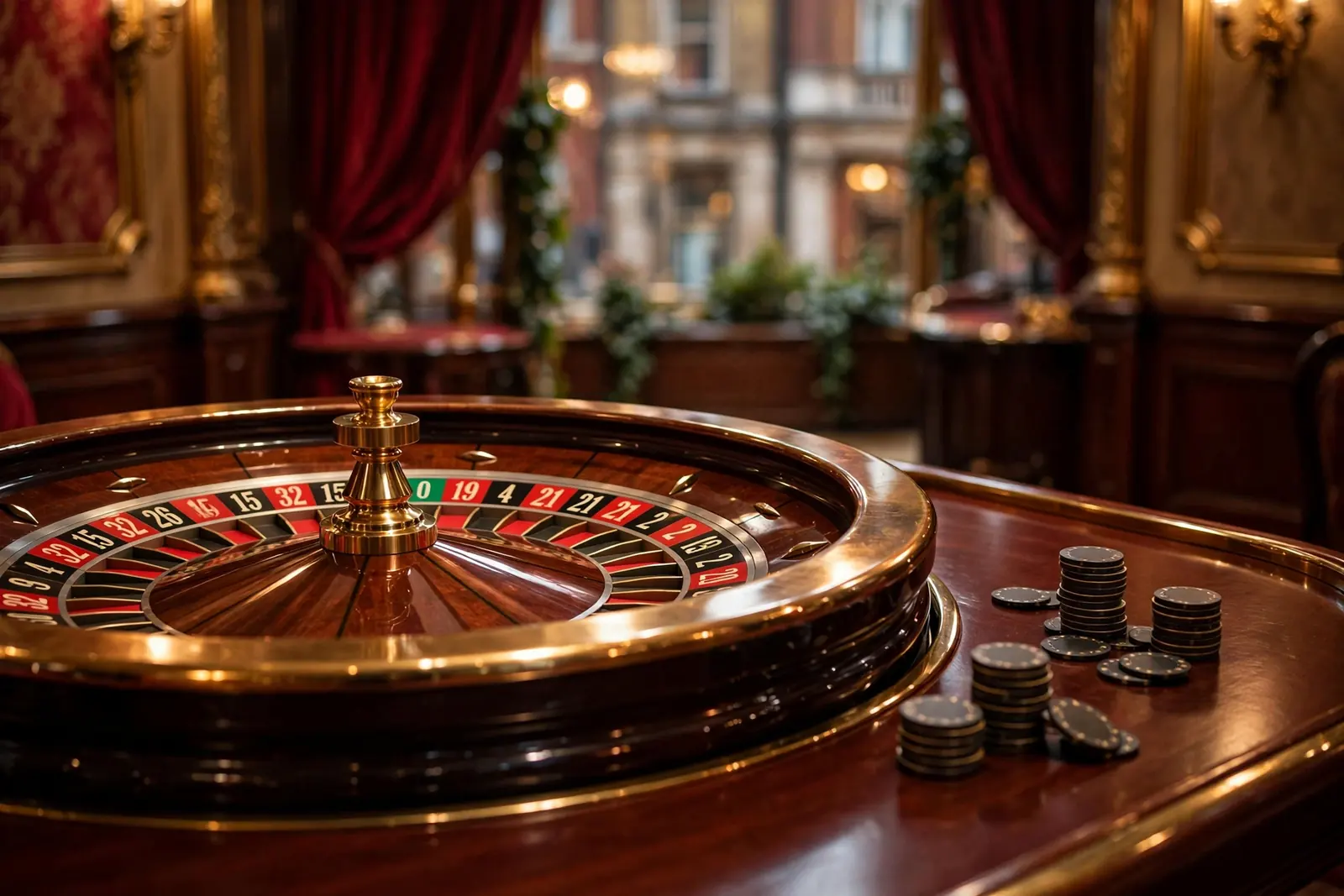
French roulette is built around a single-zero wheel: the numbered pockets run from 1 to 36, with one additional pocket marked zero. That green pocket matters because it is not part of the red-or-black, odd-or-even or high-or-low choices. When the ball lands there, the casino’s zero rules determine what happens to those even-money wagers.
The key distinction is between a bet’s usual payout and the way zero is treated. On an even-money bet, a winning selection returns an amount equal to the stake, while a losing selection costs the stake. Without a special rule, zero is a losing result for either side of such a bet. La Partage and En Prison soften that outcome. They do not alter where the ball can land; they change the settlement of eligible bets when it lands on zero.
La Partage returns half of an even-money stake when zero appears. The other half is lost. The rule therefore avoids the full loss that would otherwise apply to that wager, while leaving the casino with a smaller mathematical advantage over time.
Choosing a UK casino for French roulette means checking practical details as well as the game offering. This list highlights the payout-speed information available for each operator.
Britsino
Britsino lists a payout speed of 1–3 business days, a useful detail to consider when choosing where to play French roulette.
Zombillion
Zombillion lists a payout speed of 1–3 business days. That gives readers a clear practical detail to weigh when considering this operator.
SlotoSport
SlotoSport lists a payout speed of 1–3 business days, providing a concrete point of reference for players considering French roulette.
Chanze
Chanze lists a payout speed of 1–3 business days. This payout information is the available practical detail for considering the operator.
Dieselwin
Dieselwin lists a payout speed of 1–3 business days, which may help players assess its practical fit.
NightLuck
NightLuck lists a payout speed of 1–3 business days. This is the available factual detail to consider when looking at the operator for French roulette.
WinBeast
WinBeast lists a payout speed of 1–3 business days, offering a clear practical point for readers to consider.
x3bet
x3bet lists a payout speed of 1–3 business days. This provides a concrete detail for players assessing the operator.
Amunbet
Amunbet lists a payout speed of 1–3 business days, a practical detail to keep in mind when considering where to play.
EvoSpin
EvoSpin lists a payout speed of 1–3 business days. This is the available factual point to weigh when considering the operator for French roulette.
For eligible even-money bets, La Partage reduces the house edge to 1.35%. The figure applies to those bets under the rule, not to every wager on the table. A bet on a particular number, for instance, is not an even-money selection and does not receive the same half-stake treatment. The distinction is useful when reading a table’s rules: the name “French roulette” alone does not establish how every bet is settled.
The benefit is conditional on the ball landing on zero and on the bet being one of the covered even-money choices. On other results, the ordinary win-or-loss settlement applies. La Partage is therefore not a general rebate or a reduction to every losing wager. Its value comes from limiting the damage of one specific outcome for one specific class of bets.
En Prison is the other French rule associated with zero and even-money bets. Instead of settling an eligible wager as a full loss when zero appears, the stake is held for a further spin. The later result determines whether that stake is recovered or lost under the table’s En Prison terms.
That differs from La Partage’s immediate partial return. With La Partage, half the stake is returned at once and half is lost. With En Prison, the stake remains unresolved after zero rather than being treated immediately as a complete loss. The rules are not interchangeable, and the precise settlement should be read on the table itself. A casino may describe which even-money bets qualify and how an imprisoned stake is resolved.
 Hi-Lo Casino UK: Rules, Choices and Card ValuesLearn how each reveal resets the comparison, how ace-to-king values shape choices, and why a bet on a matching card depends on…
 Live Dream Catcher Casino UK: How It WorksSee how a live dealer’s studio feed works alongside the betting interface, and why the stream alone does not establish a game’s…
Both rules address the same mathematical disadvantage: zero interrupts the even-money outcomes. They do not remove the zero pocket, guarantee a return, or make a particular spin easier to predict. Their effect is on the long-run calculation of eligible bets, not on the sequence of results.
The house edge expresses the casino’s mathematical advantage across repeated play under a defined set of rules. It is not a fee deducted from each stake, nor a prediction that a particular session will end in loss. A single result can differ sharply from the long-run expectation; the calculation becomes meaningful across many wagers made under the same conditions.
French roulette has the lowest house edge among standard roulette variants because La Partage and En Prison reduce the effect of zero on eligible even-money bets. The advantage is tied to those rules and bet types. It should not be read as a blanket claim that every French roulette wager has the same low edge, or that every table labelled French applies the same settlement in every situation.
For anyone comparing a French roulette casino with another table, the practical check is narrow: confirm that the wheel has a single zero, identify whether La Partage, En Prison or both are in force, and read which bets they cover. The label is not a substitute for the rules displayed at the table. Where the rules apply as described, even-money wagers face less exposure to zero than they would without either protection.
This is the arithmetic behind French roulette’s reputation, including at an online French roulette casino: the zero remains in play, but its impact on covered even-money bets is reduced. That changes the house edge without changing the essential uncertainty of the game. Each spin remains an independent chance event, and the rules provide no method for knowing which pocket will receive the ball.
A roulette table’s pocket count gives a direct starting point for comparing its mathematical cost. European roulette has 37 pockets: the numbers from 1 to 36 and one zero. American roulette has 38, adding a double zero to the same numbered pockets. That extra green pocket changes the house edge, so the two games do not offer equivalent odds even when the betting layout looks familiar.
The stated house edge is 2.70% for European roulette and 5.26% for American roulette. The difference is not a matter of presentation or table speed. It follows from the wheel’s outcomes: the double zero creates another losing result for many bets without adding a corresponding winning opportunity. Across repeated play, that shifts more of the theoretical return towards the house.
The house edge is a long-run measure, not a prediction of what any individual session will produce. A short run can end above or below the amount staked; the percentage describes the mathematical disadvantage built into the game over time. For a comparison between roulette variants, it is more useful than a table’s branding or visual design because it expresses the odds in a consistent way.
On a European wheel, a single number occupies one of 37 pockets. On an American wheel, it occupies one of 38. The winning number still has to match the chosen number, but the American wheel has an additional outcome that can defeat the bet. The same basic increase in possible losing outcomes affects the overall house edge.
This is why comparing only the printed numbers on the layout can be misleading. Both versions show numbers from 1 to 36, and both have green pockets, but the count and configuration of those pockets matter. A double zero is not a cosmetic variation. It changes the underlying probability of the results.
The difference is substantial in the stated edges: American roulette’s 5.26% is higher than European roulette’s 2.70%. A table described simply as roulette therefore does not provide enough information for an odds comparison. The wheel type and its green pockets need to be identified before the edge can be assessed.
A further variation is reported for some American roulette tables in UK online casinos: a third green pocket marked 000. A specialist review identifies this configuration and gives it a house edge of 7.69%. That figure relates to the described three-green-pocket version; it should not be treated as a general feature of American roulette tables.
37 pockets (1-36 and one zero) with a stated house edge of 2.70%.
38 pockets (1-36, zero, and double zero) with a stated house edge of 5.26%.
Three green pockets (zero, double zero, and 000) with a reported house edge of 7.69%.
The distinction matters because the standard American wheel described by its 38 pockets has a single zero and a double zero. A table with an additional 000 pocket has a different configuration and a higher stated edge. The table’s actual layout is therefore more informative than a broad label such as “American roulette”.
For anyone comparing French roulette options, the same discipline applies: the game name alone does not establish which wheel or rules are in use. A comparison should be based on the displayed game details and the stated edge, where available. A casino offering a French-branded table is not automatically preferable on every measure simply because its name includes “French”; the relevant question is what version is actually being offered.
The numerical order is clear for the variants covered here: European roulette has the lower stated house edge, standard American roulette has the higher one, and the reported 000 configuration has the highest of these figures. The pocket counts explain the direction of that comparison. More green outcomes mean more ways for many bets to lose, while the underlying numbered outcomes do not expand to offset them.
That comparison does not rank casinos. A venue may provide a particular roulette version, but the operator name does not alter the wheel’s mathematics. For a best French roulette casino UK comparison, the useful distinction is between checking that the game is genuinely the intended variant and evaluating its specific rules and edge—not treating a casino’s presentation as evidence of better odds.
The figures also should not be read as guaranteed losses over a single visit. They are theoretical proportions that describe the game’s structure across play, not a forecast for a particular player or session. The practical comparison is still decisive: where the wheel adds green pockets, the house edge rises; where it has fewer, the stated disadvantage is lower. That is the measurable basis for comparing roulette variants, rather than an unqualified claim that one table or casino is “best”.
A live French roulette table shows a physical wheel in a studio rather than a software animation. A human dealer releases the ball, the wheel turns, and the result is visible as the ball settles into a pocket. The stream gives the game a physical sequence: bets close, the wheel is spun, the result is called and the table moves on. It does not change the rules of French roulette; it changes how the spin is presented and conducted.
For a live French roulette casino, the practical distinction is between watching a real wheel and interacting with a simulated one. The dealer manages the table and confirms the outcome, while the interface carries the betting options and displays the round. That arrangement can make the game feel closer to a casino table, but the stream itself is not evidence of better odds or a more favourable result. The wheel still determines the outcome by chance.
Table minimums are a separate term from the game’s rules. A specialist review reports UK live roulette minimums starting at 10p; the same type of review places some auto-roulette and speed-format minimums at 5p. These are reported entry points, not a promise that every table offers them. The listed minimum should be checked on the individual table before play, since the selected game and table determine the amount required for a bet. A low minimum makes a smaller stake possible; it does not alter what a winning bet pays.
The main operational feature is the live dealer’s handling of the physical wheel and ball. The streamed view lets players follow the spin rather than relying solely on a generated result display. The table interface remains part of the experience: it is where bets are placed and where the round’s status is shown. Connection quality and the pace of a studio table can affect how the session feels, but neither changes the wheel’s pockets or converts a result into a predictable one.
The label “auto” should not be treated as a synonym for a human-dealer table. Auto-roulette may be offered with a lower stated minimum, but the defining live-dealer feature is the streamed studio and human handling of the wheel. The distinction matters when comparing table descriptions: a minimum stake says what can be placed, while the format says how the result is produced and presented.
The UK Gambling Commission regulates online casino activity in Great Britain. At UKGC-licensed live casinos, account controls are part of the service, not an optional feature of a particular roulette table. Operators must make deposit limits and loss limits available, so spending controls can be set at account level rather than negotiated round by round. Session time reminders and reality checks provide prompts about the time spent playing.
Cool-off periods and GamStop self-exclusion are also required protections. A cool-off period provides a way to pause access, while GamStop self-exclusion allows a person to exclude themselves from participating operators. These controls address access and session management; they do not change roulette outcomes or refund stakes already placed.
A table’s streamed presentation can make each round easy to follow, but safeguards work at the account level. That separation is useful: wheel mechanics govern the result, table terms govern the stake, and account controls govern access and limits. A live French roulette table should therefore be assessed on all three points rather than on the studio feed alone.
A low minimum stake limits the amount committed to each spin; it does not, by itself, limit the total exposed over a session. The other variable is pace. A table that accepts a small bet but resolves spins quickly can still put a substantial number of separate wagers through a bankroll over time.
RNG roulette has some of the lowest entry points. Its spins are generated by software rather than a physical wheel, allowing play to move faster and minimum stakes to be lower; some games accept bets as small as 10p. That makes it possible to keep each individual wager small, but the faster sequence of outcomes also makes it easier for total turnover to accumulate without much pause.
Auto-roulette and speed formats can sometimes have minimum stakes of 5p, while live roulette minimums can start at 10p. These are entry points, not guaranteed prices across every table. The minimum shown in the game determines whether a stake is accepted; it says nothing about how quickly repeated stakes add up.
A simple calculation makes the distinction clear. At a 10p stake, ten losing spins put £1 at risk; at a 5p stake, twenty losing spins put the same amount at risk. The lower minimum halves the cost of one lost spin, but twice as many such losses reach the same total. Any winnings change the session balance, but do not change the amount initially committed to each bet.
That arithmetic matters when comparing low-stakes French roulette options. A table labelled low limit may suit a smaller individual stake, yet its spin rate still determines how many decisions can occur in the time available. Minimum and pace must therefore be read together, not treated as interchangeable signs of affordability.
A standard roulette table is reported at 80–100 spins per hour, while a specialist review gives speed roulette as running at more than 150 spins per hour. The latter figure should be treated as a format-specific reported rate rather than a fixed promise for every game. Even without assuming a particular result on any spin, more rounds create more opportunities to place another stake.
RNG American roulette is typically reported at 150 to 200 or more spins per hour. By comparison, live dealer play is reported at 50 to 60 spins per hour. The gap reflects the format: a software-generated sequence does not need a dealer to release the ball and settle a physical wheel. These rates describe play volume, not a prediction of losses or a measure of a particular table’s quality.
A useful exposure estimate starts with the stake multiplied by the number of spins. At a fixed stake, a faster game can process more money through wagers in the same period, even when each spin costs less. This is turnover, not a guaranteed loss: a session balance depends on outcomes. But the total amount wagered can grow faster than the per-spin minimum suggests.
For low-stakes play, the practical comparison is therefore between the minimum accepted stake and the rate at which the game completes rounds. A small bet on a slower table and a smaller bet on a faster one may create similar cumulative exposure over a session. The label on the table is only one part of the calculation; the clock supplies the other.
French roulette offered online in RNG form does not show a ball being released onto a physical wheel. Instead, a random number generator produces the result of each spin, and the game presents that result on the virtual layout. The screen may resemble a traditional table, but the outcome is generated by software rather than by a dealer and a physical ball drop.
RNG roulette uses a random number generator to produce results via software, often allowing for faster play and lower minimums. Live roulette broadcasts a physical wheel and dealer in a studio, providing a real-time sequence of events.
That distinction changes the mechanics of the experience, not the basic purpose of a bet. A player selects a number or another permitted option on the layout, places a stake, and the game resolves the spin. The result determines whether the bet wins and what it pays. There is no visible wheel movement to follow, and the time between completed spins can be shorter than in a streamed game.
For someone looking for French roulette at an online casino, the important practical point is that the game’s interface is not evidence of a physical wheel. An animated wheel or ball can represent the result, but in RNG roulette the number comes from the random number generator. By contrast, live dealer roulette broadcasts a real wheel, a human dealer and physical ball drops. Both formats can present a roulette table on screen; only one uses a physical wheel for the spin.
RNG games can also be available at lower minimum stakes, sometimes starting at 10p. That makes the format accessible at a small outlay, while faster play means more decisions may be made over a given period. Stake size and speed therefore affect how quickly money is exposed to successive results. Neither feature changes what a particular bet pays when it wins.
The straight-up bet provides a clear reference point for the online game’s payout mechanics. It covers one number, and on European and American roulette the winning return is 35:1. That quoted payout is the return ratio, not a promise that the selected number will appear. The game settles the wager against the result of the individual spin; a screen animation cannot make a chosen number more likely.
When comparing versions of French roulette online, the displayed rules matter more than the visual treatment. The title and layout identify the game being offered, while the paytable and rules explain how winning bets are settled. A virtual presentation may reproduce the look of a table, but it does not by itself establish whether a game is RNG or live. The game information should identify its format and show the applicable rules.
RNG play is suited to a self-contained, software-led session: there is no dealer stream to watch, and the spin is resolved directly by the game. The resulting speed can be useful for players who prefer fewer pauses, though it also leaves less time between outcomes. A small minimum stake does not remove that cost of pace; it only sets a lower entry point for each wager.
The central distinction is simple: RNG French roulette simulates spins through a random number generator, while live roulette uses a physical wheel and ball. The familiar table layout and standard single-number payout can appear in either online format. What changes is how the result is produced and presented, not the fact that each wager is decided by its own spin.
Roulette’s game weighting determines how much of a qualifying stake is credited towards a bonus wagering requirement. The percentage can differ by operator and by format, so a French roulette table does not necessarily contribute on the same basis as an RNG game at the same casino. The relevant figure is in the bonus terms, not in the roulette rules.
Across UK operators, roulette is commonly weighted at 10% to 20% of the requirement. RNG roulette may instead count at 100%, while live roulette can be assigned a lower rate, such as 10% or 20%. At a lower rate, more qualifying roulette stakes are needed to generate the same wagering credit. The distinction matters when bonus funds are restricted to particular games: a large displayed balance does not establish how quickly the requirement can be met.
A specialist review reports that PartyCasino and Gala Casino list live roulette at 10% to 20% game weighting. These are examples of published terms, not a guarantee that every offer, account or game at either operator will use the same rate. Terms can be offer-specific, and the weighting shown for one roulette format should not be carried over to another without checking the applicable conditions.
No-deposit bonuses can have separate restrictions. Some UK operators exclude live roulette from their no-deposit bonus wagering; where it is included, a specialist review reports a contribution range of 0% to 10%. At the lower end, live play adds no progress to that requirement. Even where a contribution is permitted, the rate may be materially below the one applied to other games. The offer’s own terms therefore determine whether live roulette is eligible and how much credit its stakes earn.
Since January 2026, UK regulations cap bonus wagering requirements at a maximum of 10× for all licensed operators. The cap limits the size of the requirement attached to a bonus; it does not set roulette’s game weighting. Those are separate calculations. A requirement within the cap can still take longer to clear if roulette stakes count at a reduced rate, and an excluded game makes no contribution at all.
A useful check is to read the bonus terms in this order: identify the wagering requirement, confirm which roulette format is eligible, then find that format’s game weighting. A 100% rate credits the full qualifying stake towards the requirement; a 10% or 20% rate credits only that share. If live roulette is excluded, its stakes do not advance the bonus wagering at any rate. This is why the stated wagering multiple alone is not enough to compare bonus conditions. The effective workload depends on both the requirement and the games permitted to count towards it.
A premium French roulette table is defined by the scale of the permitted stakes, not by a different set of probabilities. Its minimum stake may exclude smaller bankrolls, while a higher maximum allows larger bets. Those limits affect how much can be placed on the layout; they do not make a chosen number or colour more likely to win.
That distinction matters because a larger permitted stake changes the cash exposure of each decision. If the same betting pattern is repeated at a higher stake, the amounts won or lost rise with it. The table’s premium label does not offset that increase, and it does not create a separate, more favourable roulette calculation.
For a reference point, the published house edge for European roulette is 2.70%. A table with higher limits does not reduce that edge simply by accepting larger wagers. The practical cost depends on the sums staked and the number of rounds played, as well as the applicable rules of the game. Higher limits therefore change the scale of the activity, not its underlying arithmetic.
The label can also describe the setting or presentation rather than a special mathematical feature. A polished studio, dedicated table or higher betting ceiling may make a game feel exclusive; none is evidence of better odds. The useful comparison is between the table’s actual limits and the available balance, not between its branding and another table’s branding.
Before choosing a premium French roulette casino, the relevant terms are the minimum and maximum stake shown for that specific table, together with the game rules. Limits can differ between tables, so a casino’s general description is not enough to establish what a particular game permits. If the minimum is too large for the intended stake, the table is a poor financial fit regardless of its presentation. If the maximum is higher, that is capacity, not an advantage.
Premium French roulette casinos can provide room for larger wagers, but they do not sell a different probability. The financial distinction is straightforward: table limits govern the size of the possible stake; roulette rules govern the odds.
Roulette payouts depend on how many numbers a bet covers. In a French roulette game, an inside bet targets a number or a small group of numbers. A straight-up bet on one number pays 35:1: the stated odds are the profit, with the original stake returned separately. A split bet covering two neighbouring numbers pays 17:1, while a street bet on a row of three numbers pays 11:1.
Outside bets cover broader groups. Red or black, odd or even, and high or low each pay 1:1. The smaller payout reflects the larger number of outcomes covered; it does not make any particular result predictable. Each wager is settled according to where the ball lands, not according to earlier wins or losses.
The Martingale system applies a simple progression to even-money bets: after each loss, the next stake is doubled. Its appeal is arithmetic. A win after a sequence of losses can recover the amounts lost on earlier bets and leave a profit equal to the original stake. That result depends on being able to continue increasing the stake until a win occurs.
The progression becomes costly quickly. Each loss requires a larger next wager, and repeated losses can put substantial pressure on a bankroll. A finite balance may not support the next doubled stake; a table’s permitted stake range may also prevent the progression from continuing. Neither condition changes the chance governing the next spin.
That is the central limitation: no roulette strategy can predict the final outcome, because roulette results are determined by chance. A betting system changes the size and timing of wagers, not the wheel’s outcome. It can therefore alter how much money is exposed during a losing streak, but it cannot turn a sequence of previous results into a reliable signal for the next one. For an online French roulette game, the payout table describes what a winning selection returns; a progression describes how the stake changes. Those are separate calculations, and neither supplies a forecast.
A real-money account cannot move straight from registration to funding. UKGC-licensed operators must verify a customer’s age before allowing deposits. The check is therefore a condition of access to the cashier, not a formality that can be completed after play begins. The UK Gambling Commission regulates online casino activity in Great Britain.
New customers must also be prompted to set a financial limit before making their first deposit. This places a spending boundary on the account before funds enter it. Account-level controls must remain accessible, so limits can be managed after the initial setup rather than treated as a one-time registration choice.
For anyone planning to play French roulette online, these steps sit before the choice of table or game format. The deposit limit concerns money added to the account; it does not change roulette’s rules or determine what any individual spin returns. Other controls address different points of exposure: UKGC-licensed live casino operators must offer deposit and loss limits, session time reminders, reality checks, cool-off periods and GamStop self-exclusion.
These tools do not guarantee a particular outcome or prevent every loss. Their function is narrower and measurable: they set account conditions, flag elapsed play and provide ways to pause or restrict access. The practical order is age verification, a financial limit prompt, then any deposit. Without that sequence, a request to play is not yet a funded gambling account.
For British residents, access to a website and its legal authority to offer gambling are separate matters. An offshore platform may be reachable online, but that does not give it permission to provide real-money casino games to customers in Great Britain. Remote operators serving this market must hold the relevant licence from the UK Gambling Commission (UKGC).
The UKGC is the sole regulator of online casino activity in Great Britain. A valid UKGC licence is therefore the legal boundary for real-money live roulette: a platform without one cannot lawfully offer the game to British residents. The distinction applies even when the operator is based elsewhere. Location does not replace the requirement to hold a British licence when serving this market.
This is a question of the operator’s authority, not of the roulette title or its presentation. A French roulette table on an unlicensed platform does not become lawful because the game follows familiar rules, uses a physical wheel or is available without a technical barrier. Availability is not regulatory approval.
The same boundary applies to casino games offered for real money more broadly. Online gambling is legal in the UK only through sites holding the appropriate licence, and a platform’s own claims are not a substitute for regulatory status. The relevant check is whether the operator holds a current UKGC licence for the activity it offers.
For anyone assessing a casino French roulette table, the decisive legal condition is not the wheel format. It is whether the operator is authorised to serve customers in Great Britain.
Since January 2026, UK-licensed operators cannot set bonus wagering requirements above 10 times the bonus. Roulette may contribute only 10% to 20% of wagering at many operators, while RNG roulette may count at 100%, so check the game’s contribution in the bonus terms.
European roulette has a 2.70% house edge, compared with 5.26% for American roulette. The American wheel’s extra double-zero pocket increases the house advantage.
European roulette has 37 pockets: numbers 1 to 36 and one zero. American roulette has 38, adding a double zero, which gives it a higher house edge.
Players bet on where a ball will land on a spinning wheel, and the result determines which bets win or lose. Each spin is an independent chance event; no strategy can predict its outcome.