Learn how wager contributions build shared pools, what payout conditions and RTP figures do—and do not—tell you, and how to assess UK play.
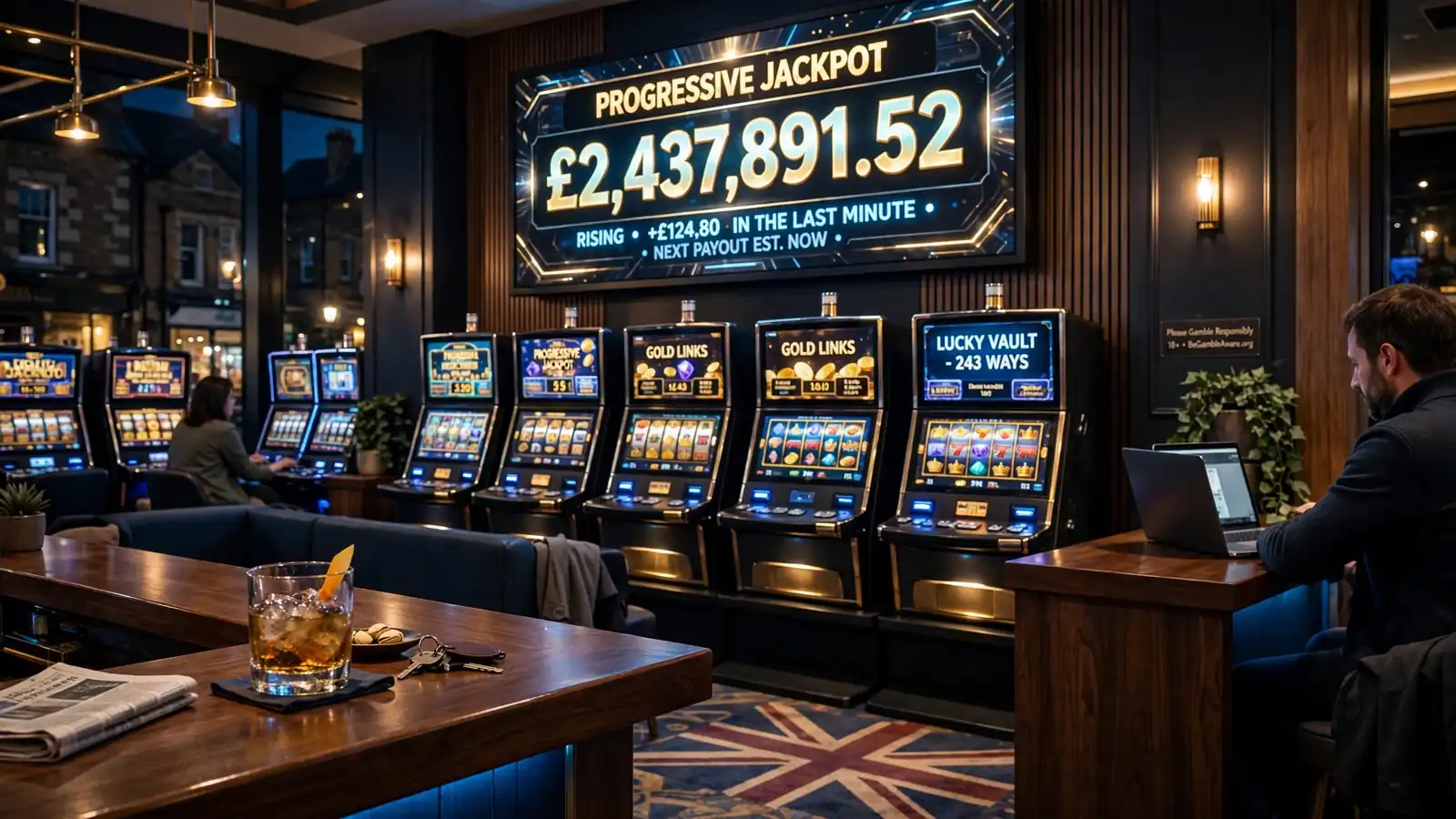
A progressive jackpot is funded by portions of wagers rather than by a fixed prize set once and left unchanged. As play takes place on connected slot machines, contributions are added to a shared pool. The displayed total can therefore grow while players wager, instead of representing a prize funded solely by one game session or one machine.
For progressive jackpot slots online in the UK, the key distinction is between the stake and the contribution taken from it. The whole wager does not go into the jackpot. A portion is directed to the pool, while the rest is handled within the game’s other payout arrangements. The contribution rate is typically between 1% and 3% of each wager. The exact rate is a feature of the game’s terms, not a universal setting that applies identically to every progressive slot.
That percentage has a straightforward effect on the pool’s funding. A wager produces a contribution calculated from its size and the game’s rate; repeated wagers produce further contributions. The pool accumulates those amounts across the connected machines running the game. A larger volume of play can mean contributions arriving from more wagers, but it does not turn the jackpot into a fixed payment from the operator. Its funding source is the connected play.
 Classic Slots Online UK: Demo Play and Real MoneyLearn how demo play works, what to check in a classic slot’s layout, and how online play differs when using deposited funds.
 Quickspin Online Casinos in the UK: What to VerifyLearn how to assess claims about Quickspin slots, UK casino availability, bonuses and play options; a UKGC licence does not verify each…
Some progressive jackpot slots operate across a network rather than on a single casino site. If multiple operators carry the same progressive slot game, the network pool can be shared across them. In that arrangement, qualifying wagers on connected machines at those operators contribute to the same jackpot pool.
This is why a network progressive jackpot can be larger than a prize funded by activity on one machine alone: its contributions can come from play across the connected network. The operator displaying the game is not necessarily the only source of money entering the pool. The relevant connection is between the game and its progressive network, not simply between a player and a particular casino catalogue.
The distinction matters when looking at a displayed jackpot. The amount shown may reflect contributions from connected play beyond the individual site where the game is open. A casino’s catalogue is the point of access to the game; it does not, by itself, define the full reach of the pool. Where the same progressive game is carried by more than one operator, those operators can share the network jackpot.
A standalone progressive pool and a network pool differ in the reach of their contribution base. In either case, the underlying mechanism is the accumulation of portions of wagers placed on connected machines. The network version extends that mechanism across operators carrying the same game. This describes where the jackpot money comes from; it does not establish how likely any individual wager is to receive it.
A contribution of 1% to 3% means that only that share of a wager is directed to the jackpot pool. It does not mean the same share is returned to a particular player, nor does it state how much any one person will receive over a session. It is a funding rate applied to wagers, not a personal forecast.
The same caution applies when comparing online slots with progressive jackpots. Two games may both be progressive but use different contribution rates or pool arrangements. A game’s label alone does not reveal whether its jackpot is limited to one machine or shared across a wider network. The contribution mechanism should therefore be understood as a property of the specific game and its connected pool, rather than inferred from the word “progressive”.
For a progressive jackpot slots site in the UK, the practical accounting question is whether the game’s pool is connected across operators or confined to a narrower set of machines. The funding principle remains the same: wagers on connected machines supply contributions. The scale of the network determines how broadly those contributions can be gathered; it does not change the fact that the pool is built from portions of play.
A list of progressive jackpot slots, whether video slots or newer releases, would not answer the funding question on its own. Titles can differ in how their pools are organised, and a name does not show the contribution rate or network reach. Those details belong to the game’s terms. No particular jackpot total, search for a “strategy”, or payment method changes the basic source of the pool: contributions from wagers on connected machines.
A progressive jackpot can be awarded through different trigger mechanisms. In one game, the award may be activated at random during play. In another, the player may need to land a specified combination or reach a bonus round before the jackpot can be won. These are different conditions for the event that pays the prize; neither should be mistaken for a general description of how often it happens.
With a random trigger, the jackpot is not necessarily tied to a particular visible symbol combination. The game’s rules determine how the random award is activated, and a winning event may occur without the base-game result looking like a conventional jackpot line. The relevant distinction is that the award is random, rather than dependent on landing a stated combination. Random does not mean that a jackpot is due after a period without a win: the trigger type alone does not provide a schedule.
Other progressive jackpots are linked to a defined game event. That may be a particular combination on the reels, or entry into a bonus round in which the jackpot can be awarded. In those cases, reaching the named combination or feature is part of the route to the jackpot. It does not mean that every bonus round pays the jackpot, unless the game rules expressly say so. The exact award condition belongs to the individual game’s rules, not to the word “progressive”.
This distinction matters when working out what “winning” requires. A spin can produce an ordinary game result without activating a progressive award. A bonus feature can also be relevant without being the jackpot itself. The rules should make clear whether the jackpot is available through a random event, a specified result, a bonus feature, or a combination of these. Treating all progressive slots as if they share one trigger would erase the condition that determines whether a particular result can pay the top prize.
There can also be a qualification condition attached to a jackpot tier. A specialist review has reported a case in which a random-trigger game required a minimum stake for eligibility for its highest jackpot level. That is a game-specific condition, not a rule that applies to every progressive slot. Where it exists, the stake condition affects access to that tier; it does not turn the random trigger into a guaranteed or scheduled award. The game’s own terms are the place to establish which stakes qualify and which prize levels are available.
A “must-hit-by” label can sound like a deadline, but the label alone is not enough to explain the trigger. The relevant terms would need to establish what event the phrase describes and what happens when the stated condition is reached. It should not be read as evidence that every progressive jackpot has a known countdown or that a win is imminent. A trigger can be random without giving a player a predictable point at which it will occur.
For the same reason, the trigger mechanism does not answer how often a progressive jackpot pays. Random activation describes the kind of event that can award it; it does not state its frequency. A required combination or bonus entry identifies a condition, not the likelihood of meeting it. Those are separate questions, and neither can be settled merely by knowing that a slot has a progressive jackpot. The practical test is narrower: identify the game’s award event, then check any qualification terms attached to the jackpot tier.
A progressive slot can show a return to player (RTP) figure that describes the base game, while a separate share of wagers contributes to its jackpot pool. For these games, the base-game RTP often falls in the 88%–92% range, with the difference in payout directed towards the jackpot pool. The figure therefore needs to be read as part of the game’s payout structure, not as a complete account of every possible return.
RTP is a theoretical measure of how much a game returns across play over time. It is not a forecast of what a particular session will return, and it does not specify when a jackpot will be won. A base-game RTP of 92%, for instance, is not a promise that a player will receive 92% of their stake back. Results in an individual session can differ, and the percentage does not tell how often a jackpot trigger occurs.
That distinction matters when comparing progressive slots RTP figures. A lower base-game return does not, by itself, reveal the odds of winning the progressive jackpot. Nor does the jackpot’s displayed value fill that gap: the amount available and the probability of a particular outcome are different measures. To assess jackpot odds, the game’s rules would need to state how the jackpot is triggered and what conditions apply. RTP alone cannot supply that information.
The jackpot contribution also should not be treated as an additional guaranteed return for each player. It is part of the game’s payout design: wagers feed a shared pool, while the base game has its own theoretical return. The pool can grow without indicating that an individual player’s chance of winning has increased in any measurable way. A larger prize is a larger potential award, not evidence of a more favourable probability.
This is why a list of progressive slots, or a comparison based only on headline RTP, cannot establish which game offers the best chance of a jackpot. The RTP range gives mathematical context for the base game and the contribution mechanism; it does not rank games by jackpot odds. A game’s information should be read for the specific jackpot rules as well as its RTP, keeping those two figures conceptually separate.
The same caution applies to searches for progressive slots with crypto in the UK: a payment method or a jackpot display does not explain the game’s return or odds. The relevant measures remain the base-game RTP and the stated jackpot conditions. Neither should be substituted for the other, and neither turns a theoretical percentage into an individual result.
Progressive slots for UK players are found through individual casino catalogues, not a single complete market-wide list. A specialist review reports that availability differs between operators and can change as providers update their games. A title appearing in a review or an older catalogue snapshot is therefore not proof that it is currently available at a particular casino.
A practical way to look is to search the casino’s games area for “progressive” or “jackpot”, then check the individual game listing. Some catalogues group games by feature or provider; others rely on a search field or display a broader collection without a dedicated progressive category. These are catalogue layouts, not guarantees that every relevant game is included or labelled consistently.
The listing should be treated as a current snapshot. If a game is not visible, that may mean it is absent from that operator’s range, has been moved within the catalogue, or is no longer offered there. If it is visible, the game’s own information and the operator’s terms are the appropriate places to confirm what applies before play. A name in a third-party article cannot settle either point.
A catalogue can help identify games available through that operator at the time of checking. It does not establish that the same title is offered across UK casinos, nor that a list described as the most popular progressive slots in the UK reflects a complete or current market view. Popularity claims need a defined basis; a selection in a casino lobby is simply that operator’s selection.
Free-play access also needs to be checked at the game level. A casino may provide a free-play option for some titles and not others, and a progressive game’s presence in a catalogue does not by itself show that it can be played for free. The listing or game information should make the available mode clear. Promotional spins are a separate matter and should not be assumed to reproduce the conditions of real-money play.
“How to play” information is usually attached to the game or its rules screen. That is where the controls, paytable and relevant game conditions can be reviewed. The catalogue can locate a title; it is not a substitute for its rules. Likewise, broad tips about progressive slots cannot establish whether a specific game suits a particular budget or objective. That depends on the game terms and the player’s own limits, not on a label such as “popular”.
Whether progressive slots are worth playing is not answered by a catalogue ranking. Availability answers a narrower question: where a title can currently be accessed. It does not show that the game is better value, more likely to pay, or preferable to another slot. Those are separate assessments and should not be inferred from prominent placement or inclusion in a list.
For a reliable check, use the casino’s current catalogue and the game’s own information, then confirm that the title remains listed when play is about to begin. The catalogue may change; a recommendation written earlier cannot freeze it in place.
A “best” list suggests that the games have been assessed against the same criteria and that the result will remain useful. Neither assumption is safe for progressive slots. Availability differs between operators, and providers update their catalogues. A specialist review has noted this changing availability; its observation describes a moving catalogue, not a permanent market-wide selection.
A comparison is more useful when it records what is actually shown for each game at the time it is checked. That means separating game information from promotional language and avoiding a single score that conceals differences in terms. A title may be available through one operator and absent from another, so a comparison based on a single catalogue cannot establish a universal order.
The first question is whether the games are being compared on the same basis. A real-money game and a free-play version do not necessarily present the same conditions. Free access can show how a game looks and feels, but it should not be treated as proof of the terms that apply to real-money play. The relevant operator’s game information remains the point of reference for those terms.
The same caution applies to descriptions such as “mystery progressive”. The label alone does not establish how a particular game works or what conditions apply. Comparisons should use the information attached to the individual title rather than assuming that games with similar labels share identical rules.
A practical comparison can keep several observations separate:
These points produce a record that can be checked and updated. They do not produce a defensible “best progressive slots in the UK” ranking by themselves. A ranking needs a stated basis, and the basis needs to match the claims made about the games. If the assessment is only about screen layout, for instance, it cannot support a broader verdict about value or suitability.
Catalogue changes make dates matter. A list assembled from one operator’s offering can become incomplete when that operator or a provider changes its selection. A title missing from one catalogue may still appear elsewhere; its absence is not evidence that it has been withdrawn across the market. Conversely, a listing is not a promise that the game will remain available.
For that reason, a short comparison table can be more honest than a winner-and-runner-up format. It can state where a title was found, what information was available, and the date of the check. Where the catalogue or terms later change, the entry can be revisited without pretending the earlier comparison was timeless.
No single game needs to be named as the strongest choice for every player. The useful distinction is between a comparison that explains its limits and a ranking that hides them. In a changing catalogue, the former remains informative even when an individual listing becomes outdated.
Free spins are promotional play, not a separate route into a progressive jackpot. A spin may look identical to one funded with cash, but the promotion’s terms determine whether winnings can be withdrawn and which games qualify. A free-spin balance should therefore be valued by its conversion rules, not by the headline number of spins.
A specialist review reports that winnings from free spins on progressive slots can be capped at £50–£100, and that most free-spin offers are limited to non-progressive games. That is a report of offer terms, not a rule applying to every UK casino or promotion. The cap may make a large displayed win worth less in cash than its on-screen figure suggests; the game restriction may rule out progressive slots altogether. The promotion’s own terms are decisive.
This distinction matters when looking for free progressive slots in the UK. A free-spin offer is not evidence that the same spins can be used on a progressive game. Nor does a free-play mode, where available, establish that real-money jackpot features are active. Promotional spins and real-money play can have different eligibility rules, and a jackpot mechanic should not be assumed to carry over simply because the game title is the same.
The practical calculation has two parts: which games accept the offer, and what happens to any winnings. A cap limits the amount that can be retained, while a game exclusion limits where the spins can be used. If a promotion excludes progressive slots, its value for someone interested specifically in those games is nil, regardless of the number of spins advertised. If progressive play is permitted, the terms still need to be checked for a winnings cap and any other stated restrictions.
No-deposit bonuses require a separate calculation. A specialist review reports wagering requirements of 40x–60x for no-deposit offers, alongside maximum withdrawal caps of £50–£100. These are reported terms, not universal conditions. A wagering requirement means the bonus or associated winnings must meet the stated play-through condition before withdrawal; the withdrawal cap then limits the amount payable even if the balance is higher. The final value depends on both conditions, not on the bonus label.
The phrase “free online progressive slots” can refer to different things: promotional spins, a game’s free-play mode, or a real-money progressive slot being offered without a deposit. Those are not interchangeable. Free spins may be restricted to non-progressive games, while a demo mode should not be treated as proof of eligibility for a cash jackpot. Any claim that a free offer includes progressive play needs to be supported by the specific promotion terms.
That also answers whether progressive slots are “better” for free play: the label alone does not establish value. A progressive jackpot may be part of the real-money game, but a promotion’s cap or game restrictions can remove that feature from the offer. A larger spin count is not a substitute for knowing the eligible games and the withdrawal limit.
The useful comparison is therefore between the offer’s usable features and its conditions: permitted games, treatment of winnings, and any cap or wagering requirement. For a free-spin offer, a short list of restrictions can outweigh the promotional headline. The advertised amount is only the starting figure; the payable amount is governed by the terms.
Playing progressive slots for real money involves more than the balance shown in the game. Deposits, withdrawal processing and account limits are separate parts of the arrangement, each governed by the operator’s terms and account controls. The jackpot mechanics do not change how a withdrawal is requested or how a UKGC-licensed operator must provide safer-gambling tools.
A specialist review reports debit-card withdrawals taking one to three working days, e-wallet payments taking hours, and bank transfers taking three to five working days or longer. These are reported timeframes, not a guaranteed service standard for every operator. Processing can depend on the payment method, account checks and the operator’s own procedures. A displayed balance is therefore not necessarily money already available in a bank account.
These timeframes are reported indications and not guaranteed service standards for every operator.
Large progressive wins may involve additional verification and, under some terms, payment in structured instalments over several years. That possibility makes the withdrawal conditions material before play, rather than a detail to inspect only after a win. The account holder’s identity and payment details may also need to be checked before a withdrawal is completed. Operators must verify age before allowing a customer to deposit.
UKGC-licensed operators must offer tools for managing gambling activity. These include deposit limits, loss limits, session reminders and self-exclusion, alongside access to support resources. New customers must be prompted to set a financial limit before their first deposit, and account-level limit controls must remain accessible. These are account features, not a progressive-slot strategy: they do not alter the game’s rules or improve the likelihood of a jackpot.
Limits have practical value only when their settings are understood. A deposit limit concerns money added to the account; a loss limit concerns losses; a session reminder draws attention to time spent playing. Self-exclusion is a stronger restriction on access. The specific operation of each tool is set out by the operator, so the terms should be read before relying on a particular setting.
Credit cards cannot be used for gambling with UKGC-licensed casinos, including where credit-card funds are routed through a money service business. Operators also cannot accept wallet payments where the wallet permits credit-card funds to be used for gambling. Payment methods are therefore not interchangeable simply because they appear in an account menu.
For real-money progressive slots in the UK, the useful comparison is between the payment route, its stated processing conditions and the account controls available—not an assumption that every withdrawal follows the same timetable. The figures reported by a specialist review provide an indication, while the operator’s own terms determine the process for a particular account.
When choosing a UK site for progressive slots, it helps to check practical details as well as the games on offer. This reference highlights the payout-speed information available for each operator.
Britsino
Britsino lists a payout speed of 1–3 business days. That is the available practical detail for considering it for progressive slots.
Zombillion
Zombillion lists a payout speed of 1–3 business days. This gives a useful payout-time reference when assessing it for progressive slots.
SlotoSport
SlotoSport lists a payout speed of 1–3 business days. This is the available detail to keep in mind when considering it for progressive slots.
Chanze
Chanze lists a payout speed of 1–3 business days. This provides a practical payout-time reference for players considering progressive slots.
Dieselwin
Dieselwin lists a payout speed of 1–3 business days. That is the available information relevant to its place in this progressive-slots list.
NightLuck
NightLuck lists a payout speed of 1–3 business days. This offers a straightforward payout-time detail for anyone considering it for progressive slots.
WinBeast
WinBeast lists a payout speed of 1–3 business days. This is the available practical information for assessing it as a progressive-slots option.
x3bet
x3bet lists a payout speed of 1–3 business days. This gives players a payout-time reference when considering progressive slots.
Amunbet
Amunbet lists a payout speed of 1–3 business days. That is the available detail to consider alongside its relevance to progressive slots.
EvoSpin
EvoSpin lists a payout speed of 1–3 business days. This provides a practical payout-time reference for players looking at progressive slots.
Progressive slots sit within the wider UK online gambling market: the jackpot feature belongs to the game, while the gambling service that makes it available falls within the country’s regulatory framework. The UK Gambling Commission oversees gambling activity across the United Kingdom, including online casino services. For remote gambling offered to consumers in Great Britain, its remit applies whether the operator’s key equipment is based locally or elsewhere.
That distinction matters in a market where online services can be run from outside the country. The location of the equipment does not, by itself, remove a remote gambling service from the Commission’s oversight when it is offered to consumers in Great Britain. Regulatory responsibility follows the service and the market it serves, rather than simply the address of the computer systems behind it.
The Commission’s role is regulatory, not editorial. It does not make a particular progressive slot a permanent fixture of the market or endorse a game’s commercial terms. Its remit concerns gambling activity and the businesses providing it. A game’s presence in an online casino catalogue is therefore a separate matter from the regulator’s responsibility for the remote gambling service.
It does not alter the basic distinction between a game feature and the regulatory framework around the operator offering that game. Progressive jackpot slots may be presented through online casinos, but the relevant regulatory question concerns the gambling service made available to consumers in Great Britain, not where the jackpot pool or game software is hosted.
The UK market also needs precise geographical language. The Commission regulates gambling activity in the United Kingdom, while the stated remote-gambling scope specifically covers services offered to consumers in Great Britain regardless of equipment location. Those descriptions should not be collapsed into a claim that every part of the UK has identical arrangements. For online casino play, the practical point is that the regulator’s reach over remote services is not determined solely by the operator’s physical infrastructure.
“Penny progressive” describes a progressive jackpot slot associated with small-stake play. The phrase combines two ideas: “penny” points to the scale of play, while “progressive” refers to a jackpot that can grow as qualifying wagers contribute to a shared pool.
The label does not, by itself, specify the stake required for a spin or establish that every stake qualifies for every jackpot tier. Those conditions depend on the individual game’s rules. A penny-style description is therefore not a complete statement of the game’s terms, and it should not be read as confirmation that a particular bet is enough to access a particular prize.
Progressive penny slots online in the UK still follow the same broad contribution principle as other progressive jackpot slots. A portion of each wager is directed to the jackpot pool; the stated contribution range is 1%–3% per wager. That percentage describes how the pool is funded, not a player’s chance of winning or the amount returned on any individual spin.
The distinction matters when comparing the label with the actual game information. A small-stake association does not mean that the jackpot is small, that the contribution rate is lower, or that all stake sizes have identical eligibility. Those details cannot be inferred from the words “penny progressive” alone.
In practical terms, the phrase is useful as a general description, not as a specification. The game’s own rules determine the available stakes, how contributions are handled and which conditions apply to jackpot participation. Without those details, “penny” says something about the style of play being described; it does not settle the financial terms.
The distinction between progressive and non-progressive slots concerns the prize structure, not the licensing status of the casino. A progressive jackpot can increase as play contributes to a shared prize pool. A non-progressive slot has no jackpot that grows in this way; its prizes are determined by the game’s own paytable and features.
That difference does not make one category less subject to regulation. Commercial gambling in Great Britain is regulated by the UK Gambling Commission, which is the sole regulator for that activity. An online casino offering real-money play to customers in Great Britain must hold the relevant Commission licence. The same licensing framework applies whether its catalogue includes progressive casino slots, non-progressive slots or both.
The Commission issues operating licences to businesses and personal licences to individuals working in specified roles in the industry. These are different permissions: an operating licence authorises a business to provide gambling facilities, while a personal licence applies to an individual’s regulated work. A game’s progressive label does not replace either requirement, and a provider’s name is not a substitute for the operator’s licence.
For comparisons of progressive slots versus non-progressive slots, the useful question is therefore twofold: how the game’s prize structure works, and whether the casino offering it is authorised to serve the Great Britain market. The first is a feature of the game; the second is a matter of regulatory status. Confusing the two can make a large advertised jackpot look like evidence of legitimacy. It is not.
The Gambling Commission’s remit here is commercial gambling in Great Britain. That geographic scope matters: the licensing statement should not be stretched into a claim about every part of the United Kingdom. For a real-money casino, the relevant check is the operator’s status with the Commission, rather than whether a particular slot is progressive or how its jackpot is presented.
Debit card withdrawals typically take 1–3 working days, e-wallets can take hours, and bank transfers often take 3–5 working days or longer. Large jackpot wins may require extra verification and can be paid in instalments over several years.
No. Game availability varies by operator and changes as providers update their catalogues, although the same game may connect operators to a shared network jackpot.
Check the game’s jackpot contribution rate, whether its pool is standalone or shared across a network, and how the jackpot is triggered. Also check whether a minimum bet is required to qualify for the highest jackpot tier.
It depends on the game: some random-trigger progressives require a minimum bet to qualify for the highest jackpot tier. Check the game’s rules to see which stake levels qualify.
Remote gambling offered to consumers in Great Britain is regulated by the UK Gambling Commission, which issues operating licences to businesses and personal licences to individuals. Licensed operators must also offer responsible gambling tools such as deposit and loss limits, session reminders and self-exclusion.