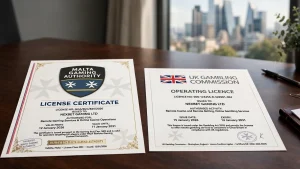
A licence identifies the regulator overseeing an operator, but it does not establish permission to serve customers in Great Britain.

A Curaçao casino licence and a UK Gambling Commission licence are not interchangeable credentials. They come from different regulatory systems and carry different meanings. A site operating under a Curaçao licence is not, on that basis, regulated by the UK Gambling Commission.
In this context, a non-UK-regulated casino is an online gambling site operating without oversight from the UK Gambling Commission. Such sites may hold a licence from another jurisdiction: Malta, Curaçao, Gibraltar and Anjouan are among the places that license online gambling operators. The location named on a licence therefore identifies a regulator outside the British system; it does not establish UKGC approval.
The distinction matters because a licence is tied to the authority that issued it. A Curaçao casino licence may describe the operator’s regulatory status in Curaçao, but it does not answer whether that operator is authorised to serve customers in Great Britain. Those are separate questions, not two descriptions of the same permission.
For operators serving customers in Great Britain, the requirement is a UK Gambling Commission licence, regardless of where the business is based. A company does not meet that requirement merely by being incorporated overseas, holding a foreign licence, or displaying a licensing statement on its website. The relevant point is the licence required for the British market, not the distance between the operator and its issuing authority.
For a UK reader researching Curaçao-licensed casinos in 2026, payout speed is one practical detail to check when considering an operator. The entries below note the stated withdrawal timeframe for each.
Britsino
Britsino lists payouts as taking 1–3 business days.
Zombillion
Zombillion lists a payout speed of 1–3 business days.
SlotoSport
SlotoSport states that payouts take 1–3 business days.
Chanze
Chanze gives a payout timeframe of 1–3 business days.
Dieselwin
Dieselwin lists payouts as taking 1–3 business days.
NightLuck
NightLuck states a payout speed of 1–3 business days.
WinBeast
WinBeast gives a payout timeframe of 1–3 business days.
x3bet
x3bet lists payouts as taking 1–3 business days.
Amunbet
Amunbet states that payouts take 1–3 business days.
EvoSpin
EvoSpin gives a payout speed of 1–3 business days.
That is the central distinction behind searches for a Curaçao casino licence in the UK: a Curaçao licence is not a substitute for a UKGC licence. A site can be licensed elsewhere and still sit outside UKGC oversight. Conversely, the fact that a site has a foreign licence does not by itself establish that it holds the permission required to serve Great Britain.
The phrase “Curaçao casinos UK” can blur these categories. It may refer to casinos licensed in Curaçao that are visible to people in Britain, but visibility does not change the regulator named on the licence. Nor does the word “licensed”, without its context, identify which authority issued the licence or what market the operator is permitted to serve. The label answers only part of the regulatory question.
The same distinction applies when a casino advertises itself as a Curaçao-licensed casino, whether it offers conventional payment methods or Bitcoin. The payment method does not turn a foreign licence into UKGC approval. Licence, regulator and permission for the British market remain distinct matters.
This baseline prevents a common accounting error: treating any licence as though it were a universal operating permit. The issuing jurisdiction and the market being served are separate entries in the calculation. A Curaçao licence can indicate regulation outside the UK system; it does not, by itself, establish that the operator holds the licence required to serve customers in Great Britain.
A Curaçao-licensed casino site may present slots alongside table games, live games and welcome promotions. Book of Dead and Starburst are familiar slot titles, but a game’s presence says little about the value of a bonus attached to it. The decisive figures are the wagering requirement, which balance it applies to, the games that count towards it and any cap on winnings.
A specialist review reports offshore welcome offers with wagering requirements of 35x or more. That figure is not a standard applying to every offer; terms vary by operator and can change. A separate offer structure described in specialist reviews uses a 40x requirement, but the multiplier may apply to the bonus and deposit together, to the bonus alone, or to the bonus and free spins together. The same multiplier can therefore produce a different qualifying balance, depending on the wording.
The distinction matters before any slot result is counted. If wagering applies to the deposit as well as the bonus, the balance subject to play-through is larger than if only the bonus counts. If a game contributes only partly—or does not qualify—the visible balance may not advance towards the requirement as expected. The terms, rather than the advertised bonus amount, determine what must be played through before winnings become withdrawable.
Free spins have their own arithmetic. A specialist review reports that winnings from them may carry wagering requirements of 30–50 times those winnings, alongside withdrawal caps of £5–£50. These are reported offer conditions, not universal limits. A cap can make the maximum payable amount smaller than the balance shown after the spins; completing wagering does not remove a separate cap.
Expiry is another cost. A specialist review describes free-spin packages that expire within 24–72 hours. Where such a deadline applies, unused spins or unfinished wagering may lose value when the period ends. The offer’s expiry, qualifying games and treatment of remaining winnings should be read together, not as isolated promotional details.
A useful comparison is therefore not “bonus versus no bonus” but cash available without conditions versus funds tied to play-through. A large headline figure can require more qualifying play, apply to a broader balance or restrict the amount ultimately withdrawable. The stated terms set the calculation; the promotional label is packaging.
GamStop is the UK Gambling Commission’s self-exclusion scheme. A casino that is not part of it does not receive GamStop’s exclusion status and is not covered by the scheme’s barrier to gambling. That distinction matters: self-exclusion through GamStop should not be treated as a block on access to a Curaçao casino or another non-UK-regulated casino.
“Not on GamStop” describes a separation between systems, not a special exemption granted to an individual casino. Casinos outside the scheme do not become part of it because a customer has self-excluded in Britain. A person who has registered with GamStop therefore cannot assume the exclusion will carry across to a separate operator that is not enrolled.
The same distinction applies to labels such as “outside GamStop” or “not regulated by GamStop”. GamStop is a self-exclusion service, not a casino regulator. Its absence does not establish what licence a site holds, what responsible-gambling controls it offers, or how effectively those controls work. Those are separate questions. A site’s use of a Curaçao licence claim does not, by itself, place it inside the UK scheme.
Self-exclusion is intended to restrict access to participating gambling services. Where an operator is outside GamStop, the scheme cannot be relied on to impose that restriction there. That does not mean every non-UK-regulated casino has identical account controls. It means GamStop itself does not supply the boundary.
Any controls offered by an individual operator are therefore distinct from GamStop. The terms, availability and practical effect of those controls may vary, and they should not be treated as a continuation of a UK-wide exclusion. A request made through one system does not automatically create a restriction in another.
This is consequential for anyone using exclusion to manage gambling. If a person needs a reliable barrier across participating UK sites, a casino outside GamStop is outside that arrangement. Searching for a new Curaçao casino that is not on GamStop does not change that boundary; it identifies a site beyond the scheme rather than one covered by it.
Non-UK-regulated casinos may apply less stringent responsible-gambling and data-protection rules than operators licensed by the UK Gambling Commission. The practical difference is not simply the absence of a GamStop logo. Players at offshore casinos also lose access to mandatory responsible-gambling tools associated with UK-regulated services and to the UK’s Financial Ombudsman Service.
That leaves fewer standardised protections if an account-control issue arises. A site may describe its own limits or exclusion process, but those arrangements are not the same as tools required within the UK regulatory system. Their existence on a particular site should not be mistaken for equivalent oversight, and a complaint cannot be routed through the UK’s Financial Ombudsman Service on the basis that the operator is outside that system.
Data protection is another part of the difference. Less stringent rules may apply, so the handling of account information is not necessarily governed by the same requirements as at a UKGC-licensed operator. The licence label and the payment options do not answer that question.
A welcome offer or no-deposit promotion does not alter the position. Promotional terms concern the offer; they do not add GamStop coverage or restore UK responsible-gambling protections. The financial terms of bonuses belong to a separate calculation, and should not be confused with the protections attached to a regulated account.
The practical test is therefore not whether a Curaçao casino calls itself “GamStop-free”. It is whether the service falls within the exclusion system and what protections remain outside it. For a person relying on GamStop, the answer is direct: a non-UK-regulated casino that is not enrolled is not blocked by that self-exclusion. No claim about an operator’s own controls changes the scope of the scheme.
The legal position depends on which side of the transaction is being considered. Under the Gambling Act 2005, the regulatory target is the operator supplying gambling services into the British market. A remote operator serving customers in Great Britain must hold a UK Gambling Commission licence, wherever its business is based. A licence issued elsewhere does not replace that requirement.
That obligation falls on the business, not on an individual player. UK law does not make it a criminal offence for a player to use an unlicensed gambling site. Nor does it expressly bar British citizens from using gambling services licensed in another country. Those points describe player liability; they do not convert an overseas site into a lawful UK operator.
This distinction matters when a Curaçao-branded casino appears to accept registrations from the UK. Access to a website, or the ability to open an account, is not evidence that its operator is entitled to serve the British market. A site may be reachable while remaining outside the UK regulatory system. The wording “for UK players” on a page or in an offer cannot settle the operator’s licensing position.
The same separation applies to a Curaçao crypto casino. A cryptocurrency payment option changes the payment channel, not the operator’s UK obligations or the player’s protections. It should not be read as a legal workaround. Whether a site accepts deposits from a particular location is also a practical matter that can change; availability does not establish approval.
For a player, the absence of criminal liability is a narrow point, not a recommendation. It does not guarantee that a foreign operator will honour its terms, provide a local complaint route or resolve a dispute in the same way as a UK-licensed business. The regulator responsible for an overseas licence is not the UK Gambling Commission, and a UK player should not assume that UK regulatory processes apply to the account.
The distinction is therefore straightforward: UK rules place the licensing duty on operators serving Great Britain, while the cited law does not impose a criminal penalty on players for using an unlicensed site. Neither statement endorses offshore gambling. Before using any service based abroad, players remain responsible for checking the laws that apply to them and understanding the implications of dealing with an operator outside the UK system. A casino that accepts UK traffic is not, on that fact alone, a casino authorised to serve the UK.
A Curaçao gambling licence and a UK Gambling Commission licence are different authorisations. A casino may hold a licence from Curaçao while operating outside UKGC oversight; the foreign licence does not become UK approval because it is displayed on the site. Operators serving customers in Great Britain need a UKGC licence, regardless of where they are based.
A licensing badge therefore answers a limited question: does the named operator claim permission from the jurisdiction shown? It does not establish that the casino is authorised to serve Great Britain, or that the UKGC supervises its conduct. The same distinction applies to a Curaçao gaming licence described as “international” or presented alongside other seals. The wording is not the authorisation.
Before relying on a claim, check the regulator’s public licence register rather than treating a logo or certificate image as proof. The entry should be current, its expiry date should not have passed, and the company named in the register should match the entity operating the casino. A brand name and a legal company name can differ, so the relationship needs to be clear in the operator’s own terms or licence details.
A missing, expired or mismatched entry leaves the claim unverified. So does a register result for a company that cannot be connected to the casino. The distinction matters: a licence belonging to another entity does not establish that the site itself holds that licence.
Curaçao eGaming casinos should be assessed on the same basis. The regulator’s name on a footer is not a substitute for a matching public record. If the register does not confirm the relevant company and current status, the label alone cannot settle the question.
Curaçao casino ratings may summarise a reviewer’s view of a site, but a score cannot replace a regulator’s record. Ratings can also mix separate issues—such as games, payments and customer service—with licensing. Those are not interchangeable measures. A high rating does not prove UKGC approval, while a Curaçao licence does not validate every claim made in a review.
For the question of whether a Curaçao casino is legal in the UK, the controlling distinction is the operator’s permission to serve the British market, not the existence of a foreign licence. Curaçao authorisation can identify a claimed regulatory basis outside the UK system; it cannot supply the UKGC authorisation required for operators serving Great Britain. Treating the two as equivalent turns a jurisdiction label into a conclusion it does not support.
A list labelled “Curaçao-licensed crypto casinos” can combine two separate claims: that an operator holds a Curaçao licence, and that it accepts cryptocurrency. Neither claim establishes the other. A licence does not, by itself, confirm which payment methods are available, while a crypto option does not demonstrate that a casino is licensed or that its licence provides meaningful protection to a player.
The wording on a site or in a review is therefore only a starting point. A “licensed” label is an operator’s claim until it is checked against the relevant licensing information. Even if the claim is accurate, it should not be treated as evidence that the casino has UK Gambling Commission approval. A Curaçao licence and a UKGC licence are different regulatory statuses; the first does not substitute for the second.
That distinction matters when a list presents several brands together as though they shared a standard set of protections. The entries may use different companies, payment processors and terms. A list can help identify names to investigate, but it cannot establish that each operator has the same licensing position, complaint route or safeguards. Nor does a favourable review turn a payment method into a guarantee that deposits and withdrawals will work on the same terms.
Non-UK-regulated casinos may accept payments by card, e-wallet, bank transfer or cryptocurrency, sometimes using alternative processors. The available methods can vary between operators and may change. A payment logo or a mention of crypto in a review is not proof that a particular method will be available to every customer or accepted for every transaction.
Cryptocurrency has a specific UK payment caveat: it can be used to get around the ban on credit-card-funded gambling. That describes a route by which a payment may be made; it does not make the transaction safer, confer UK regulatory protection or change the casino’s licensing status. Crypto should not be read as a substitute for a licence, a complaints process or responsible-gambling safeguards.
The same caution applies to a search for casinos accepting Paysafecard. A named payment method is a feature claim, not a regulatory credential. Payment availability alone says nothing about whether an operator is authorised to serve customers in Great Britain, or what recourse exists if a payment or account dispute arises. The method and the regulatory position need to be considered separately.
For a player using an offshore casino, the practical cost of being outside the UK system is not limited to uncertainty about payments. Access to the UK Financial Ombudsman Service does not extend to disputes with such operators, and the mandatory responsible-gambling tools required in the UK system are not available there. A list that records licences and payment logos may not make this difference visible.
That gap is especially relevant where a casino is promoted as “safe” because it has a licence or supports cryptocurrency. Those labels do not establish that a player can use UK complaint channels, or that the protections attached to UK-regulated gambling apply. A licence claim may describe a regulatory relationship; a crypto option may describe a way to transfer funds. Neither settles what happens when a disagreement arises or when a player needs tools to control gambling.
Reviews also have limits. They can describe features or report an assessment, but they are not a regulator’s confirmation of current authorisation. A list may become out of date as terms, payment processors or available methods change. It can also place operators side by side without showing whether their underlying arrangements are comparable. The neat format is not evidence of a neat market.
For that reason, a list should not be treated as a recommendation or as a complete safety assessment. The relevant questions are distinct: what licensing status is claimed, what payment methods are actually offered, and what protections and complaint routes apply. Crypto answers only part of the payment question. It does not answer the regulatory or consumer-protection questions.
A Curaçao-licensed casino may offer cryptocurrency, another payment method, or no crypto option at all. A casino that accepts crypto may make a licensing claim that still requires separate scrutiny. Combining the two into one label does not remove those distinctions. For UK players, the decisive limitation remains that an offshore licence and a payment option do not provide access to the protections of the UK regulatory system.
Skrill, Neteller and Trustly may appear in payment information for Curaçao casino sites, but none should be assumed to be available. A method shown for deposits may not be permitted for withdrawals, and the payment route can depend on the operator and the account. The relevant figure is not simply how quickly money can be put in; it is whether the same method can receive a payout and what conditions apply.
Non-UK-regulated casinos may set fewer restrictions on deposits and withdrawals, which can allow payouts to move faster. That flexibility is not a guaranteed service standard. Published accounts of withdrawal timing also disagree: some describe processing from 24 hours to 5 business days, depending on the payment method, while others report waits of up to three or four weeks. With no regulatory clock to enforce a deadline, the faster estimate is not a reliable promise.
The payment page and withdrawal terms therefore need to be read together. Check whether the chosen method is available for both directions, whether identity checks must be completed first, and whether the operator can require a different payout route. A successful deposit confirms only that funds reached the account; it does not establish that a withdrawal will follow the same path or on the same timetable.
A specialist review reports that some operators set daily, weekly or monthly withdrawal caps, meaning a larger balance may have to be paid in instalments. That is a claim to verify against the specific casino’s current terms, not a universal feature of Curaçao sites. Where a cap applies, the total balance and the amount payable at each interval are separate figures.
Payment convenience can obscure the final cash flow. Before depositing, the useful comparison is between the accepted deposit route, the eligible withdrawal route, any stated cap and the operator’s processing conditions. If those terms are unclear or differ across pages, the apparent ease of funding an account says little about access to its balance.
A licence can establish that an operator is subject to a regulator’s rules. It does not, by itself, establish that those rules provide the same protection as the UK system, or that a player will recover money if the business fails. “Legitimate” and “safe” are not interchangeable: a licence claim concerns formal status; safety depends on what protections apply in practice.
For a non-UK-regulated casino, responsible-gambling requirements and data safeguards can be less demanding than those imposed on a UK Gambling Commission-licensed operator. The difference matters when a player needs tools to control gambling or when personal information is handled. A licence should not be treated as evidence that UK-standard safeguards are available.
The complaint route is another practical test. A player using a non-UK-regulated casino cannot take a dispute to the UK regulator’s complaints process or rely on the UK’s Financial Ombudsman Service. The regulator named on a licence may have a narrower role, and the existence of a formal authority does not guarantee independent mediation or a remedy for an individual customer. A dispute can therefore remain between the player and the operator.
There is also a financial distinction between a recorded balance and recoverable funds. Under Anjouan’s framework, player funds need not be kept separate from the operator’s money. If the operator fails, players are unsecured creditors, rather than holders of protected, segregated funds. That is a material exposure, not a technical detail about licensing.
A sound assessment therefore separates three questions: whether a licence exists, what safeguards its rules require, and what happens if the operator refuses a complaint or becomes insolvent. A positive answer to the first question does not settle the other two. A licence may be real and still leave substantial gaps in consumer protection; the financial value of the label depends on the remedies and protections behind it.
Anjouan casino licence claims need to be read within the limits of the framework that issued them. A public register check can help establish whether a licence entry exists, whether it is current and whether the named company matches the operator’s claim. Those are useful identity and status checks. They do not establish that the casino is authorised to serve customers in the United Kingdom, that player funds are protected if the operator fails, or that an independent body will resolve a dispute.
The distinction matters for anyone comparing Anjouan-licensed operators with Curaçao online casinos. A licence from one jurisdiction is not evidence of approval from another, and the terms are not interchangeable. An Anjouan licence does not authorise operation in the United Kingdom or in other markets the framework lists as restricted. A register entry therefore cannot turn a restricted-market service into an authorised one.
The first checks are documentary: locate the public entry, confirm that it remains in force, and compare the company name against the one presented on the casino site. A mismatch, missing entry or expired status undermines the claim itself. A match supports only the conclusion that the licence record and operator details correspond; it does not certify every aspect of the site’s conduct.
That limit is easy to miss because a formal entry looks conclusive. It is conclusive only about what the entry records. It does not prove that games have been independently tested, that the operator’s financial controls are adequate, or that customers can recover money after a failure. Those require protections that a register search alone cannot supply.
Anjouan’s framework does not require casinos to arrange random-number-generator testing, undergo audits or keep player funds segregated from operating money. The absence of a requirement is not proof that every operator skips those steps. It means the licence framework does not make them a condition that can be relied on across the board. Without mandated segregation, a player’s balance is not shown by the licence itself to be held separately for repayment.
If the operator becomes insolvent, that distinction has a direct financial consequence: players are unsecured creditors rather than holders of a guaranteed claim on ring-fenced funds. The licence entry does not change that position. A balance displayed in an account is a record of an amount owed, not evidence that the corresponding cash is reserved.
The framework also does not provide an independent dispute-resolution route comparable to the approved services available under UK regulation. Anjouan’s authority does not handle, mediate or adjudicate player complaints. The operator is required to respond to a complaint within 30 calendar days, but a response deadline is not the same as an independent decision, and it does not guarantee a favourable outcome or payment.
That makes the complaint path materially different from an external adjudication process. If the operator rejects a claim, fails to resolve it, or interprets its own terms in a way the customer disputes, the Anjouan licence does not supply an equivalent independent forum to determine the matter. The procedure is therefore a channel for raising an issue with the operator, not a substitute for an outside ruling.
Lists of the best Curacao online casinos may compare visible features, but those labels do not resolve the separate question of what an Anjouan casino licence guarantees. Nor does a licence claim establish the suitability of an operator for customers in a restricted market. A ranking cannot add audit duties, fund segregation or independent complaint adjudication where the licensing framework does not require them.
For a comparison between an online casino associated with Curaçao and one licensed in Anjouan, the practical questions remain jurisdiction-specific: which entity holds the licence, whether its record is current, which markets the licence excludes, and what remedies exist if a balance or complaint is contested. Similar branding or overlapping game catalogues do not make the legal protections equivalent.
A careful register check can rule out some basic misrepresentation. It cannot turn an Anjouan entry into a guarantee of fair testing, protected balances, or independent complaint review. Those are separate protections, and under this framework they cannot be inferred from the licence alone.
Not necessarily. Offshore welcome offers may have wagering requirements of 35x or more, and free-spin winnings may carry further wagering requirements and withdrawal caps, so compare the terms as well as the headline bonus.
UK law does not explicitly prohibit British players from using gambling services licensed abroad, and players do not commit a criminal offence by gambling on an unlicensed site. However, operators serving customers in Great Britain require a UK Gambling Commission licence, and a site outside GamStop does not provide GamStop’s self-exclusion barrier.
Anjouan issues casino licences, but an Anjouan licence does not authorise an operator to serve customers in the United Kingdom. It also does not guarantee segregated player funds or an independent dispute-resolution route comparable to UKGC-approved services.
Non-UK casinos may accept credit cards, e-wallets, bank transfers and cryptocurrencies, sometimes through alternative processors. Some also allow deposits charged to a mobile phone bill or deducted from a prepaid balance.
UK law does not explicitly prohibit British players from using gambling services licensed in other countries, and players do not commit a criminal offence by gambling on an unlicensed site. Operators serving customers in Great Britain are required to hold a UK Gambling Commission licence.