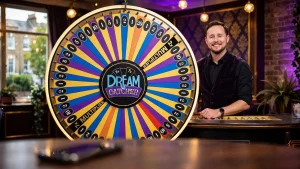
Crazy Time combines a real-time studio stream with an on-screen betting interface, while game rules and casino conditions require separate checks.
The phrase “live casino” describes how a game is presented and played, not a guarantee about its rules or outcome. Gameplay is streamed in real time from a studio where a human dealer is present. Bets are placed through an on-screen interface while the live action is taking place. In that sense, a live casino combines a broadcast with an online betting interface: the studio supplies the visible game, and the interface is where the player’s selections are submitted.
That distinction matters when considering Crazy Time in an online casino. The live-casino label places it within a format in which a studio feed and on-screen betting operate together. It does not, by itself, establish the precise rules, available choices, timing, or other game-specific details. Those belong to the game’s own published information, not to the general definition of live play.
A live dealer game is not simply a pre-recorded clip presented as though it were happening now. Its defining feature is that the gameplay is streamed from a studio in real time, with a human dealer involved. The player watches that feed and uses the digital interface to place bets. The two parts serve different purposes: the video shows the live game, while the interface communicates the player’s betting choices.
When choosing where to play Crazy Time in the UK in 2026, check practical details as well as the game itself. The verdicts below focus on the payout information available for each operator.
Britsino
Britsino has a stated payout speed of 1–3 business days.
Zombillion
Zombillion lists a payout speed of 1–3 business days.
SlotoSport
SlotoSport’s stated payout speed is 1–3 business days.
Chanze
Chanze lists payouts as taking 1–3 business days.
Dieselwin
Dieselwin has a stated payout speed of 1–3 business days.
NightLuck
NightLuck lists a payout speed of 1–3 business days.
WinBeast
WinBeast’s stated payout speed is 1–3 business days.
x3bet
x3bet lists payouts as taking 1–3 business days.
Amunbet
Amunbet has a stated payout speed of 1–3 business days.
EvoSpin
EvoSpin lists a payout speed of 1–3 business days.
This setup differs from a game that runs entirely through software without a live studio presentation. In a live casino, the visible action comes from the studio rather than being represented solely by a computer-generated display. That description is enough to explain the format; it is not enough to infer the mechanics of any named game. A studio stream does not prove what options a particular game offers, how those options are settled, or what conditions apply.
For a search framed around Crazy Time and an online casino, the useful first question is therefore about format: is the game being presented as live studio gameplay with bets submitted on screen? The wording “online” refers to the route by which the stream and interface are accessed. It does not change the basic division between the live action and the digital controls.
“Live” is a description of the delivery of gameplay. It indicates that the player is watching real-time activity from a studio with a human dealer, rather than only interacting with a wholly digital version. It should not be treated as a shortcut for understanding a game’s rules. The label alone does not explain how a round works, what a player can select, or what determines a result.
This is particularly relevant when a game name appears beside “live casino” or “online casino”. Those terms can identify the setting in which a game is offered, but they do not supply its complete specification. The studio format is one layer; the individual game’s instructions are another. Conflating the two can leave a player with a clear picture of the stream but an incomplete understanding of the game itself.
The interface is also part of the format, not a detail to overlook. It is the means by which bets are placed while the studio feed is running. The visible presentation and the submitted bet are connected through that screen, but seeing a live dealer does not remove the need to understand the on-screen choices and the applicable rules. A broadcast can make a game feel more tangible; it does not make its terms self-explanatory.
“Crazy Time live casino” can be read as a reference to the game in a live-casino setting. The general format supports a limited set of conclusions: gameplay is streamed in real time from a studio with a human dealer, and betting takes place through an on-screen interface. Any further conclusion about Crazy Time itself needs game-specific information. The format does not establish those details.
This careful distinction is more useful than treating “live” as a broad endorsement. It identifies what the player is watching and how bets are entered, without implying that the stream changes the underlying terms or makes an outcome predictable. Real-time presentation is a feature of the delivery method. It is not evidence of a particular advantage, a particular set of rules, or a different standard for assessing a bet.
An online casino page can place a game name, a live label and a play button together, but those elements answer separate questions. The name identifies the game; the label describes its presentation; the interface provides the route for submitting bets. A sound understanding starts by keeping those functions distinct and reading the game’s instructions for its own details before betting.
Live casino content is entertainment, not gambling advice. The live format explains how a studio game reaches an online player and how bets are entered; it does not determine whether a bet is suitable or predict what will happen. A budget set before play remains a practical boundary, rather than something that a live presentation can improve.
The name Crazy Time may appear alongside casino listings, but a listing alone does not establish the game’s rules, history or strategic value. Those are separate questions. A casino page can show that it offers access under that name; the game’s own rules explain how a round works; neither, by itself, demonstrates that a betting approach can produce a reliable advantage.
That distinction matters when assessing claims about a live casino game show. The live-casino format has identifiable operating characteristics: play is transmitted from a studio, and bets are entered through an on-screen interface. Those general features describe the format, not every detail of a particular title. They do not verify its rounds, outcomes, special features, paytable or development history. Such details need to be checked against the rules presented for the specific game, rather than inferred from its name or from descriptions of other live games.
A live game is not simply a digital game with a video window added. Its pace is shaped by the real-time flow of play, so it moves more slowly than a digital version. The minimum bets are also higher, and participation depends on a stable internet connection. These are practical differences, but they say nothing about whether a particular wager is favourable.
The distinction between pace and value is easy to blur. More time between decisions can make the sequence feel more deliberate, while the presence of a studio stream can make the activity seem more transparent. Neither impression changes the underlying terms of a bet. A slower round is not a more predictable round, and watching events unfold does not establish that the next result can be anticipated.
The connection requirement is similarly operational rather than strategic. If the stream is unstable, the experience may be interrupted; a reliable connection supports viewing and placing bets through the interface. It does not improve the odds or reveal future outcomes. Treating smooth playback as evidence of control would confuse the delivery of the game with its mathematics.
A search for Crazy Time at a casino may lead to a page that identifies the title and offers a route into play. That is useful for confirming availability at that venue, but it is not a substitute for the rules screen. The listing does not necessarily tell a reader how a round is structured, what choices are available, how a winning result is settled or what conditions apply to each wager.
The same care applies to descriptions of the game’s background. A date, origin story or account of how the title changed over time should be treated as a historical claim requiring evidence. Repeated wording across casino pages does not turn a claim into a verified history. A description can be copied from one listing to another; repetition is not independent confirmation.
The practical check is therefore narrow: distinguish a casino’s statement that it carries the game from the game’s own explanation of its rules, and distinguish both from claims about its history. If a detail is not stated in the applicable rules or supported by dependable historical material, it should not be used as a basis for a betting decision. A confident description is still only a description unless its underlying claim can be checked.
Strategy is often used to mean several different things: understanding the rules, managing a fixed entertainment budget, choosing when to stop, or attempting to predict results. Only the first three are decisions a player can make without claiming knowledge of future outcomes. A strategy that says a particular sequence, timing pattern or past result makes a later result more likely needs evidence specific to the game. The live format alone supplies none.
The time between rounds can encourage the impression that there is room to read a pattern. A visible stream also provides more to watch than a rapid digital interface. But additional observation is not automatically additional predictive information. A result seen on screen explains what has already happened; it does not establish what will happen next. No betting system should be described as a way to secure a win on the basis of the format’s slower pace.
This is where claims about systems can become expensive in a very ordinary way. A staking plan may change the size and timing of bets, but changing the sequence of amounts is not proof that the outcome has become more favourable. A budget sets a spending boundary; it does not turn a losing sequence into a winning one. The clean calculation is that the amount risked remains money at risk, regardless of how carefully the sequence is labelled.
For that reason, any claim that a particular approach works should be tested against the game’s actual rules and credible evidence, not anecdotes or confident language. A player’s account may describe what happened in one session; it cannot by itself establish a repeatable edge. Nor does a casino’s promotional description constitute a mathematical analysis. If a strategy depends on predictions about future results, its claim needs more than a story about past outcomes.
Before considering a wager, the relevant material is the specific game’s rules and paytable, where available. They define what the displayed choices mean and how outcomes are settled. A general article about live casinos cannot supply those game-specific terms, and an operator’s page should not be treated as a complete substitute if it does not show them clearly.
The review can be kept to a few separate questions:
These checks do not establish that a game is profitable. They establish whether the information being used is relevant to the decision. That is a smaller claim, but a defensible one.
The live format also changes the time and connection conditions under which play takes place. Rounds take longer than digital play, minimum bets are higher, and a stable connection is needed to follow the stream and use the betting interface. Those constraints can affect how long a session takes and how much money is exposed at each decision. They do not validate a prediction system.
A sensible financial boundary is therefore independent of any purported strategy: decide in advance what amount is affordable entertainment spending, keep within it, and do not extend play to recover losses or pursue a hoped-for win. The designation “live” changes the delivery and pace of play; it does not convert uncertainty into a forecast. This is entertainment information, not gambling advice.
A casino carrying a live dealer game is not legal in the UK merely because its website is accessible or the game appears in its catalogue. The relevant condition is the operator’s regulatory status: live dealer casinos may operate legally in the UK when the operator holds a licence from the UK Gambling Commission (UKGC).
That distinction matters when assessing sites associated with Crazy Time. A game title, a live stream, or a casino’s own description does not establish that the operator is authorised to serve UK customers. The licence belongs to the operator, not to the game. A site’s legal position therefore cannot be inferred from its branding or from the fact that it offers live casino content.
The UKGC’s licensing framework applies to remote gambling operators serving Great Britain, including operators based elsewhere. The Gambling Act 2005 governs gambling in England, Wales and Scotland; Northern Ireland is outside that Act’s scope. For online casino gambling in the UK, the central practical test remains whether the operator holds the relevant UKGC licence. A foreign address does not remove that requirement when the business serves the British market.
A licence is a regulatory condition, not a verdict on whether a particular game is suitable or financially worthwhile. It does not establish that a bonus is generous, that a strategy changes the game’s outcome, or that a score display predicts future results. Those are separate questions. For casino sites associated with Crazy Time, the licence check answers who is authorised to provide the gambling service; it does not certify every promotional claim or create an advantage for a player.
The distinction also helps avoid a common category error: treating the game’s availability as proof that the whole site is operating under UK rules. The relevant entity is the company accepting the gambling activity. Where a site presents several brands or games, the UKGC status must relate to the operator responsible for the service, rather than being assumed from the appearance of a familiar title.
A UKGC licence is therefore the baseline for the legal status of a site offering live dealer casino games to UK customers. Without it, the operator is outside the UK regulatory system, even if it has a licence from another jurisdiction or accepts visitors from Britain. Offshore licensing is not a substitute for the licence required to serve the British market. The legal obligation rests with the operator; the licence condition is not a marketing badge that can be replaced by general claims about security or experience.
The same test applies whether the site promotes Crazy Time specifically, advertises a casino bonus, or displays game scores. None of those details changes the operator’s licensing requirement. Nor does the presence of a page labelled for UK players establish that the business has the necessary authorisation. The licence status is the legal question; game presentation and promotional terms are separate matters.
That separation keeps the check precise: a live dealer casino is lawful in the UK when it is provided by an operator holding the appropriate UKGC licence. Content is for entertainment purposes only and is not gambling advice.
Playing Crazy Time live means accessing a casino’s live-game section and using its on-screen controls while a studio stream runs. The action is broadcast in real time from a studio with a human dealer; bets are entered through the interface rather than placed directly in the studio. The stream and betting controls are parts of the same session, so access depends on both being available and working reliably.
For a UK player looking to play Crazy Time, the practical requirement is a stable internet connection. A live session depends on an ongoing stream, not a sequence of game results downloaded in advance. If the connection drops or becomes unreliable, the picture and betting interface may not remain synchronised in a usable way. Connection quality is therefore an operating condition, not a feature that changes the game’s underlying outcome.
The live format also takes longer than a digital version. Each round unfolds through a streamed process, with the dealer and on-screen interface forming part of the pace. That makes live play less suited to someone expecting rapid, uninterrupted rounds. The trade-off is straightforward: the studio action is visible in real time, but each turn takes longer to complete.
Minimum bets are higher in live games than in digital versions. That affects the amount of money needed to participate, independently of the stream’s quality or the game’s presentation. The relevant figure is the minimum shown in the particular game interface before a bet is placed; it should not be inferred from another table or casino. A session budget also needs to account for the minimum stake and the slower pace, since more time in a session does not make a stake smaller.
“Where to play” is consequently a question of access conditions rather than the wheel’s appearance. A casino page may display a live wheel game, but the session still requires a functioning stream, an available betting interface and a connection stable enough to use both. The stream shows the studio action; the interface records the selected bet. Confusing those roles can make a technical interruption look like a game feature, when it is simply a loss of access.
Before opening a live session, the useful checks are operational: confirm that the live game loads, that the controls are responsive, and that the displayed minimum stake fits the intended budget. Once play begins, the slower round cycle remains part of the format. It is not a reason to increase stakes or extend a session. This description concerns the requirements of live play, not a recommendation of any particular casino.
“Best” is not a measurable property of a casino. For a Crazy Time search, the useful comparison is between conditions that can be checked and claims that cannot: whether the operator holds a UK Gambling Commission licence, whether the live format suits the available connection, and whether its pace and minimum stakes fit the intended budget. A name or promotional description cannot replace those checks.
A UK licence is a basic condition, not a quality score. Live dealer casinos are legal in the UK when operated under a UK Gambling Commission licence. That establishes the relevant regulatory status; it does not establish that a particular game will be available, that its terms will be favourable, or that a casino is right for every player. A comparison should distinguish the operator’s licence from claims about an individual game.
The live format also changes the practical calculation. Live games move more slowly than digital versions and have higher minimum bets. A stable internet connection is necessary for a continuous stream; interruptions can make a real-time session difficult to follow. These are operating conditions, not evidence of better odds or more predictable outcomes. A casino that presents live play clearly may be easier to assess, but presentation alone does not alter the underlying game.
Minimum stakes matter because they determine how quickly a fixed budget can be committed at the table. The relevant figure is the one shown for the specific game and table, rather than a broad casino-wide claim. The same applies to rules and paytable information: terms should be reviewed before play, since a general description of a casino does not settle the conditions of a particular game.
Claims about Crazy Time results should be treated separately from operator comparisons. Past results or statistics trackers do not affect future spins or outcomes. They cannot turn a sequence of earlier results into a strategy with a reliable advantage. A casino’s interface, live presentation or promotional language does not change that calculation. “Best strategies” are not established by choosing a particular operator.
The term “Crazy Time slot” may appear in casual descriptions, but it is not enough to establish what a listed game is or how it works. The label should not substitute for checking the game’s actual presentation and terms. This distinction matters when comparing casinos: a result page, game tile or advert is not the same as evidence that the live game has particular mechanics or features.
A practical comparison therefore has a short test: confirm the operator’s UK licence, inspect the live table’s stated minimum and rules, and consider whether the stream can be followed reliably. Set a budget before playing and keep to it; do not extend it to recover losses or pursue a run of results. This is entertainment, not gambling advice. A ranking would add little unless it disclosed comparable evidence for each operator.
A search for a Crazy Time demo is often a search for a way to see the game without staking money. The important distinction is what the session can deliver: free play may provide a no-stakes way to view gameplay, but it does not produce real payouts or winnings. A result shown on screen in a demo is not money that can be withdrawn or transferred into a cash balance.
Availability should not be assumed from the word “demo” in a page title. That label can refer to a playable no-stakes version, an explanation of gameplay, or promotional material. Those are different things. Before treating a page as a playable demo, its controls and terms need to make clear that it actually allows a free session. A description or video may show what the game looks like without offering any interaction at all.
The same distinction applies to a live-casino demo. A live stream and a practice mode are not interchangeable: seeing a broadcast does not, by itself, establish that free bets can be placed. Nor does a no-stakes interface establish that every game feature available in real-money play is reproduced there. The practical value of a demo is limited to what it actually lets the user observe or test.
A playable demo can help with basic orientation. It may make the interface easier to understand and show how its controls respond, without putting a cash stake at risk. That can be useful for deciding whether the pace and presentation suit a player. It is not a reliable way to estimate future returns, however, and practice results do not create a claim on real winnings.
A demo also cannot settle questions about the real-money version unless the relevant rules and terms are available and match. The screen alone is not a substitute for checking the game information before staking money. Where the rules or paytable are available, they should be reviewed before play; an attractive practice result does not alter them.
This is where “tips” need to be treated carefully. Interface familiarity is a practical tip: knowing where the displayed controls are can reduce confusion during a session. A supposed method for turning demo outcomes into a real-money advantage is a different claim. Nothing about a free session establishes that past results predict later outcomes or that a staking pattern can secure a payout. Calling a tactic a tip does not change its arithmetic.
The phrase “top Crazy Time slot” can also mislead. A casino game presented through a live studio is not automatically a slot simply because a page uses that word. The label does not explain whether a demo exists, what it contains, or whether it awards money. The useful questions are narrower: is there an actual no-stakes version, what can be tested in it, and are its terms clear?
Free play and real-money play have different financial consequences. A demo does not require a cash stake for its practice outcomes, and those outcomes do not pay out. Real-money play involves money at risk; any decision to move from a free session to staking cash should therefore be treated as a separate decision, not as a continuation of a successful practice run. A budget should be set before live casino play and kept within its limit.
There is no need to turn a free session into a spending decision. If no playable demo is available, a description or stream may provide information, but it should not be presented as equivalent to hands-on practice. If a demo is available, its value is familiarisation, not proof of an edge. The distinction is plain: a practice result has no cash value, however favourable it looks.
Likewise, a page calling itself a top casino guide does not establish that a particular operator offers a demo, or that its version is better for practice. A ranking is not a feature specification. The word “top” adds no evidence about demo access, fidelity, or payouts. Those details have to be stated clearly by the service offering the session; if they are not, the label cannot fill the gap.
For UK readers, the boundary matters more than the promotional wording. Free play is not a way to receive winnings without a stake, and it should not be confused with a real-money account. No-stakes access can help with orientation, where genuinely provided, but it is not a financial return and cannot be counted as one. This content is for entertainment purposes only and is not gambling advice.
A casino described as “not on GamStop” is being characterised by its relationship to a self-exclusion programme, not by its legal status. That label alone does not establish whether an operator is licensed to serve customers in the UK, nor whether the service is suitable for a particular player. The same distinction applies when the wording is attached to Crazy Time or another live dealer game: the game name does not change the operator’s obligations.
For UK players, the relevant legal baseline is clear. Live dealer casinos are legal when the operator holds a licence from the UK Gambling Commission. An offshore licence, or a statement that a casino is available to UK customers, is not a substitute for that UK licence. Casinos operating outside the Commission’s regulatory system do not hold a UKGC licence.
GamStop and licensing answer different questions. GamStop is a self-exclusion programme; UK licensing concerns the operator’s authority to offer gambling to customers in the market. A casino’s presence or absence from a self-exclusion scheme should therefore not be treated as evidence that it meets UK regulatory requirements. Nor does the phrase “non-GamStop” itself prove that an operator is illegal: the label does not supply enough information to establish licensing status.
This matters when a site promotes a Crazy Time casino as available without GamStop. Promotional wording can describe access, but it cannot confer regulatory approval. The material point is whether the operator holds the appropriate UK Gambling Commission licence. Without that, the UK legal condition for offering live dealer casino gambling is not met.
The term also says nothing about whether gambling is appropriate for someone who has chosen to exclude themselves. A search for an alternative should not be mistaken for a change in the underlying safeguard. Legal availability and personal suitability are separate considerations; neither can be inferred from a “not on GamStop” claim.
A casino bonus can look substantial in its headline value while contributing little to play on a live table. The key figure is the game-weighting rule: it determines how much eligible wagering in a game counts towards the bonus requirement. Live games may receive only a small share, with 10% given as an example of the weighting. The remaining wagering does not become eligible merely because the game is available in the casino.
The calculation is straightforward. If a live game has a 10% weighting, only a tenth of qualifying stakes is counted towards the requirement. A bonus tied to wagering therefore takes more eligible play to clear when live games carry reduced weighting. The headline amount alone says nothing about the amount of live play that will count.
Eligibility is a separate condition. A specialist review describes most UK welcome offers as slot free spins, which cannot be used at live tables. That makes such an offer irrelevant to a live game, even when it appears beside the casino’s live section. A deposit bonus may have different terms, but its presence does not establish that a particular live game qualifies.
For a Crazy Time casino bonus, a no-deposit offer or a welcome promotion, the operative terms are the eligible games, the weighting assigned to live play, and any stated wagering conditions. The offer’s label is not a substitute for those details. Where the terms exclude a game, its contribution is zero; where a reduced weighting applies, only the stated portion counts. No bonus wording establishes a payout from the game.
Bonuses should therefore be assessed by their usable value for the intended game, not by the promotional headline. A slot-only offer has no live-table value, while a live-eligible offer may still contribute slowly under its weighting rule. Terms should be checked before opting in, including wagering requirements, game weighting and maximum bet limits. Set a budget before play and keep to it; chasing a bonus does not improve its terms.
This material is for entertainment purposes only and is not gambling advice.
Choose a number or another available bet on the screen and place your bet while a live dealer spins a physical wheel. You win if the ball lands on a number you selected.
In the UK, choose one that holds a UK Gambling Commission licence. Check that your internet connection is stable and that the table’s minimum bet suits your budget.
Live roulette includes European, American and French versions. American Roulette has both 0 and 00, while European Roulette has a single 0; in French Roulette, an even-money bet loses only half when the ball lands on 0.
No. In roulette, straight-up bets have a 2.9% house edge, while other bets have a 2.7% edge; French Roulette also has a rule that reduces losses on even-money bets when the ball lands on zero.