A practical way to assess payment claims, bonus conditions, UK licensing distinctions, verification and withdrawal timing.
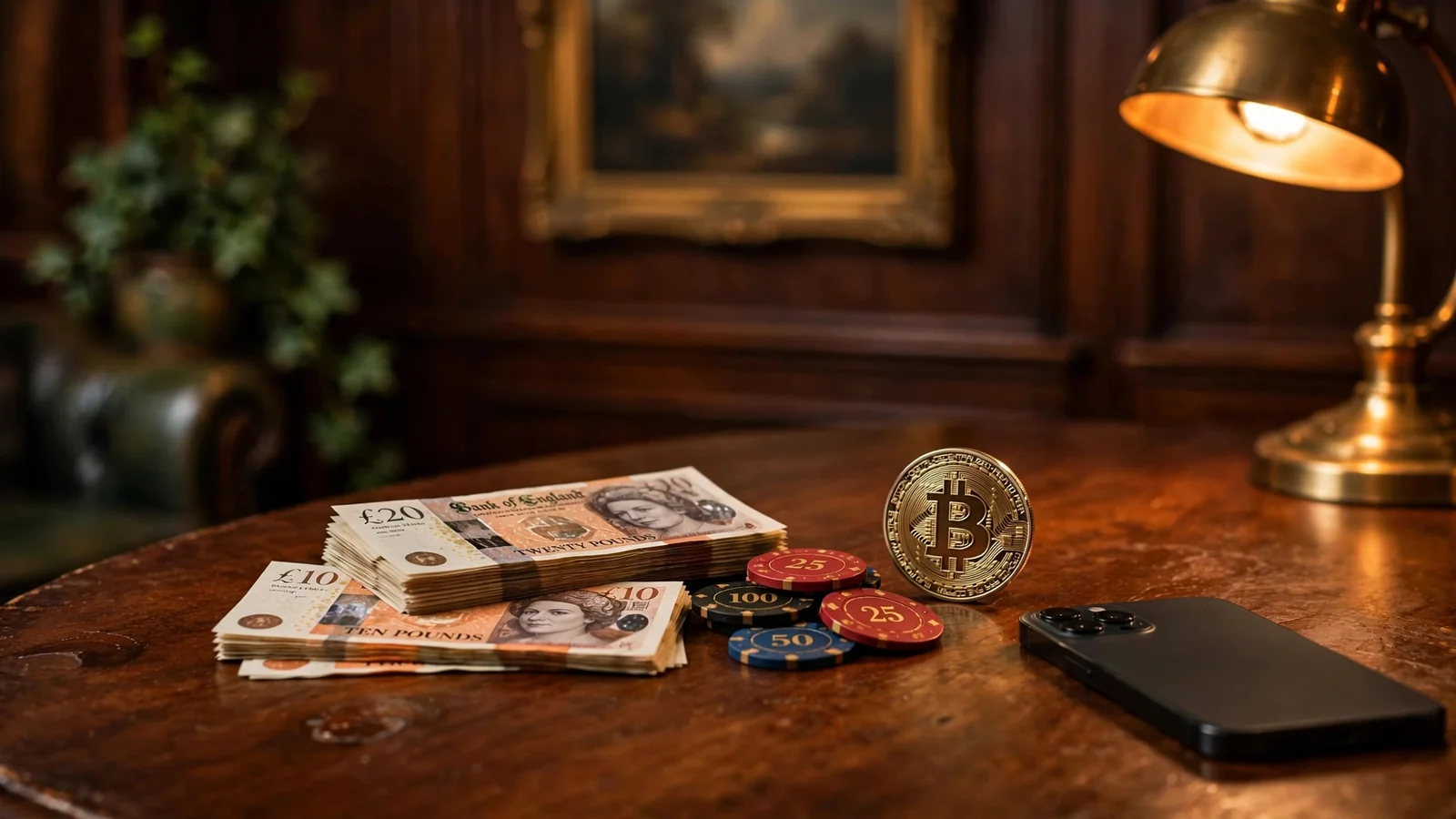
A headline offer attached to a Bitcoin Cash casino is not a cost comparison. The relevant figure is what remains after charges and conversion, not the payment label or the size of a displayed promotion. Bitcoin Cash and Bitcoin are separate assets, so an offer described for one should not be treated as applying to the other without checking its terms.
A useful comparison starts with the amount intended for the transaction and subtracts every charge that affects it. Depending on the route, the total may include a casino charge, a payment-provider fee, an issuer or bank fee, an exchange-rate spread and a network fee. A specialist payment review identifies these as possible components of the overall cost; which ones apply depends on the particular transaction. A fee shown in the cashier is only one line in that calculation.
The calculation can be expressed as:
Amount available after costs = amount sent − casino charges − provider or bank charges − conversion cost − network cost.
Choosing a Bitcoin-accepting casino in the UK means checking practical details as well as payment options. This list offers a concise starting point, with payout speed as the available point of comparison.
Britsino
Britsino lists a payout speed of 1–3 business days.
Zombillion
Zombillion lists a payout speed of 1–3 business days.
SlotoSport
SlotoSport lists a payout speed of 1–3 business days.
Chanze
Chanze lists a payout speed of 1–3 business days.
Dieselwin
Dieselwin lists a payout speed of 1–3 business days.
NightLuck
NightLuck lists a payout speed of 1–3 business days.
WinBeast
WinBeast lists a payout speed of 1–3 business days.
x3bet
x3bet lists a payout speed of 1–3 business days.
Amunbet
Amunbet lists a payout speed of 1–3 business days.
EvoSpin
EvoSpin lists a payout speed of 1–3 business days.
The terms should be included only where they apply. If a provider quotes a fee separately, it belongs in the total. If the amount is converted at a rate that differs from the rate used as the comparison point, the difference also has a cost, even if it is not described as a fee. A precise comparison therefore needs the same starting amount, the same currency assumptions and the same transaction route.
A flat charge is easy to spot because it appears as a stated amount. Conversion is less transparent: the casino, provider or exchange may use a rate that embeds a spread. That spread is the difference between the rate used for the transaction and the reference rate against which it is being compared.
A specialist payment review notes that this conversion margin can exceed a visible flat fee. That does not mean it will do so on every transaction. It means that comparing only the published fee can produce the wrong result. The useful check is the amount of Bitcoin Cash credited for the money spent, measured against the exchange rate and any other charges applied at the time.
Currency handling can also complicate comparisons between offers. If one route starts with pounds and another involves a different account currency, the apparent value cannot be compared by looking only at the number of coins shown. The rate and the point at which conversion occurs matter. A quoted amount in a cryptocurrency is not, on its own, evidence of what that amount cost in pounds.
 Casinos That Accept Boku in the UK: Deposits & BonusesLearn where Boku appears in UK casino cashiers, how bonus eligibility varies by operator, and why Boku deposits cannot be used for…
 Casinos That Accept USDC in the UK: Payment ChecksLearn how to check USDC in a casino cashier, distinguish payment eligibility from bonus and slot rules, and review withdrawals, fees and…
The lowest-cost route cannot be identified in the abstract. A specialist payment review cautions that there is no single payment method that is cheapest in every case: casino charges, provider fees, currency spread and network cost need to be assessed against the actual amount being transferred.
That makes a fixed ranking of Bitcoin Cash offers unreliable as a cost guide. A route with no stated casino fee may still have a provider charge or an unfavourable conversion rate. Another route may show a flat charge while applying a smaller spread. The result can change with the transaction amount and the rates in effect, so the comparison should use the same amount for each route rather than relying on a general claim that one method is “free” or “low cost”.
A compact worksheet helps keep the comparison consistent:
| Cost line | What to record |
|---|---|
| Starting amount | The amount in pounds or other funding currency |
| Casino charge | Any charge stated for the transaction |
| Provider or bank charge | Any separate fee applied by the payment service or bank |
| Conversion | The rate used and the resulting spread against the chosen reference |
| Network cost | Any cryptocurrency network charge |
| Net amount | The value remaining after applicable costs |
The table is a calculation aid, not a promise that every line will appear. If a fee is not charged, it should not be deducted. If a conversion rate is not disclosed clearly, the net amount cannot be compared confidently until the credited value is known.
The same method applies whether the offer is presented as a Bitcoin casino deal or as a Bitcoin Cash promotion. The advertising label describes the package; it does not establish its net economics. A meaningful comparison records the actual funding amount, identifies each applicable cost and calculates the resulting value on a consistent basis. Only then can a headline benefit be judged against what it costs to obtain.
A reference to cryptocurrency is not the same as confirmation that Bitcoin is available. Payment information can group several digital currencies under one heading, while the detail needed to establish a particular method is absent. A specialist review of casino websites mentions Visa, Mastercard, bank transfers, e-wallets and several cryptocurrencies; that range describes what those pages discuss, not proof that Bitcoin is enabled for every account or transaction.
The distinction matters for an online Bitcoin casino UK claim. A broad label such as “crypto accepted” identifies a category, not necessarily the specific currency, account conditions or transaction route. Bitcoin should be named explicitly in the relevant payment information. If a page lists several currencies but does not identify Bitcoin, the claim remains incomplete; the presence of other cryptocurrency names does not fill that gap.
Payment pages, promotional copy and account interfaces can describe different levels of availability. A general page may outline methods supported by a service, while the account information may determine which options are presented for an individual customer. A statement that an operator handles cryptocurrency therefore should not be read as confirmation that Bitcoin appears as an available choice in every account.
The useful check is consistency. The operator’s wording should identify Bitcoin clearly, and the account details should not contradict that description. If the public page says “cryptocurrency” but the account information names no currency, the claim has not answered the relevant question. If the account shows a particular route, that is more specific evidence than a broad headline, though it still needs to be read alongside the conditions attached to that account.
The same discipline applies to phrases such as “Bitcoin casino” or “Bitcoin payments available”. They can be labels rather than complete descriptions. A label alone does not explain whether the statement applies to all customers, only some accounts, or a particular stage of a transaction. The wording should be treated as a claim to verify, not as a settled fact about every possible use.
Payment information is only useful when it corresponds to the customer’s own account. The account name and the details attached to the payment route should belong to the same person. Keeping those basic ownership details aligned lowers the risk of avoidable questions or friction over who controls the account and the funds.
That is a consistency check, not a promise that every transaction will proceed without review. It simply removes one preventable mismatch from the picture. A payment route associated with someone else, or account information that does not match the person using it, makes the claim of straightforward compatibility less persuasive. The relevant question is not merely whether Bitcoin appears somewhere on a website, but whether the stated method is presented in a way that fits the customer’s own account.
A careful reading should also distinguish between a general list of methods and information that applies to the specific account in use. The former can indicate what a site discusses; it cannot by itself establish that a particular customer has access to each listed option. The latter is more relevant to the customer’s situation, because it connects the method with the account rather than leaving the claim at site-wide level.
A useful payment statement identifies Bitcoin by name and makes clear which account or transaction context it concerns. A broad cryptocurrency reference establishes less. A list that combines cards, bank transfers, e-wallets and digital currencies is not evidence that every listed method is available to every customer; nor does the inclusion of cryptocurrency prove that Bitcoin is one of the supported currencies.
This is why claims about an online Bitcoin casino should be assessed in layers: what the site says generally, what currency it names, and whether the account information is consistent with that statement. Each layer answers a different question. Treating them as interchangeable turns a mention into a conclusion that the wording itself has not earned.
 Casinos That Accept Litecoin in the UK: What to CheckLearn how to check Litecoin availability, bonus eligibility and payment conditions. A cashier option alone does not confirm that a deposit qualifies…
 Casinos That Accept Citadel in the UKLearn how to check Citadel deposit support, understand return-to-source withdrawals and distinguish payment access from slot availability or bonus eligibility.
For UK customers, the regulatory status of the operator is a separate matter from its payment claims. Remote gambling operators serving the British market must hold a Gambling Commission licence, and online gambling is legal in the UK only at licensed and regulated sites. A Bitcoin reference does not establish that status, just as a licence does not by itself establish that a specific account has Bitcoin available. Payment wording and licensing evidence should therefore be read as separate claims, each requiring its own confirmation.
A Bitcoin casino deposit has two separate figures: the amount transferred and the amount credited for play. A promotion may add a bonus balance, but that does not make the bonus equivalent to withdrawable cash. Its availability and use depend on the offer’s conditions, which should be read before a deposit is made. The cashier’s minimum and maximum amounts also matter: an advertised bonus can be irrelevant if the required deposit falls outside the permitted range for the selected payment method.
One specialist casino review reports minimum deposits in the £10–£20 range, varying with payment method. That is a reported range, not a universal threshold for Bitcoin casino deposits in the UK. The cashier is the operative reference for an individual account: it should show whether Bitcoin is available, the minimum accepted for that route and any applicable maximum. A promotional page can describe an offer broadly while the payment screen applies method-specific limits.
Maximum deposits may be set per transaction, per day or per month, and the permitted amount can depend on both payment method and account status. A limit shown before login may therefore not settle what is available to a particular customer. The relevant account controls and cashier terms determine the usable ceiling. Where a transaction exceeds a route’s limit, splitting it into smaller payments should not be assumed to work; the operator’s rules may apply an aggregate limit as well.
The first deposit also has a required financial-limit step. UK Gambling Commission rules require remote gambling licensees to prompt new customers to set a financial limit before that deposit, and to make account-level limit controls accessible. This is a separate control from a payment provider’s transfer limit or a casino’s deposit ceiling. A customer-set limit may constrain deposits even when the payment method and cashier would otherwise allow a larger transaction.
Bonus eligibility is another independent condition. The deposit method may affect whether an offer can be claimed, even when the payment itself is accepted. A specialist review reports that PayPal can be excluded from bonus eligibility; that is a qualification to check against the specific promotion, not a fixed rule for every casino. A separate specialist casino review reports that Skrill and Neteller are often excluded from promotions at sites that offer them. The promotion’s own payment exclusions decide whether a particular deposit qualifies.
 Casinos That Accept Dogecoin in the UKUnderstand how cashier availability, promotion terms and slot access differ, and why a successful Dogecoin deposit does not confirm bonus eligibility.
 Casinos That Accept Giropay in the UK: What to CheckLearn how to check cashier support, whether a Giropay deposit qualifies for a slot promotion, and why deposit and withdrawal routes may…
That distinction matters when comparing a standard deposit with a Bitcoin casino no-deposit bonus. “No deposit” describes the advertised entry condition, not the practical value or unrestricted availability of the bonus. Eligibility criteria, any permitted games and conditions attached to converting bonus funds can affect how much is available to play or withdraw. The label alone does not establish that a customer qualifies, or that a payment route has no bearing on eligibility. Those terms should be checked before selecting an offer rather than after funding the account.
The same applies to searches for Bitcoin casinos with no-deposit bonuses in the UK, including claims presented as the best offer. A headline does not establish that Bitcoin is an eligible payment method, or that the bonus is available to every account. The relevant calculation starts with the actual deposit accepted, then separates deposited funds from promotional credit and notes the conditions on each. If a bonus requires a qualifying deposit through a specified route, a Bitcoin transfer may not meet that condition. The offer’s written terms, the account’s eligibility and the cashier’s limits together determine the usable amount; the headline figure does not.
“Not on GamStop” describes a self-exclusion distinction, not a payment feature or a licence category. Bitcoin acceptance does not establish whether a casino is covered by GamStop, and the absence of GamStop coverage does not show that Bitcoin deposits are available. These are separate questions: one concerns access to gambling after self-exclusion; the other concerns how an account may be funded.
For customers in Great Britain, the legal distinction is more important than the payment label. Remote gambling licensees serving the British market must hold a UK Gambling Commission licence, whether based in the UK or elsewhere. Online gambling is legal in the UK only through a licensed and regulated site. An offshore casino without a UKGC licence is outside that regulatory system; describing it as a Bitcoin casino or as “not on GamStop” does not alter that status.
UKGC-licensed casinos must provide responsible-gambling tools, including self-exclusion. GamStop is associated with self-exclusion, but it should not be treated as a substitute for checking the operator’s regulatory position. A claim that a site is outside the scheme says nothing by itself about whether it holds a UKGC licence or whether it provides the protections required of a licensee. Those questions need to be considered independently.
There is also a practical difference between choosing to self-exclude and looking for a site that does not participate in the scheme. Self-exclusion is intended to support a person’s decision to stop gambling; seeking an alternative route can undermine that decision. If a self-exclusion is in place, a Bitcoin payment method does not make the underlying concern disappear. The payment rail is not a safeguard, and a cryptocurrency logo is not evidence of consumer protection.
For a UKGC-licensed remote operator, account controls form part of the regulatory picture. Before a new customer can make a first deposit, the operator must present a prompt to set a financial limit. The customer must also be able to find and use account-level limit controls. These requirements sit alongside self-exclusion; they are not replaced by the casino offering Bitcoin or another payment method.
 Monzo and UK casinos: what payment evidence showsLearn how Boku’s phone-billed deposits differ from Monzo payments, why cashier options do not prove Monzo acceptance, and what deposits say about…
 Casinos That Accept Interac in the UK: What to CheckLearn how Interac acceptance differs from bonus eligibility, what to check in casino terms, and how deposits, withdrawals and alternatives work.
A phrase such as “Bitcoin casinos not on GamStop UK” can therefore cover materially different situations. It may refer to a claim about self-exclusion participation, while leaving the licence status unclear. It may also be used to make an offshore site sound like a specialist payment option. Neither interpretation establishes that the site is legally permitted to serve customers in Great Britain. An operator’s location does not remove the licensing requirement when it offers remote gambling to the British market.
The useful distinction is straightforward: GamStop status concerns self-exclusion, while UKGC licensing concerns whether an operator may lawfully offer real-money gambling to customers in Great Britain and which protections apply. Bitcoin acceptance answers neither point. A casino should not be treated as safer, lawful or suitable merely because it accepts cryptocurrency, nor should “not on GamStop” be mistaken for a neutral technical feature.
A free-spin banner describes a promotion, not proof that every payment route qualifies for it. A Bitcoin casino may advertise spins while its bonus terms exclude cryptocurrency deposits, or the promotion may be available only when the account is funded through an eligible method. The deciding detail is the offer’s payment clause, not the presence of a Bitcoin symbol in the cashier.
Eligibility can also depend on how a promotion is activated. The terms may require an opt-in, a qualifying deposit, or a particular payment method selected for that transaction. Where the account is funded through Bitcoin, the relevant question is whether that specific offer accepts that route. A general statement that a casino supports Bitcoin does not settle the bonus question.
Payment exclusions are not limited to cryptocurrency. A specialist review reports that PayPal may be excluded from bonus eligibility, while specialist reviews also describe Skrill and Neteller as payment methods that are often excluded from promotions. Those observations should not be treated as fixed rules for every casino or current offer: eligibility is set out in the operator’s own terms, and can differ between promotions.
For free spins, the terms should be read as a set of conditions attached to the offer. They may specify which games the spins apply to, how winnings are treated, whether a deposit is required, and which payment methods are permitted. The advertised spin count alone does not establish the amount that can be withdrawn or the conditions attached to any winnings. Those details belong to the promotion rules.
The practical check is to match the offer terms to the intended payment route before accepting the promotion. If Bitcoin is excluded, a deposit made with it may leave the account outside the offer even when the banner remains visible. If the terms are unclear about cryptocurrency, the offer cannot safely be counted as eligible until the operator confirms it. A displayed promotion and an available promotion are not necessarily the same thing.
Account consistency matters as well. The payment method used should belong to the account holder, and the account details should match the payment route. That reduces avoidable questions about basic ownership during a transaction, but it does not override a bonus exclusion. Nor does switching to another method guarantee eligibility: the promotion’s conditions still govern.
 Casinos That Accept WebMoney in the UKWebMoney and Boku are different payment methods. Learn what a Boku cashier listing confirms, and why it does not establish WebMoney availability.
 Casinos That Accept Maestro in the UK: Payment GuideLearn why a successful Maestro deposit does not guarantee a bonus, and how card acceptance, slot access and promotion terms are separate…
A useful comparison therefore separates three things: the promotion advertised, the payment method used, and the terms that determine whether the account qualifies. For Bitcoin casino free spins in the UK, the relevant evidence is an offer clause that clearly addresses Bitcoin or cryptocurrency deposits, together with any activation and game restrictions. Without that match, the spins are a marketing description, not a confirmed benefit.
“Bitcoin slots” describes a payment context, not a separate category of slot-game rules. The label does not change how a spin must work in Britain. Online gambling is legal in the UK only when provided by a site holding the relevant UK Gambling Commission licence, and the rules on slot play apply independently of whether a casino advertises Bitcoin.
A Bitcoin casino slot machine is still an online slot for regulatory purposes. Each spin must last at least 2.5 seconds. That minimum applies to the time taken for an individual spin, not to how quickly a player can open the game or move between its screens. A faster interface does not permit a faster sequence of spins.
Autoplay is banned for online slots in Britain. A game cannot run a series of spins automatically while the player watches. Each spin must be started separately, so any feature presented as autoplay would conflict with the British rule. Bitcoin acceptance does not create an exception.
Each spin must last at least 2.5 seconds for regulatory purposes in Britain.
Games cannot run a series of spins automatically; each spin must be started separately.
Maximum stakes are £5 per cycle for adults 25+ and £2 for those aged 18 to 24.
Stake limits also apply to each game cycle. For customers aged 25 and over, the maximum stake is £5 per cycle. For customers aged 18 to 24, it is £2. The £5 limit for all adults came into effect on 9 April 2025, but the lower limit remains relevant to the younger age group. These are regulatory caps, not recommended spending levels or a promise that a particular slot will offer every stake amount below the cap.
This distinction matters when a site groups games under headings such as Bitcoin casino slots, Bitcoin jackpot slots or Bitcoin slot machines UK. Those labels do not establish that a game is available to every account, that it accepts a Bitcoin balance directly, or that its mechanics fall outside UK rules. Payment wording and game rules answer different questions.
The licence is the starting point for assessing whether British protections apply. Remote gambling licensees selling into the British market must hold a UK Gambling Commission licence, regardless of where the business is based. A site’s use of Bitcoin as a payment option does not establish that licence status. Nor does the word “Bitcoin” in a game or casino description alter the age-based stake cap, the minimum spin duration or the autoplay ban.
For slot play, the practical test is therefore straightforward: the relevant UK rules concern the game cycle and the customer’s age, not the currency used to fund an account. A cryptocurrency label cannot turn a prohibited autoplay feature into an allowed one, shorten the required spin duration or raise the applicable stake ceiling.
A Bitcoin logo on a casino page establishes little about what an account can actually do. The method may appear in general payment information but not be available in the cashier, or it may be offered for deposits without being available for withdrawals. These are separate functions and need separate confirmation.
The cashier is the practical check. Before sending funds, confirm that Bitcoin appears as a selectable deposit method for the account and that the stated minimum, maximum and any transaction charges are visible before authorisation. Then inspect the withdrawal page or payment terms for Bitcoin as an available payout route. A deposit option alone does not establish that withdrawals can be made through the same method.
Closed-loop rules can affect the route used to return funds. The cleanest arrangement is often one named account used consistently for both transactions, with ownership details matching the casino account. If a casino requires a different payout method, that alternative may involve additional checks; the payment page should explain the process rather than leave it to inference.
Currency is another part of the transaction, not a display preference. A specialist review may state that a casino supports GBP, but the account currency should still be confirmed in the cashier before the first transaction. If the account is denominated in another currency, conversion can alter the credited deposit or the amount received at withdrawal. The relevant figure is the amount shown after conversion, not simply the Bitcoin value sent or requested.
For a useful comparison, record the method shown at each stage, the account currency, the exchange rate or conversion basis, and any disclosed charges. Check whether the withdrawal screen names Bitcoin specifically, rather than relying on a general statement that the casino accepts cryptocurrency. Where Bitcoin is absent from the account’s cashier, a broad payment logo is not a substitute for availability.
The same verification discipline applies to familiar card logos. A specialist review may list Visa and Mastercard, but a current UK cashier check is still needed to establish whether a particular card product is eligible. Payment branding describes a possible route; the account-specific cashier determines whether that route is available for the transaction in question.
A Bitcoin casino list is a starting point for checking claims, not evidence that every entry accepts Bitcoin for every customer or transaction. A specialist review of analysed websites mentions Visa, Mastercard, bank transfer, e-wallets and several cryptocurrencies. That establishes only that these payment categories appear in the material reviewed; a general reference to cryptocurrencies does not identify Bitcoin as a working option at a particular casino.
The distinction matters because a list can compress different kinds of evidence into one label. A site may mention cryptocurrency in general, while its cashier presents a narrower set of methods. A payment option may also depend on the account or transaction. Treating a broad category as confirmation of a specific route turns an editorial description into a payment promise it may not support.
A list of Bitcoin casinos UK readers encounter also cannot establish that an operator is a legit Bitcoin casino UK residents may use under British rules. Bitcoin acceptance and Bitcoin casino legality are separate questions. Remote gambling licensees selling into the British market must hold a UK Gambling Commission licence, regardless of where they are based. The licence should be checked against the Commission’s public register; a cryptocurrency mention, logo or list entry is not a substitute.
The same caution applies to a supposed list of all Bitcoin casinos. Without clear criteria, “all” has no stable meaning: a directory may count sites that mention cryptocurrencies, while a reader may understand it to mean operators with a confirmed Bitcoin option. Those are different sets. A list becomes more useful when it states what evidence supports inclusion, how recently that evidence was checked and whether the entry refers specifically to Bitcoin rather than digital currencies generally.
Nor does a casino list prove that a Bitcoin slot is available. Payment information and game catalogues answer different questions. A label attached to a site cannot establish what games are offered or which rules apply to play.
The sound reading is narrow: a list can point towards places worth examining, but it cannot certify payment functionality, licensing or suitability. Each claim needs evidence matching that claim. Otherwise, the list is a map with the destination left unconfirmed.
A Bitcoin payment does not, by itself, make gambling anonymous. The payment method and the casino account are separate parts of the transaction: using a cryptocurrency address does not remove the operator’s need to establish who holds the account or assess a withdrawal. A payout can therefore involve identity checks even when the deposit was made in Bitcoin.
KYC may be required before funds are released, particularly where an account or payment needs further review. Details used to open the account and the ownership of the payment route should be consistent. If a withdrawal request involves a different source or account, the operator may need additional evidence before processing it. A Bitcoin casino payout is not exempt from these checks simply because the payment uses cryptocurrency.
UK anti-money laundering rules commonly require a withdrawal to go back to the original payment source. This is a closed-loop control: funds are returned through the route used to deposit, rather than sent to an unrelated destination. Returning funds to that source also serves as an anti-fraud measure. Where the original route cannot be used and an alternative is proposed, further verification may be necessary.
This matters when judging claims of anonymity. A transaction method can limit the personal details shown in a payment interface, but that is not the same as gambling without account checks or leaving no relevant transaction record. The account, the payment source and the requested destination still have to align with the operator’s controls.
A specialist review notes that withdrawal processing includes the casino’s internal approval, and that first withdrawals may take longer while verification is completed. That describes a stage before payment is released, not a promise that a Bitcoin transfer will be immediate once requested. The payout route, account review and source-of-funds controls can all affect whether a request proceeds without further questions.
The practical distinction is between a cryptocurrency payment and anonymous gambling. Bitcoin may be the payment method, but it does not cancel KYC, closed-loop rules or the operator’s anti-money laundering checks. A fast-looking payment label cannot settle those account-level requirements.
An “instant Bitcoin withdrawal” can describe a payment method or a step in processing; it does not, by itself, establish how quickly a requested payout will reach a player’s wallet. The casino may still need to review and approve the withdrawal before releasing it. A fast transfer after approval cannot remove time spent in that earlier stage.
Specialist casino payment reviews identify internal approval and whether the account is fully verified as factors in withdrawal speed. That makes the status of the account material to any timing claim: a request from a verified account may not follow the same process as one that triggers further checks. “Instant” should therefore be read as a specific claim about a stage or service, not as a complete timetable unless the terms define what the clock covers.
The distinction applies beyond Bitcoin. Specialist reviews describe PayPal, open banking services and debit cards connected to fast payout systems as among the quicker withdrawal routes. Even then, speed of the payment route is only one part of the result. A card deposit may appear immediately while the corresponding payout takes several business days, according to a specialist review. Deposit speed is not evidence of withdrawal speed; the two transactions have different processing steps.
For a casino advertising immediate Bitcoin payouts, the useful details are the point at which processing time begins, whether casino approval is included, and whether account verification can delay release. If the claim does not explain those conditions, it is not a dependable estimate of when funds will arrive. The word “instant” can be accurate for one part of the transaction and still leave the total wait unspecified.
That distinction matters when comparing a casino with Bitcoin against one using another payment route. A headline about speed does not establish the time from submitting a request to receipt of funds. The relevant measure is the completed withdrawal, including the casino’s review, rather than the payment label alone.
Yes, verification may be required, particularly before a first withdrawal. Payouts usually go back to the original payment source, and alternatives may require additional checks.
PayPal, open banking and debit cards linked to fast payout systems are generally among the quickest options. The casino’s approval process and whether your account is verified also affect the time.
Common options include Visa and Mastercard debit cards, PayPal, bank transfers and open banking, e-wallets such as Skrill and Neteller, and Paysafecard for deposits. Some UKGC-licensed casinos also accept Apple Pay.
Yes, GBP is supported. Check that your account is set to pounds before depositing to avoid conversion costs.
The minimum deposit usually starts at £10–£20, depending on the payment method.
UK casino card deposits must be made with debit cards; credit-card gambling has been banned since 14 April 2020. Visa and Mastercard are listed, but check the cashier to confirm that your specific card is eligible.
Yes, Skrill is available at some UK-friendly casino sites and remains a common deposit option. It may be excluded from bonus eligibility.