Are casino winnings taxed in the UK?
 Available in GB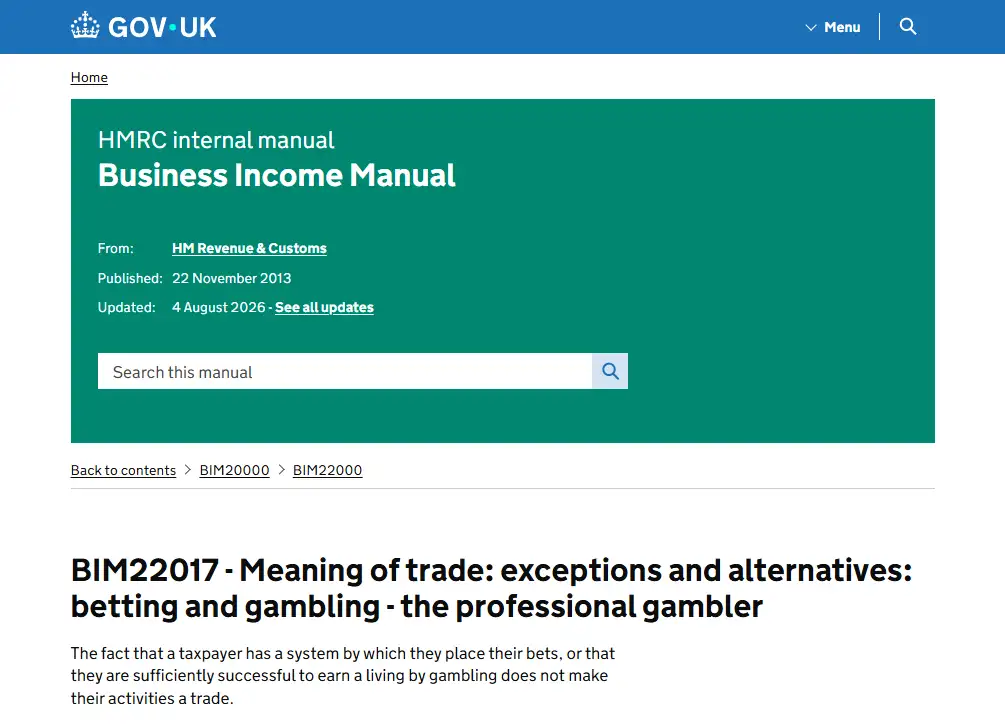
HMRC guidance checked 13 September 2026
For ordinary players, personal gambling winnings are generally not treated as trading income in the UK. HMRC guidance says that having a betting system, being systematic or even earning a living from gambling does not by itself make personal betting a trade. Separate commercial services or a wider business connected to gambling can be treated differently.
The distinction prevents two opposite errors: assuming every win creates an income-tax bill, or claiming that every receipt connected with gambling is always tax-free. The facts behind the payment matter.
The ordinary-player answer
Table of Contents
- Personal gambling does not normally become a taxable trade
- How the distinction works in practical scenarios
- Frequency and success do not settle the tax question
- Player income tax is not the same as operator duty
- When the general answer is not enough
- Tax does not replace licence, slot or bonus verification
- When UK gambling winnings can still need specialist tax advice
- Supporting guides
- UK online casino rules: what readers should verify
Personal gambling does not normally become a taxable trade
HMRC’s Business Income Manual addresses when betting and gambling amount to a trade. Its guidance states that a taxpayer’s system for placing bets, expertise, repeated activity or success is not enough on its own. A person can gamble frequently and skilfully without organising those personal bets as a trade in the tax sense described by the manual.
That is why the usual short answer for a UK player is that casino or betting winnings are not normally taxed as trading income. It is still better to say “generally” rather than “always”. The manual also recognises that a person associated with gambling can provide other services for reward, and those separate receipts require their own analysis.
The wording HMRC uses is deliberately careful, and it is worth mirroring. The Business Income Manual explains that having a system for betting, applying skill, betting repeatedly or even making a living from gambling does not, on its own, make the activity a trade. The reasoning is that the winnings arise from the wager rather than from an organised commercial supply to customers. That is why the accurate general statement is that ordinary personal winnings are not normally taxed as trading income, rather than a flat promise that all gambling money is tax-free.
Three contrasting cases
How the distinction works in practical scenarios
| Scenario | Nature of the receipt | General HMRC-based reading |
|---|---|---|
| Occasional personal player | A person plays a casino game for themselves and receives winnings. | The activity is ordinary personal gambling and is generally not treated as a taxable trade. |
| Systematic personal player | A person studies form or games, uses a system, plays often and can support themselves from the results. | System, skill, frequency and success alone do not automatically create a trade of gambling. |
| Paid gambling-related service | A person receives appearance money, fees for content, tips or another service supplied to a customer. | The payment is separate consideration for a service and can form part of taxable commercial activity, depending on the facts. |
The third scenario does not automatically make every gambling win part of the service business. HMRC gives the example of appearance money for television work and says whether gambling winnings are proceeds of that trade depends on the facts. The correct approach is to identify why each payment was received rather than applying one label to every inflow.
Two opposite oversimplifications are worth naming. The first assumes every win produces an income-tax bill, which the ordinary-player position does not support. The second treats every pound connected with gambling as automatically tax-free, which ignores that separately rewarded services can be taxable. HMRC’s distinction sits between them: it turns on whether a receipt is a betting outcome or consideration for a supply, so a blanket slogan in either direction will mislead a reader sooner or later.
A common misconception
Frequency and success do not settle the tax question
Calling someone a “professional gambler” in everyday language does not determine whether they carry on a trade for income-tax purposes. A person might play daily, keep detailed records and rely on winnings for living costs. HMRC guidance still says that expertise or systematic betting is not enough by itself.
It follows that the everyday word “professional” is not the tax test. A person can be highly skilled and consistently successful and still not be trading in the tax sense described by the manual, because the character of a betting win does not change simply because the person is good at choosing bets. The analysis looks at the source of each receipt, not at how impressive or regular the personal gambling has become.
By contrast, a contract to produce paid gambling content, appear on a programme, sell services or perform work for a customer introduces a commercial relationship that personal betting lacks. The earnings from that relationship should not be described as casino winnings merely because the subject matter is gambling.
- Ask whether the money came from a wager or from a customer paying for a service.
- Do not use playing frequency alone as the test.
- Do not assume skill or profitability automatically creates a trade.
- Keep separately rewarded work distinct from personal wins.
- Seek professional advice when several activities or jurisdictions interact.
Separate obligations
Player income tax is not the same as operator duty
Gambling businesses can have licensing, reporting and gambling-duty obligations of their own. Those operator responsibilities should not be converted into a tax charged to an ordinary player on each win. This page does not analyse remote gaming duty rates because that is a business-level issue outside the reader’s core question.
The separation between player and operator is easy to lose in casual summaries. A gambling business can owe licensing fees and gambling duties calculated on its own activity, but those are charges on the operator, not a tax the player pays out of each win. Confusing the two can make an ordinary player fear a liability the guidance does not create, or assume that an operator’s duty somehow certifies the casino. Neither follows, which is why the operator-duty detail stays out of this player-focused explanation.
Tax treatment also does not prove that a casino is legitimate. A personal receipt can have one tax treatment while the operator’s licence position is an entirely different matter. Readers checking Sloty should use the Sloty licence record for current UKGC evidence, not this tax page.
What needs individual analysis
When the general answer is not enough
Individual advice becomes important when a person earns fees for tips or media, receives sponsorship, runs a gambling-related content business, works for customers or mixes personal play with commercial services. Residence, overseas activity and company structures add further facts that this page does not attempt to resolve.
The point at which general reading should give way to individual advice is fairly predictable. It arrives when money is received for something other than a personal wager: appearance fees, paid content, sponsorship, tips for a service, or a business built around gambling activity. In those cases the receipt may be consideration for a supply rather than a betting outcome, and only the specific facts can settle it. Recognising that boundary is more useful to a reader than any attempt to state one rule that would fit every situation.
Records help preserve the distinction. Keep statements showing wagers and winnings separate from invoices, contracts, sponsorship receipts and business expenses. That separation gives a tax adviser the information needed to determine whether a payment came from personal gambling or a service.
Related UK checks
Tax does not replace licence, slot or bonus verification
The parent UK casino rules guide explains how to match a legal entity and domain in the UKGC register. The UK online slot limits page covers the £2 and £5 age bands, while the UK bonus rules page explains the 10x wagering ceiling. None of those operator rules changes the HMRC distinction between personal bets and separately rewarded services.
Nor does a tax answer work in the other direction. A generally untaxed win does not show that the operator behind it is licensed, solvent or safe, just as a licence says nothing about an individual’s tax position. These are parallel checks, and a reader who needs both should run each against its own authority rather than letting a favourable answer on one question stand in for the other.
For the brand-specific context, the Sloty Casino UK guide separates the former casino, its historical operator and the current editorial domain. A favourable general tax answer must never be used to imply that a particular operator is active, licensed or suitable.
When UK gambling winnings can still need specialist tax advice
Ordinary personal casino winnings are generally not treated as trading income, and system, skill or frequency alone does not overturn that position. The analysis changes when money is received for appearances, content, tips or other services connected with gambling. People combining personal play with commercial work should keep the receipts separate and obtain advice based on their circumstances. Tax treatment remains independent of whether a casino holds a valid licence.